Finding Your Roots
Wiz Khalifa Discovers His Ancestor’s Courage to Vote
Clip: Season 12 Episode 2 | 4m 8sVideo has Closed Captions
Wiz learns about his ancestor's courageous decision to register to vote.
Henry Louis Gates, Jr. introduces rapper Wiz Khalifa and actor Sanaa Lathan to ancestors who left the American South in search of better lives in the North, boldly breaking racial barriers and forever transforming their families.
From
Problems playing video? | Closed Captioning Feedback
Problems playing video? | Closed Captioning Feedback
Corporate support for Season 11 of FINDING YOUR ROOTS WITH HENRY LOUIS GATES, JR. is provided by Gilead Sciences, Inc., Ancestry® and Johnson & Johnson. Major support is provided by...
Support provided by:


Finding Your Roots
Wiz Khalifa Discovers His Ancestor’s Courage to Vote
Clip: Season 12 Episode 2 | 4m 8sVideo has Closed Captions
Henry Louis Gates, Jr. introduces rapper Wiz Khalifa and actor Sanaa Lathan to ancestors who left the American South in search of better lives in the North, boldly breaking racial barriers and forever transforming their families.
From
Problems playing video? | Closed Captioning Feedback
How to Watch Finding Your Roots
Finding Your Roots is available to stream on pbs.org and the free PBS App, available on iPhone, Apple TV, Android TV, Android smartphones, Amazon Fire TV, Amazon Fire Tablet, Roku, Samsung Smart TV, and Vizio.
Buy Now
Explore More Finding Your Roots
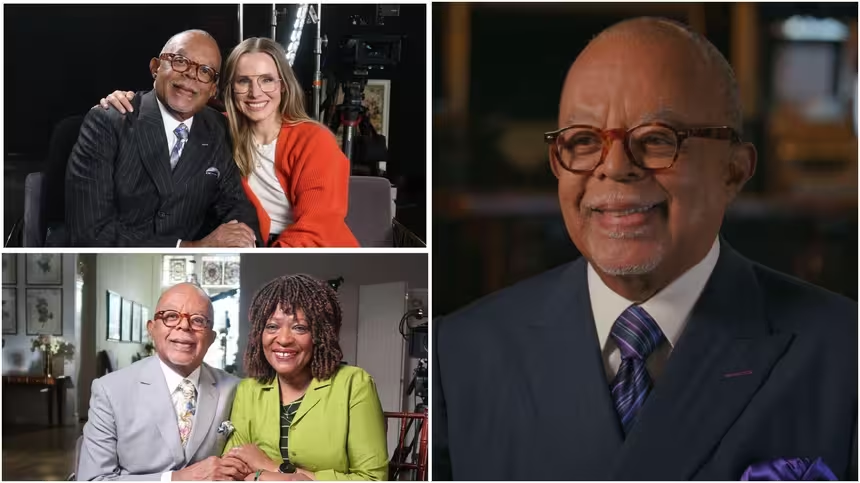
A new season of Finding Your Roots is premiering January 7th! Stream now past episodes and tune in to PBS on Tuesdays at 8/7 for all-new episodes as renowned scholar Dr. Henry Louis Gates, Jr. guides influential guests into their roots, uncovering deep secrets, hidden identities and lost ancestors.Providing Support for PBS.org
Learn Moreabout PBS online sponsorshipWiz's ancestor would eventually decide that he no longer wanted to live next door to the man who had owned him.
In the 1870s, Howard moved his family roughly 30 miles away from Thomas to become a tenant farmer.
But his new life was by no means an easy one.
"Each farmer who rents a piece of land from some more affluent person has a hard row in hoe.
His land will probably produce half a quarter of a bale to the acre."
Damn.
"Generally half of this cotton must go to the landlord.
Another generous amount must go for provisions, and that leaves very little for the care of his stock, for the clothing and the proper care of his family."
Damn.
.
What's it like to see that?
It seemed like a lot of hard work for nothing to come from it, and they just using the land saying, oh, we'll rent it to you, but it's still you working on their land and bringing them what they need.
So it's the exact same thing.
Wiz, I'm gonna let you work this land.
Yeah.
And you're gonna make everything that's profit.
Yeah.
But we gonna subtract a few things before we ascertain the profit.
Yeah, yeah.
Like half of it goes to me-- Right.
Off the top.
Then, you ate a lot of pork chops over the last year.
You know, all of that kind of stuff.
Yep.
So these guys were always in the hole.
Yep.
Always in the hole.
It was a horrible system.
Yeah.
He's still a slave.
Essentially, Wiz is correct.
The system virtually guaranteed that his ancestor could never gain economic independence, no matter how hard he worked.
Of course, Howard did have an option to try and change the system.
In the wake of the Civil War, Black American men had gained the right to vote.
The only problem?
Exercising that right could be extremely dangerous.
"In the southern states, the Negro, if allowed to vote at all, must either vote the Democratic ticket or have his vote counted out by a partisan judge of election.
If he's too prominent in electioneering or working for the Republican ticket, he's shot."
Whoa.
"White supremacy means everything.
Those words can possibly imply in the south.
The south is solid and will remain so.
White supremacy is assured.
Speakers who do not believe in the existence of the Confederacy state rights, Jefferson Davis and divinity of slavery will not be tolerated.
The Negro must vote right or not at all."
Ooh.
That is the environment in which your fifth great-grandfather had to decide whether or not he was gonna vote.
That's crazy.
In the years following the Civil War, the South was ridden by violence against African Americans who tried to vote, enabled impart by the rise of white paramilitary groups like the Ku Klux Klan.
Wiz's ancestor Howard likely thought seriously about staying away from the polls or leaving Alabama altogether.
But in the end, he chose a different path.
"We, the undersigned registered electors, do solemnly swear or affirm that I will support and maintain the constitution and laws of the United States and the constitution and laws of the state of Alabama, and that I am a qualified elector under the constitution and laws of this state.
Names of electors, Howard Williamson, colored."
Your ancestor registered to vote-- Oh, cool.
In 1880, in spite of all the racist threats against his life.
Sweet.
How do you think Howard felt about voting?
Whatever he was believing in at the time he was willing to put it all on the line for it.
Yep.
He said, I'm not a slave anymore.
Absolutely, 100%.
Video has Closed Captions
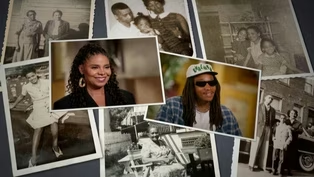
Preview: S12 Ep2 | 30s | Henry Louis Gates, Jr. maps the roots of rapper Wiz Khalifa and actor Sanaa Lathan. (30s)

Sanaa Learns About Her Paternal Grandfather’s Journey
Video has Closed Captions
Clip: S12 Ep2 | 4m 7s | Sanaa learns about her paternal grandfather's roots and struggles. (4m 7s)
Providing Support for PBS.org
Learn Moreabout PBS online sponsorship
- History
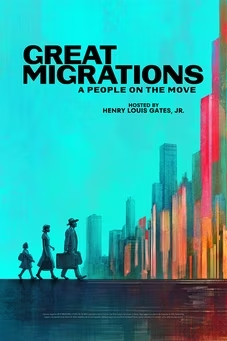
Great Migrations: A People on The Move
Great Migrations explores how a series of Black migrations have shaped America.



Support for PBS provided by:
Corporate support for Season 11 of FINDING YOUR ROOTS WITH HENRY LOUIS GATES, JR. is provided by Gilead Sciences, Inc., Ancestry® and Johnson & Johnson. Major support is provided by...