
The War of 1812
10/10/2011 | 1h 56mVideo has Closed Captions
This documentary shows how the glories of war become enshrined in history.
This documentary shows how the glories of war become enshrined in history. How failures are quickly forgotten and how inconvenient truths are ignored forever. With stunning reenactments, evocative animation and the incisive commentary of key experts, The War of 1812 presents the strange and awkward conflict that shaped the destiny of a continent.
Problems playing video? | Closed Captioning Feedback
Problems playing video? | Closed Captioning Feedback
The War of 1812 is presented by your local public television station.
Funding for The War of 1812 was provided by the National Endowment for the Humanities, The Wilson Foundation, Warren and Barbara Goldring, the Corporation for Public Broadcasting, The Arthur Vining...
The War of 1812
10/10/2011 | 1h 56mVideo has Closed Captions
This documentary shows how the glories of war become enshrined in history. How failures are quickly forgotten and how inconvenient truths are ignored forever. With stunning reenactments, evocative animation and the incisive commentary of key experts, The War of 1812 presents the strange and awkward conflict that shaped the destiny of a continent.
Problems playing video? | Closed Captioning Feedback
Where to Watch The War of 1812
The War of 1812 is available to stream on pbs.org and the PBS app.
Providing Support for PBS.org
Learn Moreabout PBS online sponsorship♪♪♪ Joe Mantegna: In June 1812, the young United States declared war on the greatest power in the world: Great Britain.
For 2 1/2 years, Americans fought against the British, Canadian colonists, and native nations in a small but bitter war, yet in the US today very little of the War of 1812 lives on in the public mind.
Scott S Sheads: It's the forgotten war.
It's the war that we don't know too much about.
Why was it fought?
Where was it fought?
Why is it important?
Joe: It's the war that Americans have largely forgotten, but the British don't remember it either.
Andrew Lambert: For the British, 1812 is when Napoleon marched on Moscow.
They have no idea there was a war going on on the other side of the world.
Joe: But if it's been forgotten in Britain and the United States, there is a place where people remember the War of 1812: Canada.
Jim Hill: In our minds, the War of 1812 is where we defend our version of freedom and liberty and democracy.
Joe: The native nations that fought alongside the British would remember it too but not as a victory.
Rick Hill: There's this sense that we lost because what we lost was the ability to govern ourselves on our own land.
Joe: What lasted on every side was a mythical version of history.
Donald Hickey: Stories grew up that really departed from the truth.
These were enshrined in the history books.
This was a time when legend and myth often substituted for verifiable history.
Joe: Even real stories turned into legends.
In Canada, both a frontier housewife and an aristocratic British general became national heroes.
In the US, a Shawnee chief is still much admired, though he fought on the other side, and a war composed largely of American defeats is now remembered for a victory at New Orleans, Old Ironsides, the credo "Don't give up the ship," and a Star-Spangled banner fluttering in the dawn.
Peter Twist: 1812 is a tiny war by world standards.
Both sides are struggling to try and defend their own borders and attack the enemy.
The total number of people killed in the war is very small compared to the major wars of the world, and yet it forges the destiny of a continent for 200 years to come.
♪♪♪ announcer: "The War of 1812" has been made possible by a major grant from the National Endowment for the Humanities, because democracy demands wisdom; with funding provided by the Wilson Foundation; Warren and Barbara Goldring; the Corporation for Public Broadcasting, a private corporation funded by the American people; the Arthur Vining Davis Foundations, dedicated to strengthening America's future through education; Phil Lind; and the Annenberg Foundation; with additional support from these funders.
Joe: The War of 1812 was a paradox of scale.
Its armies were small and casualties very few, yet the battleground stretched across much of North America and beyond.
But in Europe another war raged, the decades-long struggle between Britain and Napoleon's France.
It was this titanic conflict that touched off the War of 1812.
♪♪♪ Ron Dale: Britain was in a death struggle with Napoleon Bonaparte on the continent of Europe and on the seven seas at the time.
It was a world war that was going on.
The only way that Britain could really curtail Napoleon's empire building was to cut off supplies from reaching Napoleon's troops.
So they were stopping ships on the high seas, and this upset the United States a great deal.
Andrew: If you carry goods for the French, you're on the side of the French.
You cannot be neutral.
The Americans are desperately trying not to take sides because they can make a lot of money by being neutral, and what they're finding is that neutrality has a cost.
Joe: That cost could be high.
In 1807, Britain began to issue a series of decrees to undermine American trade.
All neutral ships trading with France had to stop in Britain first and pay a duty or else the British would simply regard them as enemy.
The enormously powerful Royal Navy seized hundreds of American ships.
In fact, the British took more than ships and money.
They seized men as well.
Andrew: By 1812, the Royal Navy had been at war for 19 years.
They had over 120,000 men in service, and they're losing 10,000, 15,000 men a year.
If they run out of sailors, they'll lose the war at sea, and they'll lose the war.
Ron: When they stopped an American ship and discovered a sailor with a British accent, if he looked like he was a prime sea hand, he would be impressed into the Royal Navy.
Joe: In the first years of the 19th century, Britain impressed over 6,000 sailors from American merchant vessels.
Then one June afternoon in 1807 just off the Virginia coast, the British ship Leopard demanded to board the US Navy frigate Chesapeake, where four British deserters were serving in the crew.
The Chesapeake refused.
The British simply opened fire.
They cannonaded the ship for 10 minutes, killing 3 sailors, wounding 18 more.
The Chesapeake surrendered.
The British came on board and took four men away.
Victor Suthren: The whole incident led to extremely difficult feelings, as you can imagine, between Great Britain and United States.
It was an example, perhaps the most egregious example, of this kind of high-handedness on the part of Great Britain that clearly the American public were not about to tolerate.
Donald: The British in no way really threatened our independence.
They did what great powers always do when they are at war.
They ran roughshod over the rights of a second-rate neutral power.
Joe: No war was declared in 1807, but British impressment and American resentment went on without stop.
♪♪♪ Anthony Pitch: In 1810, a new breed was elected to Congress, men like Henry Clay of Kentucky and John C. Callahan of South Carolina, both of whom had been born after the Declaration of Independence.
So what was tolerable for older Americans was insufferable for the new generation.
War for them was the only answer.
Andrew: War is pushed by a Republican Party based in the center and south with the support of the Western War Hawks.
Their ambition is to seize land; the land of the Native Americans, the land that is now Canada.
Joe: Expansion into Indian land to the west had been a basic part of US policy for years.
Among the principal architects of that plan was a learned, long-faced, hot-tempered man named William Henry Harrison, governor of the Indiana Territory.
Walter Borneman: William Henry Harrison has been slowly but steadily acquiring lands from Native Americans throughout the Ohio River Valley.
A number of tribes give him their lands, make treaties with him.
Joe: In these treaties, tribes had signed away more than 100 million acres of land, but one Shawnee war chief refused.
Tecumseh was 42, but he'd been through the fire long before.
Donald Fixico: As he grows up, he sees much of his family, his father, and his older brother die in battles.
He sees himself as kind of a person who has to kind of take charge because there's really no one else to take charge at his time in his life.
Joe: Tecumseh became a fierce warrior, yet it was his compassion that marked him.
He refused to make war on women and children.
He envisioned a confederation of tribes from the Great Lakes to the Gulf of Mexico, a union of Indian nations.
A.J.
Langguth: Tecumseh, the great Shawnee leader, was really not so different in his thinking from George Washington.
As Washington had seen the states jealous and fighting with each other, Tecumseh saw the tribes doing the same and losing ground to the United States.
Robert J. Miller: Tecumseh was way ahead of his time because he realized that the United States was picking tribes off just one by one and a tribe 100 miles away or 500 miles away thought that was not their problem.
He was trying to resist the United States with a united front.
Joe: The two protagonists met at Harrison's home in Vincennes in August 1810.
The governor wanted to know why Tecumseh refused to accept treaties that others had signed.
Harrison had expected to meet with 30 native warriors.
Tecumseh brought more than twice as many.
The confrontation soon took on mythic overtones.
Robert: There were many examples of paintings of Tecumseh raising his hatchet at William Henry Harrison and Harrison has his sword out.
These may be apocryphal, but it's a perfect example of the relationship that these two had.
Fixico: Tecumseh goes right at William Henry Harrison, delivers a very bitter speech and--denouncing Harrison for being there and denouncing the white settlers.
male: Tecumseh: "The great spirit said he gave this great island to his red children.
He placed the whites on the other side of the big water, but they were not content with their own and they came to take ours from us.
They have driven us from the sea to the lakes.
We can go no farther.
My brother, I do not see how we can remain at peace with you."
John Sugden: The thing which Tecumseh and Harrison had in common was their standing as warriors.
They respected each other as warriors.
Beyond that, they had almost nothing in common.
Harrison was a dedicated expansionist.
He saw the United States' destiny as rolling westwards, and he saw really no place for the Indians in that future.
Joe: In the fall of 1811, Tecumseh set out to recruit Indian nations in the south to join his confederacy.
Harrison seized the chance.
He gathered an army and marched toward Prophetstown, Tecumseh's home base in what is now western Indiana.
Robert: Harrison led 1,000 troops towards Prophetstown.
He was plainly going there to attack it when he thought it was weak, when Tecumseh was not there to lead the troops.
Joe: A group of native warriors at Prophetstown decided to strike first.
Before dawn on the morning of November 7th, they moved through an oak thicket toward Harrison's army, camped on the banks of the Tippecanoe River.
Peter: The attack certainly initially goes extremely well.
The American soldiers are thrown into complete chaos.
The natives inflict significant casualties.
The Americans organize themselves.
They start to hit back.
And so before light the natives withdraw.
♪♪♪ Joe: In the real Battle of Tippecanoe the natives inflicted a good deal of damage, but Harrison's reports to Washington described a decisive victory, a glorious victory; a report that became an American legend.
The day after the battle, Harrison's troops burned Prophetstown to the ground.
His men dug up Indian graves and scalped and mutilated Indian corpses.
In the village, they found British weapons, a discovery that outraged the frontier press.
"Vengeance," one newspaper demanded.
The news angered the war hawks in Washington as well and made life difficult for President James Madison.
A.J.
: Madison was pressured by the war hawks.
He was a brilliant legislative mind.
As an executive, he foundered to some degree.
He was a sensitive man, very small.
He could look, one observer said, like a withered little applejohn.
His enemies, who called him a pygmy, acknowledged that he was very smart, but he probably wasn't cut out to be what was called then the chief magistrate.
Donald E. Graves: He lacked a certain decisiveness.
He lacked an instinct for the jugular.
Joe: Where Madison was an introvert, his wife Dolley was quite the opposite.
She was 17 years younger, a fashion plate, politically astute yet blazingly social.
Madison himself was more at home among his books than in human company.
Walter: He's the architect of the constitution.
He certainly understands very well that the power to declare war, the war powers are in fact lodged with Congress.
Donald: Madison sent a war message to Congress in June of 1812.
What he does in that message is lay out all our grievances against Great Britain and then say Congress may wish to consider what to do next.
Joe: On June 1st, 1812, Madison's war message was read before both houses of Congress.
It listed the reasons for war.
The British were impressing sailors, interfering with trade, and stirring up Indian warfare in the northwest.
Three days later, the House voted 79 for war, 49 opposed.
But in the Senate, debate lasted for weeks and the margin was 19 to 13.
It was the closest formal war vote in American history.
Patrick Wilder: It was a foolish notion to think that the United States could take on Great Britain, the world's most powerful naval power.
It was a nation able to produce everything from muskets to cannon to ships of all sizes, shapes, and description.
Joe: But in Britain, the declaration of war was yet another unwelcome piece of news.
Napoleon and his allies controlled most of Europe.
King George III was insane.
In May, the prime minister had been shot and killed in the House of Commons.
The last thing Britain needed was another war.
In Canada, there was even less enthusiasm for the war.
People there knew that the declaration would soon be followed by an invasion.
Walter: There were many Americans living in Canada.
Madison felt that Canada would almost welcome the United States as a liberator.
Graves: The Madison administration was very confident that this--the conquest of Canada would be, as Thomas Jefferson said, a mere matter of marching.
I'm glad he said that because British and Canadian historians have been dining out on that quote ever since.
But there was a misplaced confidence and--in that the Canadians would not fight hard, that Britain would not fight hard to defend this territory.
Joe: Even in the United States, the war got a mixed reception.
In the west, the announcement was celebrated, but in New England the reaction was quite different.
This was the bastion of the Federalist Party, the opposition to Madison's Republican Party.
Here, shops closed, bells tolled, flags hung at half-staff.
Victor: The New England states had a flourishing coastal trade with Great Britain, which they weren't interested in losing.
The effort on the part of the war hawks to paint Great Britain as the great enemy that had to be opposed really didn't find much support in New England.
The New Englanders were fairly happy with the way things were, thank you very much, and their livelihood depended upon it.
James Elliott: There was quite a bit of opposition to the war.
Probably the most eloquent and forceful of the opposition papers was published by a Baltimore lawyer by the name of Alexander Hanson.
He was publishing an anti-war newspaper in Baltimore, which was decidedly pro-war.
Anthony: He denounced President Madison and Congress for declaring war because the country was not ready for it.
In his newspaper, he foresaw the ruin of America.
Joe: As soon as war was declared, Hanson came out against it.
Many in Baltimore were outraged, violently outraged.
James: There was a huge mob of people gathered outside the house.
Hanson had a group of his friends inside that were barricaded.
Anthony: And so at nighttime they were taken--these few people and Hanson himself were taken into protective custody in jail, and they were given the assurance that their lives would be protected.
James: The mob broke into the jail, took the prisoners.
They were all beaten, really beaten.
Hanson was beaten unconscious.
Joe: Nine men were clubbed and stabbed.
One was tarred and feathered, then set afire.
A general in the Maryland militia was stabbed to death.
Alexander Hanson was left for dead, but he survived.
Anthony: What happened in Baltimore in those early days of the War of 1812 is a lesson in how you should not subdue dissent even during warfare because a mob can get out of control and destroy the very values which you are trying to uphold.
Joe: For the United States, this was an inauspicious start to a war that would go on for 2 1/2 years.
The first chapters of the war were a story of American disaster, one blunder after another.
Douglas DeCroix: One of the greatest mistakes that the American government makes in declaring the war is the way they go about informing their own army that war has been declared, particularly in the northwest.
They make the mistake of sending word out by the common post, which could take weeks, even months.
The British commanders in the northwest know that war has been declared before the American commanders do.
Joe: At the western edge of the United States, the American fort on Mackinac Island commanded by Lieutenant Porter Hanks controlled the strategic narrows between lakes Michigan and Huron.
One peaceful day in July 1812, a British and Indian force gathered on the heights behind the fort and sent over a messenger.
Douglas: Lieutenant Porter Hanks is completely unaware that war has been declared until--you know, this is oversimplifying to a point, but he wakes up one morning, there's a cannon pointing down the hill and a guy in a red coat knocking on the door saying, you know, "We'd like the keys."
Joe: Lieutenant Hanks surrendered to the British and minutes later the Union Jack flew over the fort.
Douglas: A fort of this magnitude has simply fallen without a fight.
This is a tremendous blow to American morale, to the strategic situation in the northwest.
Joe: In the summer of 1812, James Madison approved a plan that surprised no one.
The United States would wage war on Britain by invading Canada.
The Americans would invade in three places.
One army would plow into Canada from Detroit at the western edge of Lake Erie, another force would cross the border at the Niagara River just east of Lake Erie, and a third would head directly for Montreal.
Rene Chartrand: The US plan at the beginning of the war is that they were planning to attack everywhere, it seems, and it was all very disorganized.
Joe: The US plan ignored some basic truths of the era.
There were no real roads.
Transportation moved well only on water, and the British held the St.
Lawrence.
Towns on the distant frontier were out of touch with Washington and communication between the three American armies was nonexistent.
Rene: At the same time, the British, who had very--much smaller forces in Canada, the planning was very good, the defense planning.
They knew what they wanted to do.
Joe: And they knew who they wanted to do it.
The fate of the Canadian colonies rested in the hands of Governor General Sir George Prevost, a sensible, practical administrator.
His job was to hold on to as much of Canada as he could.
John Grodzinski: He faced a big challenge, large territory, a sparse population, and what--and a territory that wasn't all that well fortified.
Joe: But Prevost had an asset in the brilliant general Isaac Brock, commander in Upper Canada.
Brock was Prevost's antithesis.
He was 42, strikingly handsome, a wine lover and gourmet, a dazzling dancer, an omnivorous reader, an aggressive, willful gambler, an aristocrat to his bones.
Peter: He was extremely energetic.
He was extremely ambitious.
He did not want to be in Canada.
He knew the real war was in Europe; and he felt that if he distinguished himself here, that they would send him over to Europe to where the real war was.
Ron: When he first joined the 49th Regiment of Foot, in the regiment was a famous duelist.
This man insulted Brock.
Brock insulted him right back.
So this man challenged Brock to a duel.
Brock chose pistols to be fired over a handkerchief, not a distance of 30 paces but over the width of a handkerchief.
The duelist backed down and being disgraced had to leave the regiment.
Joe: In North America, Brock and Prevost realized that Upper Canada, the vast province in the west bordering all five of the Great Lakes, might be lost to the invading Americans.
male: Isaac Brock: "My situation is most critical.
Most of the people have lost all confidence.
I, however, speak loud and look big."
Joe: Looking big might not be enough.
Brock had a massive area to defend and few men to do it with.
Beyond the Canadian militia, he had just 1,200 regular soldiers from the British Army, but it was an army of veterans.
Peter: It was an army made up basically of the poor.
The soldiers were there out of economic desperation by and large.
Ron: They joined the army for the food, the lodging, and the clothes on their back because it beat the devil out of starving to death in the slums of Glasgow.
Joe: One British soldier was Shadrack Byfield, a young man from Wiltshire, a weaver by trade.
male: Shadrack Byfield: "I entered the military service at 18 in the year 1807.
My mother, on hearing I was enlisting, was so affected she fell in a fit and never spoke after.
I was obliged to march off the next morning."
Andrew: The man who understood British soldiers best, the Duke of Wellington, said that they were the scum of the earth enlisted for drink.
He also said that he put his life in their hands.
So they were at one and the same time at the bottom end of the socioeconomic scale, and they were hugely important.
These guys are professionals.
Joe: The US Army by contrast had virtually no professionals.
Americans still distrusted the entire idea of a standing army, which might become a threat to their liberty.
So the United States would rely heavily on militia.
Patrick: Many of the militia during this period regarded their training on a monthly basis as an opportunity to get together with friends, discuss what's going on, and then adjourn to the local tavern to end up the day with a few drinks.
Joe: American militia service was an oddly informal arrangement.
They often had no uniforms.
They often elected their own officers.
Their attachment to their home state was as powerful as their feelings for the country and few imagined that invading another nation might be part of the job description.
The American generals Madison had to choose from were hardly better.
In fact, they were worse.
A.J.
: The generals he had to pick among were either very young and untried or veterans who were 30 years past their prime.
He went with the veterans, and it was disastrous.
Joe: One such veteran was William Hull.
A.J.
: William Hull had been a brave soldier in the revolution.
He was 58.
He had eaten and drunk a great deal too well for 30 years.
And when the war was looming, Madison called him back to Washington and offered him a generalship in the fledgling American army.
They needed him to go and invade Canada, so he went off with many misgivings and no possibility of success.
Joe: In July 1812, General Hull assembled an army for what looked to be an invincible invasion sent from Detroit.
General Brock had only one hope to stop the American invasion: help from the native warriors.
male: "We are committed to a war in which the enemy will always surpass us in numbers, equipment, and resources.
It is of primary importance that the confidence and goodwill of the Indians be preserved."
Joe: During the American Revolution, most Native Americans had allied themselves with the British, a decision that cost them lives and land.
Rick: The British understood that without native allies they would have a very difficult time, but because of our losses during the Revolutionary War our people were very hesitant to fight.
When we put ourselves in the moccasins of these fellows back then, what big decision is ahead, what side to pick, what fight to make, and where to make that fight, they're big, big decisions.
Joe: But after the burning of Prophetstown, Tecumseh had made his choice.
Late one August evening, he entered Brock's quarters on the Canadian side of the Detroit River.
The two men liked each other on sight.
male: "A more sagacious and gallant warrior does not, I believe, exist.
Tecumseh has the admiration of everyone who conversed with him."
Jim: They've both been professional full-time soldiers basically in their culture since they've been teenagers.
Isaac Brock's older brother had been killed during the American Revolution as a British officer, and Tecumseh's older brother had been killed and his father as well fighting Americans.
Joe: All of Brock's officers urged caution.
Tecumseh pushed for an immediate attack.
Brock agreed.
"This is a man," Tecumseh said of Brock.
On the morning of August 15th, 1812, they crossed the river and took up positions around Fort Detroit.
The Americans sat safely behind walls 11 feet high, but the audacious Brock sent General Hull a demand.
"I require," he wrote, "your immediate surrender."
Hull was tortured by doubt.
A.J.
: He had an inordinate fear of the Indians.
He was convinced that the Indians were savages beyond any recognition as human beings; that if they were unleashed on his family or his troops, it would be the worst kind of massacre.
Joe: Brock dressed Canadian militiamen in surplus uniforms so they looked like regulars.
Tecumseh marched his same men past the fort three times so it looked as if he had thousands of warriors.
Then the British primed the cannon.
Dianne Graves: The British gave notice that they would commence a bombardment of Detroit.
When it began, Lydia Bacon, who was the wife of an American army officer, was actually in the fort.
She was in the hospital quarters with other women preparing bandages for the wounded.
The British got the range of the fort so well that a shell came through the next door room and killed two officers outright.
female: Lydia Bacon: "The cannon began to roar.
A 24-pound shot cut two officers who were standing in the entry directly in two.
The same ball passed through the wall and took the legs off of one man.
My feelings were wrought up to a high pitch, but weep I could not, complain I would not."
Joe: William Hull did not have Lydia Bacon's courage.
The American general disintegrated.
A.J.
: In the fort, there was Hull slumped on the ground drinking heavily, smoking tobacco juice and spittle running down the front of his uniform.
His men are so angry they haven't fired a shot.
Joe: Hull begged for time.
He sent a note to Brock asking for a 3-day ceasefire.
male: Shadrack Byfield: "I was with General Brock at that time, and from what we could hear the American general inside the fort wanted 3-day cessation; to which our general replied that if they did not yield in 3 hours, he would blow up every one of them."
Joe: Hull didn't need 3 hours.
After a few minutes, he ordered a white tablecloth hung out a window.
It was the only time in history that a white flag was raised over an American city before a foreign army.
A.J.
: Brock comes.
He marches thousands of American troops out.
Some of them militia he sends home.
Hull, he takes to Canada, marches him through the streets and ultimately sends him home.
Joe: "I have done what my conscience directed," Hull wrote.
"I have saved Detroit from the horrors of an Indian massacre."
But Hull had lost an entire army and had dealt a shocking blow to the morale of his own country.
A.J.
: And Hull's men are pressed to have him court-martialed, and he is found guilty and he is sentenced to be shot.
Madison reviews Hull's record, decides that he was a hero in the revolution; and he sustains the sentence but not the execution, and Hull goes home in disgrace to Massachusetts.
Joe: But Detroit was only the first of three parts to the American invasion of Canada.
In October, a second American army assembled in New York at Lewiston across the Niagara River from the Canadian village of Queenston.
Douglas: The general that's in command of the region for the American army is Stephen Van Rensselaer.
He's one of the richest men in New York.
Robert Malcolmson: Stephen was a fine fellow, an effective politician, a statesman in New York State, but he had no military experience at all.
Joe: The British Army by contrast was led by Isaac Brock himself.
Brock had sailed quickly down Lake Erie to take command of a small army of regulars and irregulars.
Jim: And at Queenston Heights, Isaac Brock's got black troops following him.
He's got poor Canadian farm kids, and he's also got a couple of hundred Grand River warriors.
It's this mishmash of people who all come together and fight and defend our version of North America.
Joe: Brock's forces were assembled along the heights at Queenston, yet Van Rensselaer decided to send his army across the Niagara River at Queenston directly into the British troops.
Malcolmson: The Americans had thousands of militia, hundreds of regulars that could have crossed the river, but they only arranged for 13 boats to carry them.
Now, the Niagara River is a difficult piece of water to get across and especially in the middle of the night and especially when it's rowed by men who haven't been across the Niagara River before.
Joe: At dawn on October 13th, 1812, the Americans began to cross as cannon on both sides roared incessantly.
A group of Americans reached the shore, then found a fisherman's path up the cliff and took the heights overlooking the town.
Ron: Brock knew that if the Americans were able to successfully get a toehold and capture Queenston Heights, there's a good chance that the British would lose Upper Canada.
Douglas: He leads British soldiers up the hill, dismount it with a sword drawn in full view of the American troops.
Ron: An American soldier at about 20 paces away with a double shot and musket fired at Brock, hit him in the heart, and killed him instantly.
Joe: The British raised the shout, "Revenge the general," but the Americans held a high ground, a decisive textbook advantage; but the Grand River Iroquois warriors did not engage in textbook warfare.
Wolf Thomas: Our style of warfare we like to stick close to cover, keep stealthy and gain the advantage on the enemy.
Queenston Heights was a--was basically a flanking maneuver on the native part.
Joe: The native warriors worked their way behind the Americans, then burst out of the woods screaming their war cries.
One American remembered, "I thought hell had broken loose and let her dogs of war upon us.
I expected every moment to be made a cold Yankee."
Douglas: American militia that are still on the American side of the river can hear the whoops and hollers of the warriors as they're popping in and out of the woods, taking shots and so forth.
Wolf: Once the militia on the American side heard the war cries of our warriors, they refused to fight on Canadian soil, and they refused to cross to the Canadian side and aid the regulars that were being attacked up on the heights.
Joe: The Americans who had crossed the river were doomed.
John Beverley Robinson, a British artilleryman, watched them go.
male: John Beverley Robinson: "They had no place to retreat to and were driven to the brink of the mountain which overhangs the river.
Many leaked down the side of the mountain to avoid the horrors which pressed on them and were dashed in pieces by the fall."
Joe: Many died.
The rest surrendered, giving the British almost 1,000 prisoners and one of the most momentous victories in the history of Canada.
But they had lost one very important man.
Isaac Brock, once called the savior of Western Canada, was now gone.
Douglas: Brock was one of those rare individuals who has a tremendous amount of charisma, a tremendous amount of organizational talent.
This is a tremendous blow to Upper Canada.
It's a tremendous blow to the British military in that time period.
Joe: Yet the British, Canadian, and native forces had again beaten back an invasion.
Two down, one to go.
There was a third American army heading for Montreal.
This one was commanded by a general named Henry Dearborn.
Ron: Some of the young American officers coined the phrase Granny Dearborn 'cause he was like their old granny.
Aging, sickly.
He needed his hot water bottle at night for the rheumatism.
He was slow to move, conservative in his ideas.
Joe: In November 1812, Dearborn sent his force of 4,000 north toward Montreal, but in his two columns confusion was so general that the troops fired at each other.
At the border, a full two-thirds of the militia refused to cross into British territory.
Dearborn's troops never engaged the enemy.
He called off the third American invasion of Canada.
It was an invasion that never happened at all.
Grodzinski: The first year of the war ended in disaster for the Americans.
Every offensive that was undertaken into Canada ended in failure, abysmal failure.
Joe: The Americans had been hugely overconfident about conquering the Canadian colonies by land.
On the other hand, the US never had the slightest illusion about being able to defeat the British at sea.
Andrew: In 1812, the Royal Navy has over 100 ships of the line in commission.
It has 200 frigates.
The United States Navy has eight frigates, no ships of the line, a few brigs, a few sloops, some gunboats.
Who's gonna win this war?
It's obvious.
Joe: But in this war of surprises, it was on the waves where the Americans had their first success.
On August 19th, 1812, the American frigate constitution encountered the British Guerriere in the Atlantic.
Victor: During the battle with HMS Guerriere, British gunnery, of course, was brisk and hot.
One sailor saw the round shot bounce off the thick bulwarks of hull of constitution and the sailor said, "Huzzah.
Her sides are made of iron."
And, in fact, it simply was that the planking was deliberately built thicker.
At the end of the battle, there were over 12 of these round shot, cannonballs you'd call them in civilian language, that were lodged in the hull of constitution.
So she became known as Old Ironsides, which she still is today.
Joe: A few weeks after cutting the guerriere to pieces, Old Ironsides met a second British frigate, the Java.
The result was the same: surrender.
And a second frigate, the United States had defeated the Macedonian.
With more guns and more men, the Yankee frigates simply overpowered their British counterparts.
Walter: Strategically, those victories weren't terribly important, but, my goodness, from a morale sense they really fired up the American nation.
Andrew: The Americans won three straight.
That was absolutely unprecedented.
The French hadn't won three straight frigate actions against the British ever.
So this caused some concern.
What was wrong with English ships and English men that they couldn't beat these upstart Yankees?
Joe: The upstart Yankee Navy still had few ships, but the US government commissioned hundreds of ships as privateers.
Donald: Privateers were merchant vessels built for speed, authorized to carry arms and cruise against the enemy's commerce in time of war.
Andrew: Privateering is state-licensed piracy.
It's an age-old system.
It's a cheap kind of militia system as opposed to a regular navy.
Donald: They were never gonna determine the outcome of a war, but they did put pressure on the enemy's commerce.
Joe: In the autumn of 1812, the American victories at sea gave people in the United States a sense of hope.
The invasions of Canada had not gone well, but the Americans were willing to try again.
In the west, William Henry Harrison had recruited a sizable army, much of it crack Kentucky sharpshooters.
William Atherton, a 21-year-old farm boy, was one of the recruits.
male: William Atherton: "We volunteers from Kentucky left our homes on the 12th of August, 1812.
We anticipated danger and made arrangements to meet it."
Joe: In late fall 1812, Atherton traveled with Harrison's army on a search-and-destroy campaign west of Lake Erie.
Harrison's plan was to clear the natives from their lands, then head for Fort Detroit.
Harrison was ruthless.
male: William Atherton: "At Fort Wayne, we were ordered to march to two Indian towns for the purpose of burning their houses and destroying their corn.
We accomplished this."
Donald: Frontiersmen and natives were accustomed to engaging in a very brutal form of warfare.
They killed women and children.
They took scalps and other body parts for souvenirs, took no prisoners of war.
That kind of warfare was typical of what occurred on both sides on the frontier.
Joe: But by December, Harrison's men were suffering as they struggled toward Detroit.
male: William Atherton: "The men became very sickly.
The typhus fever raged among us.
We saw nothing but hunger and cold staring us in the face.
We scarcely had anything to eat.
Many times the dead march was heard in the camp."
Joe: There was worse to come.
In early 1813, a portion of Harrison's army encamped at Frenchtown near the River Raisin in what is now southeastern Michigan.
male: "We were accommodated with all the necessaries of life.
We almost seemed to forget we had an enemy in the world."
Joe: But on a quiet January night, an attack force of over 1,100 British and native warriors commanded by Henry Procter silently made its way through the snowy forest.
Shadrack Byfield, the private from Wiltshire, was among them.
male: "Under cover of a wood, we approached near to the enemy unperceived."
male: William Atherton: "I slept soundly until awakened by the startling cry of, 'To arms, to arms,' and the thundering of cannon and the more terrific yelling of savages.
The first thing that presented itself to my sight was the fiery tail of a bombshell, and these came in quick succession."
male: Shadrack Byfield: "Before daylight, we had charged them several times.
I was much affected by seeing a lad about 11 or 12 years of age who was wounded at one of his knees.
The little fellow's cries from the pain of his wound, his crying after his dear mother and saying he should die were so affecting that it was not soon forgotten by me.
Then I received a musket ball under my ear and fell.
My comrade exclaimed, 'Byfield is dead.'
And I thought to myself, 'Is this death?'"
Joe: But the British and native forces soon overwhelmed the Americans.
Colonel Procter, who had no combat experience, simply marched away, leaving 80 wounded prisoners to his Indian allies; and the native warriors, long enraged by Harrison's brutality, were not in a merciful mood.
Douglas: There's a number of American wounded that are left behind in some of the cabins, and there's only a very small British guard on these folks.
Many of these prisoners are massacred.
Robert: Tecumseh's brother said whenever the Indians win a battle it's called a massacre.
Whenever the whites win a battle, it's called a great triumph.
So political spin was used here about who was committing atrocities.
Rick: When the Haudenosaunee would take a prisoner, it really depends on what happened just prior to that and what that person did.
If that person had killed somebody on our side, then in likelihood they would be executed if not, you know, pretty severely tortured.
John: The Indians had very logical reasons for killing prisoners.
They had no jails to put them in, and they had no means of granting them paroles and exchanges.
And they often said, "Well, the reason we kill prisoners is that we don't want to fight our enemies twice."
Joe: But William Atherton would not be killed at the Battle of River Raisin.
male: William Atherton: "An Indian took me to the back of a house, put a blanket around me, and gave me a hat.
He brought with him a pack horse and gave me the bridle, making signs to march on."
John: Captives, particularly young male captives, were very highly prized amongst the Indians.
They were often integrated into the Indian tribes in a remarkably close way.
Joe: William Atherton from Kentucky would now learn to be a Pottawattamie in the cold, quiet forests of Michigan.
male: "I have nothing to say against the Indian character.
They are a brave, hospitable, kind, and honest people, but Kentucky, my home, would rise up before my mind.
I found among the Indians a scrap of newspaper printed at Lexington.
This I read over and over, again and again."
Joe: For James Madison and his nation, 1812 was a year of debacle and defeat, the utter collapse of the ambitious three-part invasion of Canada.
1813 had begun with the massacre of American troops at River Raisin.
Even worse, the British navy had begun a strangling blockade along the Eastern Seaboard.
By the end of March, the blockade extended from the Delaware Bay to Florida.
Andrew: The American economic system just stops, trade dries up.
The British have just closed down American shipping.
Joe: As the spring of 1813 arrived, British general Henry Procter was marching his army into Ohio, but William Henry Harrison after the disaster at River Raisin would be ready for him.
Douglas: He moves part of his army up to the rapids of the Maumee River near modern Toledo, Ohio.
He builds what will become Fort Meigs.
Meigs is essentially a fortified camp.
It's about 10 acres.
It's a picketed stockade.
Joe: With seven two-story blockhouses, five raised batteries, and sheltering embankments 12 feet high, Fort Meigs was built to withstand almost any attack.
Soon, it would have to.
Douglas: In early May of 1813, the British and natives under Procter and Tecumseh come to lay siege to the fort.
Up until now, the British and the natives have enjoyed an unbroken string of victories in the northwest and humiliations to boot.
Well, that's not gonna happen at Fort Meigs.
Harrison understands frontier warfare, and he's not going to be scared into surrendering like his predecessors had been.
Joe: Harrison waited inside the fort, much to Tecumseh's fury.
"It is hard to fight people who live like groundhogs," the Shawnee said.
Douglas: About 4 days through the siege, Harrison receives word that there is a party of reinforcements, Kentuckians, coming down the river.
The Kentuckians stormed the British batteries.
They're cut off and surrounded by the native force.
Joe: Once more defeated American soldiers were in the hands of the native warriors as they had been at the River Raisin.
Once more a massacre begins.
Douglas: It's not the British that put an end to this massacre, it's Tecumseh.
Tecumseh rides in waving his tomahawk, according to the stories, and puts an end to this massacre where the British had stood by and literally done nothing.
John: He had a sense of honor.
He was a humane, compassionate man.
He was a man who didn't believe in gratuitous violence.
He didn't believe in slaughtering people out of any sense of triumph.
Joe: Inside the fort, Harrison and his army were still safe.
For over 4 days, the British blasted away, pounding the fort with cannonballs to no avail.
Procter refused to make a direct assault on the fort.
Tecumseh was furious.
His warriors would not make war by sitting and waiting.
He later said that Procter was a fat animal that carries its tail on its back but when affrighted drops it between its legs and runs off.
Douglas: This is a really good example of the dynamic between Tecumseh and Procter versus the dynamic between Tecumseh and Brock.
At one point, supposedly he says to Procter, "You are unfit to command.
Go and put on petticoats."
Joe: In the end, Procter simply departed, leaving the fort in Harrison's hands.
Douglas: For a change, the British have been turned back.
Fort Meigs is the beginning of the end for Tecumseh and for the British in the northwest.
Joe: But the American success at Fort Meigs was not repeated along the Niagara border.
In the spring of 1813, an American army again crossed the Niagara River.
As the Americans camped near Stoney Creek, a small British force launched a raid at night.
Grodzinski: The British had the advantage of surprise.
It's pitch black.
There's only ambient light from the stars.
So when the British charged into the camp, the American units are trying to figure out where is the enemy.
Joe: Two American generals got lost and wandered into enemy lines.
A third American officer led a valiant cavalry charge only to find out that the army he was cutting to pieces was his own.
Douglas: The Battle of Stoney Creek is in many ways representative of the War of 1812 in microcosm.
The American commanders are captured.
The British commander gets lost in the woods.
The Americans technically are defeated, but they retain the field.
The British are victorious, but they retreat.
Ron: The term the fog of war was coined at that time in the age of muskets because every musket that was fired gave off a cloud of black powder smoke.
male: Hey, aim.
Fire.
Ron: Muskets were dreadfully inaccurate.
They were also slow to load.
You had to get within about 80 paces of an enemy to shoot your musket at them and hope to hit them.
So the most effective way of using the muskets was to mass your men together in tight formation and have them fire a volley.
Rick: What I have here is a war club.
It's the Indian weapon in the War of 1812, even though they had muskets and carbines.
We actually call it the skull cracker.
It cracks your skull, and that was what it was intended to do.
Hit a guy hard enough in the head, you're gonna knock him out of commission.
Sometimes they would dire--decorate them with their totem animal or your dream animal, something of power, something that would come to you, but you would use this thing.
In battle you would go running up to a guy, crack him in the head with this thing, and you're gonna do some damage.
During the War of 1812, they began to add sharp deer antler pieces or even knives or blades on here because they became more powerful.
They cut through the soldiers' uniforms.
Joe: If the war club was the most basic weapon, the most powerful weapon was the cannon.
It took a crew of up to 15 men to charge, aim, and fire these hefty and often inaccurate guns.
One British captain, Philip Broke of the Shannon, outfitted his ship with gun sights at his own expense.
He drilled his crew constantly in gunnery.
It paid off in short order in a memorable duel with the American ship, the Chesapeake.
Andrew: The British won the Shannon Chesapeake action off Boston.
The USS Chesapeake and in the space of 11 minutes flat went from a fighting ship to a complete wreck with a British crew on board.
This was the shortest, sharpest, and bloodiest frigate battle in the history of war at sea under sail.
Joe: But in America, the bloody battle would be remembered for a slogan, the dying words of the American captain James Lawrence.
Victor: Before he died, he uttered the words, "Don't give up the ship," and that became a watchword for the United States Navy from then on.
Donald: The irony is that not long after Lawrence urged his crewmen and his officers, "Don't give up the ship," that's exactly what they did.
They had no choice.
The British boarded the Chesapeake, and the Americans had to surrender the ship.
So in the end it was given up.
Joe: James Lawrence died in battle at sea, but the naval battles that would really matter in this war were fought inland on the lakes.
Victor: It was important for the British to maintain naval power of some kind on Lake Erie and equally important for the Americans to obtain naval power on Lake Erie.
Douglas: If you can control the lake, you can control the flow of supplies, you can control the logistics of the area.
The--both armies are operating at the end of a very tenuous supply line.
Joe: The commander in charge of the small British squadron on Lake Erie was Robert Heriot Barclay, a 27-year-old veteran who had already lost an arm in battle.
His opposite number was Commander Oliver Hazard Perry of the US Navy.
Both men were overseeing the feverish construction of ships on Lake Erie.
Andrew: Both countries have to build fleets out of local timber with imported shipwrights, imported materials.
It's competition.
Who can build the biggest ships the fastest?
Joe: The coming naval battle would decide the fate of the entire Great Lakes region.
On the morning of September 10th, 1813, the US fleet sailed toward the British, Perry on his flagship, the Lawrence, flying a flag that paid homage to Lawrence's last words.
"Not a word was spoken," an American seaman remembered.
It seemed like the awful silence that precedes an earthquake.
This was the time to try the stoutest heart.
Donald: Perry sailed into the British squadron with his flagship, the Lawrence, and just started trading broadsides with the two principal British ships on both sides.
Joe: The first cannonball tore through the Lawrence.
Peter: The biggest risk to the sailors were not direct hits by the balls themselves.
The biggest damage was caused by the splinters when the cannonballs penetrated the oak hull.
It sent huge splinters out that would be like flying lances.
The scuppers would actually run with the blood.
Victor: Lawrence was soon reduced to a wreck.
There were casualties strewn across the deck.
It was customary if your vessel was incapable of maneuvering you would strike your colors.
Perry wasn't about to do that.
Miraculously, he had survived the cannonading.
He had the ship's long boat brought alongside, and he jumped down into the long boat.
He was shot whizzing around his ears.
The famous painting shows him standing in the boat.
He probably didn't stand in the boat.
Donald: But he certainly was under fire.
The British realized what he was doing and they tried to target him.
There were cannonballs and round shot and grapeshot and canister raining down, but he made it safely to the second ship the Niagara.
Victor: He hoisted his colors in the Niagara and pressed on with the attack.
Joe: After 3 hours, the British gave up their ships, all of them.
An entire squadron of the world's most powerful navy had been captured.
Victor: At the end of the battle, Perry sits down and he writes a very simple note: "We have met the enemy, and they are ours.
Two ships, two brigs, one schooner, and one sloop."
Barclay had been wounded in his other arm.
And when the officers of both sides who had died were being buried ashore, it was Perry who held Barclay to his side.
Two young men and really the--one of the most poignant scenes, I think, from a war that many say should never have happened watched the burial take place.
There was gallantry on both sides.
There was honor on both sides.
Joe: The US controlled Lake Erie, and the British supply line was severed.
Immediately, General Procter withdrew from his position on the Detroit River, pulling his troops far back into Canada.
Victor: The British retreated eastward along the Thames river, Tecumseh urging Procter to stand and fight.
male: Tecumseh: "We are very much astonished to see our father preparing to run away.
The Americans have not yet defeated us by land.
We wish to remain here and fight our enemy.
We are determined to defend our lands.
We wish to leave our bones upon them."
Victor: Finally, at a place called Moraviantown, Harrison's advance guard of mounted Kentuckians came up with Procter's retreating force.
Joe: Procter prepared to make a stand in a swampy wooded ground along the River Thames.
He established two thin lines of defense.
Harrison's Kentucky horsemen cut right through them.
male: Shadrack Byfield: "After exchanging a few shots, our men gave way.
I was retreating when one of our sergeants exclaimed, 'For God's sake, help me.
Stand and fight.'
I stood by him and fired one shot, but the line was broken and the men were retreating."
Fixico: Procter was riding away from the battle.
Tecumseh will not give ground.
He's not going to retreat any more.
Already years had passed where he had rebuilt his army.
Tecumseh and his warriors are really kind of left to fight by themselves, who is gonna stay and fight even if it cost him his life, and it does.
He's wounded in the chest mortally.
He dies in the pitch of the battle.
Andrew: Those Kentucky men who rode him down and killed him, they were desperate to see the end of him and everything he stood for.
The death of that one iconic leader took one of America's really dangerous enemies out of the war.
After that, the Native Americans were no longer a force in this conflict.
Rick: Imagine for a minute if we had rallied with Tecumseh, if we had gotten the native nations together, if we drew this thin red line on the border and say, "That's it.
Enough is enough."
At that time, we would have had the balance of power to change American history.
Joe: Tecumseh's death marked the end of an era.
Never again would Indian nations help decide who had power in North America.
Soon, 62 native chiefs signed an armistice with William Henry Harrison himself.
Ron: Immediately after the Battle of the Thames, William Henry Harrison started building Tecumseh up into a larger figure, referred to him as the Napoleon of the west.
Rick: America seems to love dead Indians.
Not only is there a--is that a historic line, the only good Indians I saw are the dead ones, but in reality the killing of Tecumseh is one of a series of victories that fuel the American spirit.
If you go to Annapolis at the Naval Academy, there's a statue of Tecumseh.
Apparently, they paint him up every time they go to have final exams or heading off to war.
That somehow he's this symbol--this living symbol for the military even though he was defeated.
Joe: By that fall, William Atherton was no longer a Pottawattamie.
After months in the Michigan forests, he told his native family that he wanted to go home.
male: William Atherton: "Every eye was fixed upon me.
Some seemed astonished and others angry because I would think of leaving after being adopted into the family, but they soon made signs that I could go."
Joe: But he was still not home free.
He had to be handed over to the British and he became their prisoner of war.
On both sides, military prison life was a matter of survival at best.
male: "When I was delivered to the British, I was placed in the guardhouse, and during our confinement we suffered from hunger.
I had the floor for a bed and a log for a pillow."
Joe: In the fall of 1813, William Atherton would be marched from Michigan to a military prison in Quebec, but there were other Americans marching north as well.
With Lake Erie secure, the United States was free to try again to conquer the eastern heart of the Canadian colonies, Montreal, and even Quebec.
Victor: In the fall of 1813, Canada faced the most serious threat to its continued existence as a British colony.
The Americans sent one large army of 7,000 men down to St.
Lawrence towards Montreal and another army of 5,000 men marching up the Champlain Valley to then rendezvous with them at Montreal.
Joe: With a total of 12,000 soldiers, this was the largest American operation of the war, but once again the Americans put an invasion into the hands of incompetent officers.
Victor: The larger army was commanded by James Wilkinson, a somewhat strange, corrupt Revolutionary War veteran.
Commanding the other army coming up the Champlain Valley was a Carolina planter named Wade Hampton, of whom it could be said his most salient feature was that he loathed Wilkinson.
Neither men could stand each other.
Joe: The two forks of America's 1813 invasion would never be in tune.
Wilkinson and Hampton each carried out his own private war.
On October 25th, Hampton led his army to the Châteauguay River just inside the Canadian border.
There he engaged the enemy but not the British.
Rene: There were no British troops there.
There was a Canadian force that was at Châteauguay and mostly French Canadian.
The French Canadian population basically sided with the British because, as one British officer put it, they trusted the Americans even less than the British.
Joe: The French Canadian regiment at Châteauguay, the Voltigeur, was commanded by Lieutenant Charles-Michel de Salaberry.
The Americans hoped that he and his volunteers wouldn't have their heart in the battle.
Victor: Hampton sent an officer forward on horseback, who could speak French, and asked him to harangue the Canadians, tell them to surrender.
So this officer dutifully rode forward and said, "Brave Canadians, give yourselves up.
We have no argument with you.
We come to bring you liberty and freedom."
De Salaberry took a musket from one of his men and he fired a long range shot, which dropped the American officer in mid-speech.
Rene: They formed.
They attacked.
The Americans were repelled on the west side of the river, and on the east side of the river they tried to surround the Canadian force.
They were beaten there too by an ambush in the woods.
Joe: The Canadians were outnumbered five to one.
Still, Hampton had the American forces retreat across the border.
Half the invasion of 1813 was finished.
Ron: The Battle of Châteauguay loomed very large in Canadian mythology.
The battle was fought primarily by Canadians and their aboriginal allies, that--and so that one is rightfully claimed as a great Canadian victory.
Victor: There were principally French Canadians there, but there were also Scottish, Irish, even German Canadians who took part, all of whom used French as kind of a common language at the time and who fought well together in defense of their farms.
It was perhaps one of the first times in Canadian history that the disparate populations of Canada had ever fought together in a common cause.
Joe: Hampton's wing of the invasion had been beaten back, but General James Wilkinson was still sailing his 7,000-men American army toward Montreal.
Peter: Wilkinson is heading east along the St.
Lawrence River.
Ron: But it's estimated that a log would float down the St.
Lawrence River faster than Wilkinson's fleet went.
Graves: Almost from the day they set out, General Wilkinson began dosing himself with laudanum to fight off dysentery.
Wilkinson appears from witnesses to have miscalculated his dosage and from time to time he was one to break into song and tell funny stories about previous experience when he should maybe have kept his nose to the grindstone.
Joe: Wilkinson had never commanded even a regiment in battle and expected the worst.
"In case of misfortune," he decided, "the army must surrender."
When his forces met up with the British at Crysler's Farm, Wilkinson stayed behind.
Peter: His army outnumbers the British three to one.
The vast numerical superiority he enjoys is completely negated by the fact that he doesn't even show up to conduct the battle himself.
Patrick: The Americans attacked through the mud of the fields at Crysler's Farm and were driven back by volley after volley of accurate gunfire.
The Americans were forced to retreat.
Peter: Wilkinson simply withdraws and abandons the entire attempt.
His army hasn't been destroyed.
He just doesn't have the stomach to continue.
Joe: Wade Hampton resigned as commission and returned to South Carolina.
James Wilkinson faced a court martial but was acquitted.
In the United States, the invasion of 1813 was forgotten as quickly as possible.
In Canada, the militia's role in the battles of Châteauguay and Crysler's Farm would be remembered forever.
Victor: Canadians weren't quite sure who they were before the War of 1812; but after the War of 1812 the key populations knew who they weren't, and they weren't American.
Grodzinski: In Canada we have the emergence following the war, something known as the militia myth, which would plague the Canadian military right up until the First World War; and this was the idea that the farmer, the clerk, the ordinary individual could be called up, given a weapon, sent to the field, and defeat whomever opposed 'cause after all in the Canadian mind it was these people who had won the War of 1812.
Joe: Laura Secord was another ordinary Canadian who came to Britain's aid in the War of 1812.
A 37-year-old housewife from Queenston, she became famous for struggling through 20 miles of wilderness alone to warn the British about an impending attack.
There has been debate about the usefulness of her trek, but over time she became a legend.
On the 100th anniversary of her journey, a Canadian chocolate company adopted her name and image as its logo.
By 1992, she was put on a postage stamp as a true national hero.
Dianne: Modern historians look at her representing the pioneer woman's experience.
A lot of courage, a lot of fortitude was necessary for many pioneer women to survive in the Canadas in those days, and I think in a sense she has become representative of that collective experience.
Douglas: It's indicative also of the post-war thinking process that both nations have coming out of the war.
Both Canada and the United States have this grasping for national heroes.
Joe: By late 1813, it was the American side that was running short of heroes.
They'd secured the Great Lakes only to launch another invasion that crumbled in the face of smaller British forces.
Morale for the American army was at rock bottom just as it was for young William Atherton freezing in Quebec.
male: "It was an uninterrupted scene of suffering from beginning to end for a company of cold, ragged, and starved Kentucky boys.
Often people came to see us in the prison.
An idea prevailed that we were wild men or an order of beings that scarcely belong to this earth."
Joe: Atherton would spend another year trying to survive the horror of military prison, and on the Niagara border it would be a winter of horror on all sides.
Ron: Warfare at the time between Christian nations there were certain conventions that one followed at the time, and one of those conventions is that you did not disturb the civilian populace, if possible.
So that you could capture an enemy village but you would not plunder the houses in that village, you would not burn civilian property.
Joe: But earlier in the year, poorly-disciplined American troops had burned the public buildings in the capital of Upper Canada, York, the tiny town that eventually would become Toronto.
The burning of York was just a prologue, the first in a string of actions that would make this war a milestone in the growing history of brutality.
Dianne: On the 10th of December, 1813, the Americans set fire to the town of Newark, which is now Niagara on the lake.
It was a very cold, snowy day and by, you know, the middle of the afternoon the town was virtually a smoking room and people were homeless and left to try and fend for themselves in the bitter winter conditions.
There was one woman who was ill in bed.
They moved her bed outside the house and just left her in the snow while they set fire to her house.
Douglas: The British called for an immediate retaliatory strike.
This kicks off a rash of burning that really lay waste to the entire Niagara frontier by the end of the year.
Joe: In one day, the British burned three towns to the ground.
In Lewiston, one American said, "Our neighbors were seen lying dead in the fields and roads; some horribly cut and mangled, others eaten by the hogs."
Then it was Buffalo's turn.
Shadrack Byfield was there.
male: "We took possession of the place.
Orders were given so that no dwelling was to be spared except one, where the dead body of a child lay who had been shot in the street.
This was in compassion towards his sorrowful mother."
Joe: The people of Buffalo gathered at the river and watched the smoke rise.
Burning cinders from their homes sailed toward them borne on the wind, and the sound of wailing and sobbing too rose on the wind.
Fire had bred fire.
Douglas: People are being not only put out of their houses by the burnings, but they're being killed and maimed in some very atrocious ways.
People are being scalped.
People are being tortured, carried off, separated from the rest of their families.
It's really a tragic scene of affairs on both sides.
Graves: When the war broke out, the officers from the American garrison at Fort Niagara were at church across the river, with British officers in St.
Mark's Church in Newark.
They were friends and neighbors.
They traded across the border.
They married across the border.
By the end of 1813, it was a scene of desolation.
The Canadian and American side of that river were just desolation.
Joe: By the end of 1813, President James Madison was hoping hard for peace.
On December 30th, word arrived that Britain would negotiate and Madison sent representatives off to Europe, but negotiations would not begin for over 7 months.
As the United States hoped for peace, the country finally began to become proficient at war.
Douglas: This is not the American army that went to war in the fall of 1812.
What you have is a new, younger, aggressive breed of American officer.
Men like Jacob Brown and Winfield Scott have done a tremendous amount of drilling and training of the troops under their command.
This really represents the coming of age of the American army.
Joe: The improved American army would show its medal in the summer of 1814.
In July, Jacob Brown's troops battled British regulars twice on the Niagara Peninsula.
On July 5th, in a field near the Chippewa River, Winfield Scott led his brigade right through a hail of artillery fire, causing the British to retreat.
Three weeks later, by a Canadian cemetery within earshot of Niagara Falls the two armies met again, this time in one of the bloodiest battles of the war, a desperate encounter at Lundy's Lane.
Graves: It's the worst kind of battle you could want to fight.
It's an unplanned meeting engagement with continuous reinforcement on both sides and highly unusual for the time.
It goes on into the night.
One American participant called it a conflict obstinate beyond description.
They got stuck into each other, and they weren't gonna let go.
Ron: The soldiers were firing their muskets at each other at only a few feet away.
The flash from the musket fire might scorch their clothes as the musket ball went flying by.
male: Shadrack Byfield: "Our bugles sounded for the company to drop.
A volley was then fired upon us, which killed two corporals and wounded a sergeant and several of the men.
The company then arose, fired, and charged."
Andrew: Units of the American army perform very well and battles like Chippewa and Lundy's Lane, you know, the British are, you know, grudgingly respecting of the American performance.
They stand on the field of battle under gunfire and they don't flinch.
At this point, the British say, "Well, you know, these guys have actually learned how to do this."
Graves: By the end of 5 1/2 hours of fighting, close to a third of both armies are dead or wounded or run off in the night.
Brown was badly wounded during the battle.
Scott was seriously wounded.
On the British side, General Drummond was wounded.
Major General Ryle was not only badly wounded, he was also captured.
It was a bad night for generals at Lundy's Lane.
That's a fact.
It was a bad night for everybody.
male: Shadrack Byfield: "The 49 suffered severely in this engagement.
In the morning, we collected the wounded and received orders to burn the dead."
Joe: Shadrack Byfield had escaped unscathed from what had been one of the bloodiest battles in the war.
Two weeks later, in a much smaller fight, Byfield was hit by a musket ball below the elbow.
Andrew: There was no ability to repair that kind of damage.
So on any limb that was hit, the typical treatment would be to amputate.
Douglas: This is done without anesthetic.
The surgeons were quite good at what they were doing, and they were quick.
You've got the so-called loblollies that are standing by with the surgeons who are ready to hold you down as he takes off a limb with things that we would normally find at a hardware store.
male: "Our doctor informed me that my arm must be taken off.
They had men to hold me, but I told them there was no need of that.
The operation was painful and tedious."
Graves: Byfield had his forearm amputated and still had enough presence of mind after the operation was over.
The attendant was gonna take it out and throw it in a pile of limbs.
He said, "No, no, no.
Bring that back.
I wanna give that arm a decent burial," and he did.
male: "A few boards were nailed together for a coffin.
My hand was put into it and buried on the ramparts.
The stump of my arm soon healed and 3 days after I was able to play a game of cards for a quart of rum."
Joe: The Niagara Theater was the setting for much of the bloodiest fighting of the war.
Over and over the Americans tried to push into Canada, but these battles ended in stalemate.
However, the year 1814 did see one clear victory.
The British and their allies defeated the French, marched into Paris, and captured Napoleon.
A world war that had lasted nearly 20 years was apparently over.
male: President Madison and his cabinet realized that the troops that were now fighting against Napoleon, upwards of 60,000, could be redirected elsewhere.
If the world's largest power churned all their forces against the United States, there could be serious territorial losses.
Joe: With the fall of Napoleon, the British could expand their operations on the East Coast.
By now they were a familiar presence in the Chesapeake Bay.
The year before, the dashing and aggressive Admiral George Cockburn had cruised relentlessly up and down the bay, burning homes and inflicting damage wherever he could.
Dianne: The very mention of his name instilled fear into people's hearts by this time.
His remit really was to harass the people of the area to gain intelligence and to capture and destroy trade and shipping.
Vince Leggett: The British actually launched raiding parties on the western shore of the Chesapeake Bay.
They would get off of their larger boats, come in on smaller boats on the land.
They would raid plantations.
They would steal silverware, cattle, burn the farms, and take away the slaves.
Joe: Over the course of the war, the British freed over 4,000 American slaves.
A number of those slaves didn't just run away.
They fought on the British side.
John Weiss: The colonial Marines were ex-slaves who enlisted in a special corps of Marines in British service from about April 1814.
Royal Navy captains were more than happy to help slaves escape.
Vince: There was a long legacy of slaves trying to find any means necessary to have freedom, and the British offered that.
The British really wanted to show that America was really a hypocrite.
We had a president of the United States that was holding slaves at the time.
The nation's capital, Washington D.C., was a slaveholding district.
Weiss: George Cockburn, although he was initially very dismissive of the notion of recruiting the refugee slaves, after a few weeks he had nothing but praise for them and he found that they were very, very determined.
They were infinitely more dreaded than any of the British troops.
Andrew: Black men in red coats really gives a powerful edge to this war.
It's something that scares the living daylights out of the American south, the idea of large numbers of disciplined armed black men.
What's gonna happen next?
Joe: In August 1814, 4,500 British regulars sailed up the Chesapeake Bay and landed in Maryland.
The British were just a day's march from the nation's capital.
Walter: Washington as a capital has really only been in place for less than--far less than 15 years.
It's really just dirt streets, mud, a few government buildings.
Joe: Washington was a swampy, mosquito-infested, malarial town of just 8,000 people full of tree stumps and refuse.
Even John Armstrong, the American Secretary of War, called Washington a sheep's meadow.
He insisted that it would not be a target for the British, but Admiral Cockburn pushed hard for the British to strike against the capital.
"Within 48 hours," he said, "the city of Washington might be possessed without difficulty."
And in fact, the capital was virtually undefended.
Graves: Madison had this obsession with the northern theater.
This leads to the situation where a British army moves on Washington and the best troops in the United States Army are 1,000 miles away.
Joe: The British first faced American militia at Bladensburg near the capital.
The Americans had the advantage of numbers, but the well-trained British regulars advanced steadily and the militia quickly broke and ran.
"We made a fine scamper of it," one private said.
A.J.
: It was at that battle when we found out that we couldn't keep on depending on militia when they were routed so severely and opened the path to the destruction of Washington.
From that time on, the country understood it needed a professional army and navy.
Joe: But the American militia were not the only ones running away.
Dianne: The citizens of Washington were hastily gathering up all their movable possessions and leaving the city in all safe directions.
Dolley had remained in the president's house with instructions from her husband to be ready to flee at a moment's notice.
female: Dolley Madison: "Since sunrise I have been turning my spyglass in every direction hoping to discern the approach of my dear husband, but alas, Mr.
Madison comes not.
Two messengers covered with dust come to bid me fly."
A.J.
: Dolley Madison had been deserted by her honor guard that were supposed to keep her safe.
Dolley was a Quaker, although not a fanatical one.
She slept with a sword beneath her bed and said that she believed in giving as good as you got.
female: "I was so unfeminine as to be free from fear and willing to remain in the White House if I could have had a cannon from every window, but alas, those who should have placed them there fled before me.
Two hours before the enemy entered the city, I sent out the silver, the velvet curtains, the cabinet papers, and General Washington's picture."
A.J.
: One thing she wouldn't give way on was the portrait of George Washington.
It was one of the standing portraits mounted in the entrance hall.
She knew that to the British, who still considered Washington one of history's great traitors, that portrait would be the greatest trophy of the war, and she was determined that they wouldn't have it.
Dianne: It was actually screwed to the wall.
There wasn't time to unscrew it, so she gave the order to break the frame and take the painting out, which was then given to, as she put it, two gentlemen of New York for safekeeping.
Dolley set off in her coach and made for the country.
It was twilight on the 24th of August, 1814 when the red-coated troops were at the city and marching up Pennsylvania Avenue.
Anthony: When they arrive in Washington, they burned the capitol and then tramped more than a mile down Pennsylvania Avenue before they got into the White House.
They found a table laid for 40 because Dolley Madison, the first lady, had been expecting the military and the cabinet for dinner.
So they feasted inelegantly.
They toasted the health of their Prince Regent.
They even drank to peace with America and down with Madison.
And when one of the men found the ceremonial hat belonging to the president, he raised it by the tip of his bayonet and he said if they could not capture the little president they would parade his hat in England.
They hacked the doors and window frames.
They got all the furniture together.
That night they burned the White House.
Joe: That night people in Washington could read by the light of the fires.
From a distance, the president of the United States riding away kept stopping to look at the flames coming from his city.
Dianne: Washington was a city in the making before the war.
It was still evolving, a work in progress, if you like; and that had all been destroyed.
Joe: The American press was outraged at the burning, and even London newspapers were shocked.
"The Cossacks spared Paris, but we spared not the capital of America?
Is it certain that this is a legitimate method of warfare?"
Andrew: The Americans had torched the public buildings of York, now Toronto, the capital of Canada.
This was just straightforward payback.
John: There was a feeling in Britain in 1814 that America deserved some punishment.
America had stabbed Britain in the back while we were fighting Napoleon, and Britain looked on the fight against the French and Napoleon as everybody's battle, not just Britain's battle.
We were trying to confront tyranny in Europe, and while we were doing that, here's the United States stabbing us in the back and trying to invade Canada.
Joe: The British occupied Washington for just one day.
Soon, President Madison rode back into his charred, scarred city.
This was the darkest hour of his presidency.
The capital city was destroyed and much worse seem to be coming.
Donald: The government simply did not have a way of financing the war in the fall of 1814, and one of the byproducts of that was that it defaulted on the national debt.
Public credit had collapsed, and I think it's fair to say the US government was on the verge of bankruptcy.
Joe: "We are bankrupts," wrote one Massachusetts newspaper.
"Our goods sitting in warehouses, our ships rotting at the wharves, our commerce dead."
Patrick: People didn't have hard cash in the United States at that time, and people preferred to trade where they could get hard money.
The British took advantage of this by paying American farmers in hard money.
Donald: And a tremendous amount of American produce and provisions was flowing into Canada and actually feeding the British Army.
Joe: And prisoners of war as well.
William Atherton, locked away in a Quebec prison, tasted New England's opposition to the war.
male: William Atherton: "In prison, the British tauntingly told us that we were eating Yankee beef.
Most of their supplies came from the states.
These things occur very frequently, and men who profess great patriotism are sometimes found to be engaging in it.
Such patriotism as this would scarcely be found in Kentucky."
Joe: That autumn of 1814, James Madison sent two regiments to an unusual destination: Hartford, Connecticut, where there were in theory no enemies but force might be needed to quash a rebellion against the United States itself; for a group of New England leaders had announced a convention to be held in Hartford in the fall, and the New Englanders were bitter about the war.
Many were openly defiant.
Donald: Madison, like most Republicans, feared that the Hartford Convention was part of a larger secessionist plot.
Joe: "Let the union be severed," wrote one Massachusetts leader.
"The United States seem to be on the eve of destruction from within and without."
Andrew: America's badly beaten, the capital city's been torched.
The British have won the war.
It's just a question of what terms they're prepared to accept.
Joe: At the negotiations in Ghent, Belgium, the British were prepared to accept large areas of American territory for themselves, including parts of what would become Maine and Minnesota, and they demanded that a massive Indian state be created around the Great Lakes.
In other words, they were determined to end American expansion into the west, and there was muscle behind these demands.
In September 1814, the governor general of Canada, George Prevost, led a British army into northern New York.
It was the largest force ever to invade the continental United States.
Andrew: This is going to be a killing stroke.
If it's carried out effectively against a relatively small American garrison, the English can win a decisive battle here and force the Americans to concede terms.
Joe: Prevost planned to attack and occupy the American forts at Plattsburgh.
To keep his troops supplied there, he needed to control Lake Champlain as well.
What stood in his way was a small American squadron on the lake commanded by a young officer named Thomas Macdonough.
Walter: Macdonough chooses to anchor the American flagship Saratoga and fight from an anchorage in Plattsburgh Bay.
Victor: He was going to simply turn his ships into floating gun platforms.
The idea was that since there was overwhelming force coming by land and possibly an equal size forced to Macdonough's own fleet coming by sea, he was going to back himself into a corner and fight like a badger and not come out until he won.
Joe: On September 11th, the British fleet sailed up to engage Macdonough's ships.
Walter: The British have to sail up the lake against the wind.
They struggle into the bay, begin to exchange some fire.
Andrew: These ships are relatively lightly built.
They carry heavy guns.
In any kind of firefight, they will be knocked to pieces and the guns on one side will be taken out of battle.
Macdonough is ready for this.
When his ships are so badly battered they can't fight, he simply hauls on the cables, turns the ship around, and presents a fresh broadside to an enemy who is already badly beaten up.
The English commander cannot do this.
He's only anchored one way.
He can't turn his ships around, so he's going to lose.
Joe: After almost 3 hours of fighting, the British struck their colors.
Any chance for their control of the lake was gone.
With a single naval battle, the largest invasion of the continental United States had been brought to an abrupt halt.
Grodzinski: Prevost calls off the attack and orders the division to move back to Canada to destroy the excess stores and off they go and everybody, from the soldiers, the NCOs, the junior officers, senior officers, could not understand why he did that.
Sir Christopher Prevost: He had to operate a defensive campaign up till that time.
And when the navy was defeated on Lake Champlain, in his opinion it was no point in risking British lives by taking Plattsburgh, which he could well have done.
So he withdrew the army for the protection of Canada in the future.
Graves: Prevost is a tragic figure, a sad figure.
The man is told to hold the line, hold the line, and he does that.
He followed orders that finished his military career.
Grodzinski: When he got back to Montreal, a cabal of disgruntled officers began a letter-writing campaign back to London basically criticizing Prevost for his command, his conduct on the Plattsburgh campaign and that leads to his being sent back to England in disgrace.
Joe: Prevost's retreat meant the end of Britain's killing stroke invasion into New York State.
But just 2 days after Macdonough's victory, British forces launched another bold attack, this time against Baltimore.
Vince: The British went through Bladensburg.
They ransacked Washington, D.C., but the big prize was Baltimore.
It was an international community.
It was a deep port.
It was the center of commerce.
Andrew: And it's the home of a lot of the privateers that are causing them problems.
Baltimore, big shipbuilding town.
So it would be really nice to get into downtown Baltimore and burn the shipyards, destroy the privateers.
Joe: The star-shaped fort called McHenry at the top of the bay was the linchpin.
Destroy the fort and the city would fall.
On the morning of September 13th, the British Navy attacked the fort.
Bombs began bursting in air.
Scott: The British hurled 1,400 cast iron exploding shells at the fort within a 48-hour period.
That's a total of about 133 tons of exploding metal over Baltimore harbor that could be heard, by the way, 100 miles away in downtown Philadelphia.
Joe: For all the explosions, what Americans would remember from that night was the work of a lawyer Francis Scott Key.
He watched the bombardment from a ship just 8 miles away.
Anthony: Key had seen over Fort McHenry this gigantic flag flying before sunset, and throughout the night he paced the deck of his ship in the darkness hoping the explosions would continue because if there was silence it might mean the fort had capitulated.
Scott: As the morning mist clears, as he says in his hymn, he saw the American flag.
Anthony: And he had never looked with such reverence upon the symbol of his country.
He took a letter out of his pocket and on the back of it jotted down thoughts, words, phrases, anything that tumbled through his mind while the intensity of the moment lasted.
That poem was crafted and polished, and it was set to an old English drinking song called "To Anacreon in Heaven."
Scott: Within a week after the battle for Baltimore, the song is published.
It is four stanzas long.
Within a month, every newspaper in the United States has published it.
Joe: The "Star-Spangled Banner" didn't become America's national anthem for 116 years, but the Battle of Fort McHenry had an immediate effect.
The fort did not fall, and the British withdrew.
The results from Plattsburgh and Baltimore changed the emotional and political climate even in New England.
The Hartford Convention did meet in 3 weeks of secret sessions.
Its report denounced the war, but the word secession was not used.
The two American victories also changed the tone at another meeting, the peace negotiations in Belgium.
Britain's demand for an Indian state no longer had the force of victory behind it.
Robert: England tried to demand that America leave an Indian buffer zone between American settlements and Canada.
The United States rejected this vigorously.
They said, "This is a property right we possess."
Rick: The treaties that resolved both the Revolutionary War and the War of 1812 in many ways ignored us as primary participants where we're not nations in the final resolution of the peace, but they are still talking about us.
They're the ones deciding our rights.
And then when the war is over, they divide up our land.
Joe: No one at the Ghent talks cared about impressment anymore.
With Napoleon in exile, the British no longer needed to impress sailors.
The key question now was, where should the borders be drawn?
Negotiations dragged on into December while a massive British fleet headed for New Orleans.
♪♪♪ Walter: New Orleans is the door to half a continent.
It sits astride the mouth of the Mississippi River.
The British really wanna capture New Orleans as a strategic location to control not only the mouth of the Mississippi River but all of its drainage, including Louisiana Territory.
Joe: The Battle of New Orleans would occupy an odd place in this war's history.
The Canadians were not involved in the fighting.
The British quickly forgot it, but this battle, or rather the legend of this battle, is still remembered in the United States.
Over the years a story was told; a story of a heroic Tennessee general, of Kentucky riflemen sitting behind cotton bales, of a slaughter that won a war.
The story began on December 1st, 1814 when Andrew Jackson arrived to take command of the city's defenses.
A.J.
: Andrew Jackson is probably as brave a man as we've ever had in our American history, physically brave.
Very rash, orphaned early, ill-educated but filled with ambition.
Joe: At 13, Jackson carried messages for the Americans in the revolution.
His mother and his two brothers died during that war.
He was captured by the British and put in prison.
There an officer struck him with a sword for refusing to clean the officer's boots.
Ever after, he harbored a great hatred for the British.
A.J.
: And he hated.
He had a real capacity for hatred.
He was not a reflective man.
He liked action.
Joe: Jackson's most recent action had been a brutal campaign, a massacre of the Red Stick Creek Indians in Alabama and Georgia.
As he took command in New Orleans, the entire city knew that the British were coming.
A.J.
: They weren't well prepared in any way for an invasion.
They knew it.
So when Jackson arrived with his militia and his regular army troops, he imposed martial law.
Joe: The Louisiana legislature discussed surrendering to the British.
Jackson talked about blowing up the legislature instead and put one lawmaker in jail.
He used threats and force to recruit soldiers and entered into a highly unusual alliance with the pirates from nearby Barataria Bay.
He even accepted black men into his army, although he himself owned slaves.
Walter: Jackson's able to assemble an army there to oppose the British that combines all of these various factions, and I think that that's one of the reasons why that battle really says so much about forging a new American identity and a new American nation.
Joe: In fact, Jackson had assembled an army so diverse that orders had to be issued in English, French, Spanish, and Choctaw.
Most of his 4,700 men were militia, lawyers, privateers, farmers, shopkeepers.
The British were just one thing, soldiers, 5,300 professional soldiers.
Andrew: The British had to advance up the river.
They had to clear Andrew Jackson's three defensive positions and reach the city.
Pretty straightforward task.
Joe: At dawn on January 8th, 1815, the British general Edward Pakenham marched his troops across a field at Chalmette's plantation.
Andrew: Jackson has got his largely undertrained troops behind strong positions, so they're not gonna be quite so nervous.
Out in the open field, they wouldn't have lasted 5 minutes against British regulars.
Walter: The British advanced in just the absolute best of old world tactics in terms of rank and file and fife and drum and on across the fog-draped field they came and smack into the American line and volley after volley just tore the British troops to pieces.
Joe: From start to finish, the attack was a shambles.
The British were perfect targets on the open field, and Jackson saw his chance.
"Give it to them, boys," he called, and his artillery thundered.
The British paused to return the fire.
Mistake.
Edward Pakenham tried to rally his troops.
He was shot and killed.
For a time, no one knew who was in command so no one called off the attack.
The battle was brief and stunningly one-sided.
The Americans had only 70 casualties, the British over 2,000, all in less than 25 minutes.
John: Most British people didn't really remember this war at all, and in 1959 there was a surprising ballad "The Battle of New Orleans," which till--took most British by surprise.
It was by Johnny Horton, a country western star, or at least I think it was.
It went something like this.
"In 1814, we took a little trip down by New Orleans and the mighty Mississip'.
We took a little bacon and we took a little beans, and we fought the blooming British at the battle of New Orleans."
"Old Hickory said we could take 'em by surprise if we didn't fire our muskets 'til we looked them in the eyes.
We held our fire 'til we see their faces well, then we opened up our squirrel guns and really gave 'em well."
Joe: The song was part of a general twisting of the truth, the New Orleans legend.
The British did not run through the briars of the brambles.
They simply died.
The ramparts weren't made of cotton bales, and it was the American artillery, not the Kentucky riflemen, that did the damage.
But the details did not matter.
Nearly a month later, in early February, the news reached Washington and the town went wild.
Glorious news and newspapers shouted.
Nine days after the news came from New Orleans, a ship finally reached the western side of the Atlantic.
Peace.
A treaty had been signed at Ghent on Christmas Eve 1814, 2 weeks before the Battle of New Orleans; but most people in the United States heard about the victory at New Orleans before they heard about the end of the war, and so it seemed to Americans that Jackson's resounding victory had somehow brought peace.
Andrew: It's a great propaganda coup for the Republican Party.
It helps to keep them in power for another election or two.
So really very useful, and it will be told as the core story of the American victory in the War of 1812.
That's how you end the Great War of 1812 story.
Joe: The terms of the Treaty of Ghent were crystal clear.
The war had been a stalemate.
The boundary lines would be exactly as they had been at the start.
People had died and the United States had gained nothing, but in the US euphoria reigned.
The Senate ratified the treaty unanimously and James Madison was suddenly a popular president.
In Canada too the peace was celebrated.
The colonies were saved in part because Canadians had helped to fight off repeated invasions.
In time, Canada would become a sovereign nation.
The seeds of that sovereignty were sown in the War of 1812.
Rene: Of course, Canadians will say they won because they avoided invasion and in fact repelled the invaders, and that wasn't--that used to be in the school books.
Jim: Americans can proudly say they won the War of 1812 and then they'll bump into a Canadian who will then remind them that no, in fact, Canadians won the War of 1812, but I think it's generally agreed that it's the First Nations people of North America who lose the War of 1812.
Joe: In July of 1815, the British left Mackinac, the fort they had captured in the first battle of the war.
Their native allies watched in shock.
Chief -- of the Winnebago raged at the British officers, "You promised us repeatedly that this place would not be given up.
It would be better that you had killed us at once rather than expose us to a lingering death."
Wolf: We lost our land base.
We lost our culture.
They no longer needed us to fight their wars anymore.
Then they--our allies slowly try to make us children under the supervision of a parent.
Rick: Our land was suddenly getting smaller and smaller and smaller so that set in motion a kind of social, political, cultural, spiritual decay.
People get depressed, broken spirit, broken heart.
Joe: The warriors and the soldiers who survived the War of 1812 went home, grew old, and died.
In the end, what lived on was a story about history; how its glories are enshrined in the heart of a nation, how its failures are forgotten, how its inconvenient truths are twisted to suit or ignored forever.
Graves: People ask me who won the War of 1812.
I often say the British Army won the War of 1812.
I don't say Britain, I say the British Army 'cause the British soldier always did what he was asked to do.
Joe: Shadrack Byfield returned to England in late 1814.
He and his family lived in poverty until he designed a tool that would allow him to weave with just one arm.
male: "I went to a blacksmith, and he made an instrument for me.
I am happy to say that I have been able to labor for my family and keep them comfortably for nearly 20 years."
Dianne: Both sides can claim obviously clear areas of victory.
Both sides won certain battles and lost certain battles.
I think I share the view of a young British officer in the War of 1812, Lieutenant John Le Couteur of the 104th Foot, who when he was writing about the end of the war said how pleased he was that this was over.
As far as he was concerned, it was a hot and unnatural war between kindred people.
Joe: Young William Atherton was finally released from his Quebec prison in May 1814.
He started back to his hometown in Kentucky on foot.
male: "We had been for so long in prison and suffering that we seemed to have reached a new world almost.
I was barely able to walk in more than 1,000 miles from home without money, clothes, or friends yet my spirit did not quail for a moment.
I have told a plain, unvarnished tale yet it may not be without its use to my young countrymen to know what their fathers have suffered."
announcer: "The War of 1812" has been made possible by a major grant from the National Endowment for the Humanities, because democracy demands wisdom; with funding provided by the Wilson Foundation; Warren and Barbara Goldring; the Corporation for Public Broadcasting, a private corporation funded by the American people; the Arthur Vining Davis Foundation, dedicated to strengthening America's future through education; Phil Lind; and the Annenberg Foundation; with additional support from these funders.
♪♪♪ ♪♪♪ ♪♪♪ ♪♪♪ ♪♪♪ ♪♪♪ ♪♪♪ ♪♪♪ ♪♪♪ ♪♪♪ ♪♪♪ ♪♪♪ ♪♪♪ ♪♪♪
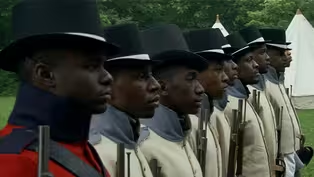
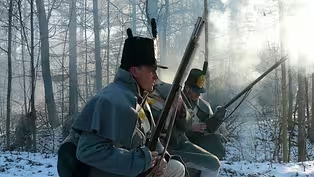
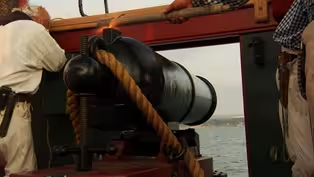
Video has Closed Captions
The British Blockade examines the effects the British exerted on U.S. Navy and shipping. (4m 56s)
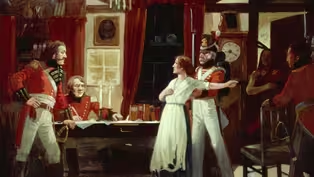
Video has Closed Captions
The Canadian Perspective presents the British North American perspective. (5m 35s)
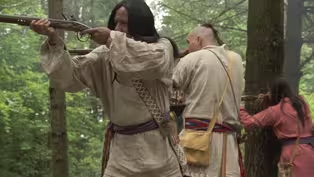
Video has Closed Captions
The Legacy of the War of 1812 and the impact it had on Native nations in North America. (6m 58s)
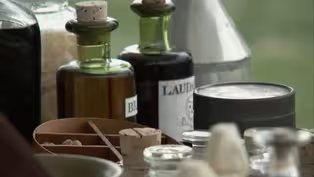
Video has Closed Captions
Military Medicine in the War surveys the risks soldiers took on the battlefield and camps. (5m 20s)
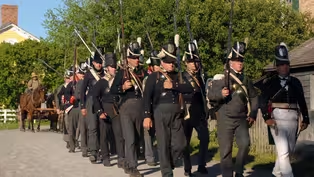
Video has Closed Captions
Military Realities, an examination of the communication, logistics, weaponry and uniforms. (4m 11s)
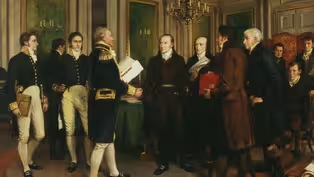
Video has Closed Captions
The Treaty of Ghent outlines the agreement that ended the war. (6m 14s)
Providing Support for PBS.org
Learn Moreabout PBS online sponsorship











Support for PBS provided by:
The War of 1812 is presented by your local public television station.
Funding for The War of 1812 was provided by the National Endowment for the Humanities, The Wilson Foundation, Warren and Barbara Goldring, the Corporation for Public Broadcasting, The Arthur Vining...