Civics Bowl
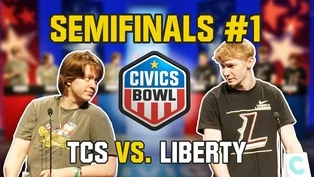
Semifinal #1: The Community School vs. Liberty
Season 2026 Episode 5 | 25m 19sVideo has Closed Captions
TCS and Liberty face-off in the first semifinal battle of the 2026 Civics Bowl season.
It’s time for the semifinals! Only four teams remain in the hunt for the 2026 Civics Bowl championship trophy. The first matchup features The Community School and Liberty High School. But only one can advance to the championship.
Problems playing video? | Closed Captioning Feedback
Problems playing video? | Closed Captioning Feedback
Civics Bowl is a local public television program presented by KSPS PBS
Support provided by:


Civics Bowl
Semifinal #1: The Community School vs. Liberty
Season 2026 Episode 5 | 25m 19sVideo has Closed Captions
It’s time for the semifinals! Only four teams remain in the hunt for the 2026 Civics Bowl championship trophy. The first matchup features The Community School and Liberty High School. But only one can advance to the championship.
Problems playing video? | Closed Captioning Feedback
Where to Watch Civics Bowl
Civics Bowl is available to stream on pbs.org and the PBS app.
Providing Support for PBS.org
Learn Moreabout PBS online sponsorshipThe questions are getting harder.
But as we've already seen in the first round of matches, these teams from Spokane area high schools, are ready.
The 2026 Civics Bowl semifinals start now.
[Voiceover] Civics Bowl is made possible by the Avista Foundation, the League of Women Voters of the Spokane area and of Washington.
And by viewers like you.
Hi everyone and thank you for joining us.
I'm the new host of Civics Bowl this season, Scott Leadingham.
If you're just catching this year's tournament, you chose a good time because this is our first semifinal match up.
Four teams advance to the semifinals.
Today, we'll see The Community School and Liberty High School face off.
They're fighting for a spot in the championship game, where they'll face the winner of the other semifinal game between Ridgeline and Lewis and Clark.
Let's say hello to the teams back in our studio today, from The Community School, please welcome Mattias, Elizabeth, Emily and Evan.
And in the audience, we'd also like to welcome The Community School's alternates, Lilly and Marie, and coaches David Egly, Corrina Barrett, and Kenji Linane-Booey.
And from Liberty, please welcome Carter, Thomas, Colin and Zoe.
We'd also like to welcome Liberty's alternate, Kenley and coach Kenny VanSickle.
It's time to get the semifinals underway.
With the toss up round.
I'll start by asking a Toss-Up question to all players.
A correct answer gives that team a bonus question.
Before we move on to another toss up.
All correct answers in this round are worth ten points.
Here's your first toss up question.
What was the French and Indian War about?
[Buzz] Emily.
[Emily] The French were fighting the indigenous people of America for territory.
[Host] Incorrect.
[Buzz] Carter.
[Carter] Uh, Great Britain was fighting France and, both sides, had alliances with, various, Native American tribes.
[Host] That is correct.
And your bonus.
After the French defeat.
Why did fighting continue between Britain and a confederation of Native American tribes?
[Liberty discussing] [Times-Up] [Host] Need an answer.
[Thomas] They impeded on their lands.
Yes.
The settlers were moving into native lands.
Another toss up.
What term describes the communication of a belief or opinion without the use of words, whether spoken or written?
[Buzz] Mattias.
[Mattias] Uh... [Times-Up] [Host] Sorry.
[Buzz] Thomas.
[Thomas] Symbolism.
[Host] We'll take it.
Yeah, its symbolic speech, but we will take that.
For a bonus.
What is one example of symbolic speech that is protected by the First Amendment?
[Liberty discussing] [Thomas] Flag burning.
[Host] That is correct.
Flag burning or desecration is protected.
There's a number of others, like signs and things like that.
Another toss up.
Let's check out your first video clue.
Hey, I'm Washington state Governor Bob Ferguson.
As you probably know, the state legislature passes an operating budget every two years.
But as governor, I do have influence over the budget process as well.
Can you name one of the ways I'm involved in the budget approval process?
[Buzz] [Host] Carter.
[Carter] He approves of the budget.
[Host] Judges?
Yes, we'll take that.
And your bonus back to Governor Ferguson.
Another part of my job as governor is working with the federal government.
For example, earlier this year, I requested FEMA emergency assistance from the federal government to repair a $182 million in infrastructure damage across Washington state.
What event occurred here in Washington state in December 2025 that caused extensive damage to many homes, as well as infrastructure like roads, bridges and public buildings?
[Liberty discussing] [Thomas] Our team's answer is extreme winds.
[Host] Incorrect.
There were high winds, but the damage that we requested was from flooding.
Another toss up.
Here's a question from another guest presenter.
Hi, I'm Katia Passerini, the president of Gonzaga University.
Before coming to Spokane to lead at GU, I studied political science, economics and information technology all over the world.
What do we call a tax on goods imported from other countries?
[Buzz] [Host] Thomas.
[Thomas] Tariffs.
[Host] Correct.
Your bonus.
Back to president Passerini.
It tariff increases the cost of an important item for American consumers.
But what is the benefit for American manufacturers?
[Liberty discussing] [Times-Up] [Thomas] Uh, I defer to Carter.
[Carter] American manufacturers gain more buyers from the U.S.
or from U.S.
citizens because, foreign goods become more expensive.
[Host] That... is correct.
Another toss up.
In 1896, the Supreme Court ruled that the principle of “separate but equal” was legal.
What did this “separate but equal” doctrine allow?
[Buzz] Elizabeth.
[Elizabeth] Segregation of public spaces such as schools.
[Host] Correct.
Your bonus.
More than 50 years later.
What Supreme Court case struck down the “separate but equal” doctrine, with Justice Earl Warren stating “separate is inherently unequal”?
[TCS discussing] [Emily] Brown v Board of Education.
[Host] Correct.
In 1954.
Another toss up.
If the president vetoes a bill, how can Congress override the veto?
[Buzz] Thomas.
[Thomas] Supermajority in both houses.
[Host] Can you be more specific?
[Thomas] 66%.
[Host] Yes.
Two thirds vote.
I had to do some math there.
[Laughs] Your bonus.
If Congress adjourns within ten days of sending a bill to the White House, and the president does not act on it, the measure dies.
What is this called?
[Liberty discussing] [Thomas] Our team's answer is pocket veto.
[Host] Correct.
Another toss up.
It's another guest for this question.
I'm Scott McQuilkin, president of Whitworth University.
Which Amendment to the U.S.
Constitution provides that states cannot set the minimum age for voting any higher than 18?
[Buzz] [Host] Evan.
[Evan] The 26th.
[Host] Correct.
Your bonus.
Back to president McQuilkin.
Using the argument, “old enough to fight, old enough to vote,” what was the main influence that led to the lowering of the voting age from 21 to 18?
[TCS dicussing] [Emily] The Vietnam War.
[Host] That is correct.
Another toss up and another guest.
Hi, I'm Warren Seyler, a tribal historian and a member of the Spokane Tribe of Indians.
My ancestors were among the first peoples to inhabit America.
What year were Native Americans granted birthright citizenship?
[Buzz] [Emily] 1924.
[Host] Correct.
This is a bonus for you.
Which president signed the Indian Citizenship Act of 1924?
[TCS discussing] [Host] Need an answer.
[Emily] Wilson.
[Host] Incorrect.
That was Calvin Coolidge.
And another toss up.
It's the last one.
Who did tribes look to for leadership due to their experience and wisdom?
[Buzz] Mattias.
[Mattias] Tribal chieftains.
[Host] Hmmm.
We will not take that.
[Buzz] [Carter] Priests.
Religious priests.
[Host] Incorrect.
We're looking for elders specifically on that.
And that is the end of the Toss-Up round.
Good job everyone.
[Clapping] After that first round, The Community School with 50 and Liberty with 90.
We're just getting started.
The head to head round is next.
[Clapping] It's time for this week's question of the week.
What year did Congress passed the Equal Credit Opportunity Act, allowing women to get credit cards and home mortgages in their own names?
A.
1920 B.
1956 C.
1961 D.
1974 We'll be back with the answer after more Civics Bowl competition.
Before we continue we have a score update.
The judges have decided Liberty's answer about the governor's budget involvement was incorrect.
The score now stands at TCS 50.
Liberty 80.
We've moved on to our head to head set now where players will go up against one another one on one.
As with the last round.
Correct answers are worth ten points.
Here's your first question.
Which two rivers in Washington state did the Lewis and Clark Expedition travel between 1805 and 1806?
[Buzz] [TCS] The Mississippi and Snake.
[Host] Incorrect.
[Liberty] Columbia and Mississippi.
[Host] Incorrect.
Snake and Columbia.
What do the Hoover Dam, The Grand Coulee Dam, the Golden Gate Bridge, and the Lincoln Tunnel in New York City have in common?
[Buzz] [Liberty] They provide hydroelectricity.
[Host] Incorrect.
[TCS] They were built during Roosevelt's presidency.
[Host] Hmmm.
Be more specific.
[TCS] During his New Deal program.
[Host] Yes.
All part of the New Deal.
Who is known as the “Father of the Constitution” because he played a leading role at the Constitutional Convention with a plan for a stronger national government?
[Buzz] [Liberty] Alexander Hamilton.
[Host] Incorrect.
[TCS] Thomas Jefferson.
[Host] Incorrect.
James Madison.
Which Washington state elected position makes sure that everyone in the state and local government follows the rules for how the public's tax dollars are spent?
[Buzz] [Liberty] Auditor.
[Host] Yes.
The state auditor.
In order to vote, every state requires a person to satisfy three qualifications.
Name all three.
[Buzz] [TCS] Be a citizen of the United States.
Be, a resident of the -- a long term resident of the state and be over 18.
[Host] Correct.
Citizenship.
Age.
Residence.
In 1972, what law ended discrimination on the basis of gender in public and private schools receiving federal funds?
[Buzz] [TCS] Title five.
[Host] Incorrect.
[Liberty] Title nine.
[Host] Correct.
What 1823 policy warned European countries to stay out of the affairs of North and South America?
[Times-Up] That is the Monroe Doctrine.
Which Amendment to the U.S.
Constitution added the voters of the District of Columbia to the presidential electorate?
[Buzz] [TCS] 23.
[Host] Yes.
23rd.
What year was the original U.S.
Constitution written prior to ratification?
[Buzz] [Liberty] 1787.
[Host] Correct.
Before the bicameral Congress was created, which state wanted to distribute the seats in Congress in proportion to the population of each state?
[Buzz] [Liberty] Virginia.
[Host] Correct.
Which late U.S.
President is the only one, so far, to live to be 100 years old?
[Buzz] [Liberty] Jimmy Carter.
[Host] Correct.
What is the name given to powers exercised both separately and simultaneously by the federal government and the states?
[Buzz] [Liberty] Distributive.
[Host] Incorrect.
[TCS] Uh... Concur.
I can't say the word.
Congruent.
[Host sighs] Its concurrent powers.
So, no.
That was our final question in the round.
Good job everyone.
[Clapping] There are two more rounds of gameplay that remain.
The category round is next.
We're back and we're going to learn a little bit more about all the teams.
So I want to ask them a few questions real quick.
Uh, Mattias, what grade are you in?
[Mattias] Ninth.
[Host] Ninth, and what do you do when you're not studying for Civics Bowl?
[Mattias] I just bum around basically.
[Host] Bum-around?!
That's right.
You got to take some time off.
That's fine.
And Elizabeth.
What grade?
[Elizabeth] I am a junior, and I write a lot.
[Host] You write a lot.
It is important to keep writing.
All right, Emily, what do you do and what grade you in?
[Emily] I'm a sophomore, and I'm a competitive archer.
[Host] Competitive archer?
I like archer, okay, so, like Olympics, maybe one day, right?
[Emily] Well, no.
No Olympics, but.
[Host] That's cool.
[Emily] I do shoot USA archery.
[Host] That's very cool.
All right.
Evan.
What grade?
[Evan] I'm a sophomore.
[Host] And what do you do when you're not studying for Civics Bowl?
[Evan] Progress my future career in enforcement.
[Host] Law enforcement.
Very good.
Okay.
Very good.
Thank you very much.
All right.
Carter.
What grade?
[Carter] I'm a junior, and, in my off time, I, raise and show livestock.
[Host] Ah!
Very cool.
Like 4H and... [Carter] FFA.
[Host] And county fair and stuff like that.
Very cool.
And Thomas grade.
[Thomas] I'm a junior.
[Host] And what do you do when you're not doing Civics Bowl?
[Thomas] I play the trumpet.
[Host] Oh, hey, so did I. That's right.
Go brass players.
That's right.
All right, Colin.
[Colin] I'm a senior, and I like making music.
That's making it, electronic, like on the computer.
I would like?
[Colin] I like to play a couple instruments, write some stuff.
That's awesome.
All right.
Maybe we looking forward to you on Inland Sessions which is another KSPS show.
[Colin] Maybe some day.
[Host] All right.
Zoe, what do you do?
[Zoe] I'm a senior, and in my free time, I like to draw.
[Host] Excellent.
Yeah, I keep that in mind working with the drawing.
All right.
Category round is coming up.
Here's important news for high school seniors.
We all know the legal age to vote is 18, but in Washington state, 17 year olds can vote in the August primary as long as they'll turn 18 before the November general election.
High school seniors, that means if you're 18 or will turn 18 before the November election, it's time to register to vote.
Only registered voters receive a ballot.
To learn more, visit votewa.gov [Host] Here are the categories you'll be choosing from; Political Thinkers, The American Revolution, Death of a President, Local Issues and Big Screen Politics.
TCS you get to select first.
[Emily] American Revolution for 15.
[Host] From famous battles and bold leaders to the untold stories of everyday citizens, this category features questions and images from the Ken Burns PBS documentary “The American Revolution.” Our first question comes from a guest.
Hi, I'm LaVonne Whitaker.
We are members of the May Hutton chapter of the Daughters of the American Revolution, an organization committed to historic preservation, education and patriotism.
Here's your question: What battle named after two Massachusetts towns and famously described by Ralph Waldo Emerson as the site of the “shot heard around the world” marked the beginning of open fighting in the American Revolution?
[TCS discussing] [Emily] Lexington and Concord.
[Host] That is correct.
To Liberty.
[Thomas] We'll do the American Revolution for 20.
[Host] Who was the king of Great Britain during the American Revolution?
This painting depicts his statue being pulled down in New York City.
[Thomas] Our team's answer is King George the Third.
[Host] That is correct.
TCS.
[Emily] American Revolution.
[Host] For 25 points.
What was the name of the volunteer colonial militia members portrayed in this painting, who claimed they could be ready to fight at a minute's notice?
[TCS discussing] [Emily] The Minutemen.
[Host] Correct.
Correct.
Liberty.
[Thomas] Will do the American Revolution for 30.
[Host] Closing out that category.
And it's another guest.
Hi, I'm Cindy Lundberg.
We are local members of the Daughters of the American Revolution.
All of our members are direct descendants of individuals who aided the American Revolution.
Here's your question.
Who famously wrote ‘Remember the ladies” in a letter to her husband urging the Continental Congress to consider the rights and interests of women while they were drafting the new nation's laws and constitution.
[Liberty discussing] [Thomas] Our teams answer is Abigail Adams.
[Host] You guys are going back and forth on that, and it turns out you were right, Abigail Adams.
TCS.
[Emily] Local Issues for 15.
[Host] For 15 points.
This category comes from a KSPS guest.
Hi, I'm Dana Haynes, the host of At Issue on KSPS PBS.
We provide in-depth reporting on some of the biggest issues facing our region.
For example, back in March, we sat down with Eastern Washington legislators to find out how this year's legislative session went.
Since 2026 is an even year.
How long was the legislative session?
[TCS discussing] [Host] Need an answer.
[Emily] 90 days.
[Host] Incorrect.
The short year is 60 days.
All right.
Liberty.
[Thomas] Will do Political Thinkers for 15.
[Host] What English political theorist promoted the idea of the natural rights of all men, which include the rights to life, liberty and property?
[Liberty discussing] [Thomas] Our team's answer is John Locke.
[Host] That is correct.
Although at that time the natural rights were limited to white men.
TCS.
[Emily] Political Thinkers for 20.
[Host] What political concept came from French philosopher Baron de Montesquieu and would become an important part of the U.S Constitution?
[Emily] Separation of powers.
[Host] That is correct.
Liberty.
[Thomas] We'll do Political Thinkers for 25.
[Host] Which figure of the Age of Enlightenment gave us the notion of “common law”?
The idea that legal decisions should be based on similar decisions made in the past.
[Liberty discussing] [Thomas] Our team's answer is Thomas Hobbes.
[Host] Incorrect on that one.
Sorry.
It's William Blackstone.
To TCS.
[Emily] Big Screen Politics.
[Host] Let's head to the theater for this one.
Hi, I'm Ryan Tucker, one of the hosts of Saturday Night Cinema here on KSPS PBS.
Now, many actors have played the role of president of the United States in movies.
Whether portraying an actual president or a fictional president.
Which one of these actors has not had the privilege of playing the president?
A. Daniel Day-Lewis B. Harrison Ford C. Morgan Freeman or D. Tom Hanks.
[Emily] Morgan Freeman.
It's Tom Hanks.
Been in a lot of movies, but he hasn't played a president.
Liberty.
[Thomas] We'll do Political Thinkers for 30.
[Host] Differing from John Locke's theory that people transfer some rights to a government but keep their natural rights, which enlightenment thinker believed people should give up all rights to their government in exchange for order and security?
[Thomas] Our team's answer is Thomas Hobbes.
[Host] Correct.
Thomas Hobbes, “Without government, life would be nasty, brutish and short.” TCS.
[Emily] Local Issues.
[Host] For 20 points.
Here's Dana again.
The state of Washington is divided into 49 legislative districts.
There are five in the Spokane area.
Name two.
[TCS discussing] [Host] Need an answer.
[Emily] Cheney and Liberty Lake.
[Host] Incorrect.
We were looking for the numbers of districts like district three, four, six, seven, and nine which cover the Spokane area.
Liberty.
[Thomas] We'll do, Death of a President.
[Host] For 15 points.
How many U.S.
presidents have died in office?
[Liberty discussing] [Thomas] Our team's answer is eight.
[Host] That is correct.
All right.
That is it for this round.
Good job everyone.
[Clapping] And taking a look at the score after that category round TCS with 90 and Liberty with 215.
The lightning round is next.
[Clapping] [Voiceover] Ready for the answer to this week's question of the week?
When did the Equal Credit Opportunity Act pass?
The answer is D.
1974.
The Equal Credit Opportunity Act made it illegal for creditors to discriminate against applicants due to sex, marital status, race or religion.
Before 1974, creditors would often deny loans to women.
Discount a woman's income on a lending application, or would require a husband signature for a woman to receive a credit card, loan, or mortgage.
Before we get to the lightning round I want to thank our judges who are crucial in making sure I look like I know all the answers and spoiler alert I don't.
We are lucky to have these three distinguished educators here today and throughout the competition.
Susie Gerard, the secondary social studies coordinator for Spokane Public Schools.
Lawrence B-A Hatter, an associate professor of history at Washington State University.
And John Yoder, professor emeritus of political science at Whitworth University.
Thank you so much for spending all these hours with us during the matches to help us promote civic education and engagement in our schools and the community.
Thank you so much for all your help.
[Clapping] Okay teams let's get back to the final round, standing between you and a trip to the championship game.
In the lightning round we'll put 90 seconds on the clock.
Questions are worth 20 points.
And points are deducted for wrong answers.
Teams, are you ready?
[Teams] Yeah.
[Host] The clock starts when I finish reading the first question.
In what city did the Second Continental Congress meet?
[Buzz] Elizabeth.
[Elizabeth] Philadelphia.
[Host] Correct.
What year did the Second Continental Congress convene?
[Times-Up] That was 1775.
Does Washington state limit the number of terms the governor can serve?
[Buzz] Elizabeth.
[Elizabeth] No.
[Host] Correct.
They do not.
What did Thomas Jefferson describe as “the most sacred of the duties of government”?
[Times-Up] To provide justice or protect the liberties of people.
Who was the first woman justice of the U.S.
Supreme Court?
[Buzz] Emily.
[Host] Sandra Day O'Connor.
[Host] Correct.
What is the only crime defined in the U.S.
Constitution?
[Buzz] Carter.
[Carter] Treason.
[Host] Correct.
True or false?
Congress sets its own pay.
[Buzz] Elizabeth.
[Elizabeth] True.
[Host] True.
Yes.
In what 1803 case did the U.S.
Supreme Court first exercise its power of judicial review?
[Buzz] Thomas.
[Thomas] Marbury versus Madison.
[Host] Correct, in 1803.
What 1787 ordinance cleared the way for the creation of new states west of the original 13 states?
[Buzz] Elizabeth.
[Elizabeth] The Louisiana Purchase.
[Host] Incorrect.
It's the Northwest Ordinance.
How many members serve in the U.S.
Senate?
[Buzz] Thomas.
[Thomas] 100.
[Host] Correct.
What is the name of the warning police are required to recite informing arrestees of their rights?
[Buzz] Carter.
[Carter] Miranda Rights.
[Host] Correct.
How long must an immigrant have been a permanent resident of the U.S.
before applying for citizenship?
[Buzz] Emily.
[Emily] 15 years.
[Host] Incorrect.
Five years or three years if married to a U.S.
citizen.
And that is the end of the lightning round.
Great job, everyone.
[Clapping] Liberty won with, 295 to 130.
Congratulations, Liberty.
You are heading to the championship game of Civics Bowl 2026.
And, taking a look at the bracket, you'll see that your face either Ridgeline or Lewis and Clark.
Community School, I just want to say that you did a fantastic job in these matches.
I hope you're proud of how far you've made it in this tournament.
Be sure to catch the next semifinal match up next Monday at seven.
And remember, you can catch up on all the previous episodes KSPS.org, on the PBS app, or on YouTube.
From all of us here at KSPS PBS.
Thank you for watching.
[Clapping] [Voiceover] Civics Bowl is made possible by the Avista Foundation, the League of Women Voters of the Spokane area, and of Washington.
And by viewers like you.
Semifinal #1: The Community School vs. Liberty | May 18th | Preview
Video has Closed Captions
Preview: S2026 Ep5 | 30s | Coming up, TCS and Liberty face-off in the first semifinal battle of the 2026 Civics Bowl season. (30s)
Providing Support for PBS.org
Learn Moreabout PBS online sponsorship











Support for PBS provided by:
Civics Bowl is a local public television program presented by KSPS PBS