
Northwest Profiles
October 2026
Season 40 Episode 1 | 29m 33sVideo has Closed Captions
Explore Partners INW, Scarywood, Don Hamilton, Montana windmills, and aviator Gladys Buroker.
Northwest Profiles kicks off its historic 40th season with stories from across the Inland Northwest! Discover how Partners INW supports families, go behind the scares at Scarywood, meet Spokane photographer and filmmaker Don Hamilton, and explore windmills in Montana. Plus, take a trip into the archives to revisit the remarkable story of pioneering aviator Gladys Buroker.
Problems playing video? | Closed Captioning Feedback
Problems playing video? | Closed Captioning Feedback
Northwest Profiles is a local public television program presented by KSPS PBS
Northwest Profiles is proudly supported by ICCU
Support provided by:

Northwest Profiles
October 2026
Season 40 Episode 1 | 29m 33sVideo has Closed Captions
Northwest Profiles kicks off its historic 40th season with stories from across the Inland Northwest! Discover how Partners INW supports families, go behind the scares at Scarywood, meet Spokane photographer and filmmaker Don Hamilton, and explore windmills in Montana. Plus, take a trip into the archives to revisit the remarkable story of pioneering aviator Gladys Buroker.
Problems playing video? | Closed Captioning Feedback
Where to Watch Northwest Profiles
Northwest Profiles is available to stream on pbs.org and the PBS app.
Providing Support for PBS.org
Learn Moreabout PBS online sponsorshipGood evening and welcome to the 40th season premiere of Northwest Profiles on KSPS PBS.
Did he say 40th season premiere?
Yes I did.
Happy 40th anniversary to Northwest Profiles.
I'm Tom McArthur, eage to share the work of our story producers in this month's all new program.
Let's go.
Every October, Silverwood Theme Park in North Idaho takes a frightening turn, transforming into Scarywood.
Behind all the screams are months of preparation, plenty of imagination and a small cauldron of people who know how to scare the daylights out of us.
Let's meet some of them.
Opening night, night, the energy in the park is is really unmatched right before those gates opened to our guests.
We're bringing that theming and that story line.
I'm going to stal you no matter how long it takes.
Running won't help.
Every October, Silverwood become something different.
But long before the first guest screams, every detail must be woven together.
Scarywood is Silverwood theme parks Halloween event that allows people to come out and experience a darker side of Silverwood.
2009 was our first year where we did Scarywood.
Knott Scary Farm, down in California, was a big inspiration.
So there's lots of trips going down to these parks that are doing it well.
Scarywood is so much more than just simple Halloween decorations.
We start planning for the next season right after the previous season ends.
Scarywood is composed of different scare zones and haunts.
A scare zone is an outdoor area with distinct set pieces, roaming characters, and eerie environmental details.
A haunt is an immersive indoor attraction that centers around a specific fear.
It is months of building.
It is a full month and a half of auditions, and then we really nai down the back half of September for training and gettin everybody ready to be on stage.
But what does it take to bring these nightmares to life?
Everybody has a phobia.
Everybody has something that they're just timid of, and they may not even know it until they're faced with it.
That's kind of where our ideas start.
How are these character looks developed?
Research being on the internet or movies.
We look at it and say, oh, we'd like that.
Or maybe, oh, let's try this, but let's tweak this aspect a little bit.
We hire over 330 haunters.
You have the costume them.
So we take over one of our warehouses.
We make a makeup room and we have our clothing room, and we have racks upon racks of clothing, because we have ten scare zones, we have five haunts, and a look for each one.
When the show is up and running, it's all hands on deck behind the scenes.
The scare actors are supported not only by makeup and costume departments, but by lighting, set design maintenance, I.T., and effects.
Even the fog takes careful planning.
So everything that you see in the park cannot be brought i until the very end of September.
It's just this mad dash to get everything in.
What we really work on from an actor perspective is, is creating environments that are false and everybody walking in our false, but they convoluted the mind so much that they appear real.
And appearances can be deceiving.
It's like a storyline to me.
You start at the at the top of the page and then you continue on down till the story is finished.
And it's the same thing for me when I get into these characters that I've done for so many years.
I really want to become tha character, whoever it might be.
So I'm going to do studying.
I'm going to develop it.
I'm going to test with makeup, prosthetics, whatever it might be.
I want to make sure that it's top tier.
I've been doing it for so long.
When an individual walks in, or a group walks in, or anything like that, and when I get that stare down and I can see that they're thinking like, this is a little bit too real, then that's when I lock it.
I'll continue to walk and stalk to one end of the park, to the other end of the park, without you not even knowing that I'm there behind you.
What keeps the staff coming back year after year?
Our community behind the scenes is phenomenal.
You have such a variety of age group from 16 to 76.
There's usually music going, theyre dancing.
Oh my god, were on TV!!
Honestly, it becomes like a big family.
And I guess that's what I like about it is that family unit.
Before we go out, we do what's called the heart of the haunt.
That is our seize the night moment where everybody does thei heartbeat and then we flatline.
Beep!
Carpe Noctem!
Hey, let's have a great night, everybody.
I love my job at Scarywood because it gives me an opportunity to be creative with stories that, aren't typical.
It's just been this adventure and it's just grown into this wonderful part of my life that I never knew was even there.
I've been doing it now for 30 plus years, and I plan on continuing doing it until I'm being pushed around the wheelchair.
Then new character can be developed.
It's wonderful.
There's a lot more to a goo scare than meets the eyeballs.
And for the people who bring Scarywood to life each fall, all that planning, preparation, and hard work pays off when somebody lets out a good old fashioned, milk curdling scream.
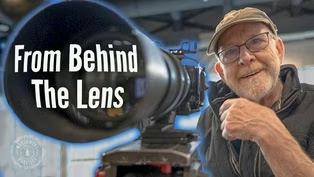
Up next, Don Hamilton has been a familiar name in Spokane's creative community for more than 40 years, as long as this program has been on the air.
Photographer, filmmaker, voiceover artist and now owner of an intimate music club.
We paid a visit to Hamilton Studio to look back on a remarkable career Yeah, this is definitely the place where you can b the big fish in the little pond.
The place is Spokane, and the big fish is Don Hamilton, a photographer, cinematographer, producer, director and action, and the owner of Hamilton Studios.
I was ready for a change.
I was working down at the South Coast Repertory Company.
Theater is my actual background.
He was the stage lightin designer and technical director, while also working as the theater's photographer on New Year's Eve 1979.
He decided to make the move.
I was tired of driving the LA freeways, and I came to Spokane to pursue the American Dream.
I started workin as a still photographer in 1980.
I got to thank my mom.
She put a camera in my hand early on.
My dad had an Argus C-44, and that was my first 35 millimeter rangefinder camera, had a dark room in a bathroom at my home in Tarzana.
And I tell young people today you used to have to get your hands wet to make a photograph.
I don't know, I just sort of always loved it and been very lucky to make a living at it.
Some of my first work was done for publication called Spokane Magazine, and so I could remember doing editorial work for them, covers doing ads for the clients that they came up with.
And then I was originally thinking, maybe I was looking for a farm with a bar that I could turn into a studio.
But then the diocese had this white elephant.
This was originally built as the Saint Joseph School auditorium and gym.
It was just perfect space for us.
Big empty room, no posts in the middle of it, and we did quite a bit of work.
We moved in, we changed ou the HVAC, new electrical system, blew in the soun insulation, built the cyclorama, and we've been using it as a photography studio and motion picture soundstage since 1985.
And it used to be we shot film.
These days it's all digital.
And so it's a completely different world.
Okay.
Camera a speed.
One on one, take seven.
But that basic storytelling process, the idea of a camera on a talking human being or a story being told with fictional characters.
For me, it is the same whether it's a vertical video on your phone or if it's a HD TV commercial that's on the big screen, it's still the same storytelling process.
I'm rolling.
Thank you.
I can remember for a good part of my life, I used to hang out the door of a helicopter with a film camera on my shoulder shooting stuff.
Now I got a couple of drones that do remarkable work and in a completely different manner.
The technology has evolved and continues to evolve.
Well.
It's exciting.
I mean, I'm very lucky to b playing this game at this time.
Here we go.
Rehearsal up.
And action.
I do like the idea, though, of actually directing a feature film, which is something I'm contemplating rather heavily right now.
I've worked on feature films as a director of photography, as a producer, and I would be delighted to take that next step.
In the 1990s, Spokane became the backdrop for the Hollywood film.
Benny and Joon and Don saw an opportunity.
The local media said that an L.A.
crew was coming up here to make a movie, and then were going to bring up Aidan Quinn and Mary Stuart Masterson and Johnny Depp, and they were going to cast a couple of local roles.
They were going to cast the video store owner and the UPS man.
And so I got mysel a cardboard box and a clipboard, and 4000 people turned up for the auditions for those two roles.
And so I went to the front of that 4000 person line with my cardboard box and my clipboard, and I said, I'm looking for casting director Rick Montgomery.
So I went in there and I found Rick Montgomery, and I said, sign for the box.
And later on he opened it up and inside was my eight by ten and resume.
I need a check Benny C.O.D.
In a minute, meet me in the office It's a true story, and I still get residual checks every 90 days.
But the work hasn't kept Don close to home.
His photography has taken him across the country and around the world, sometimes to places few photographers ever get the chance to see.
I did work for an art exhibition called Son of Heaven, and I made four trips to China, and I had a studio inside the Forbidden City.
But it was built before Columbus sailed, and we photographed the objects for the catalog for that, and made documentaries to market and tell the story of that.
And that was an interesting time to be in China.
My last day in China was in 1989, four weeks before they cleared Tiananmen Square.
of all the students.
After decades of photography, filmmaking, and telling other people's stories, Don has found a new way to bring people together.
at his studio, with The Listening Room.
music It started out as an experiment, and I suppose it's still an experiment.
Like a bugaroo towards the swimming pool.
Listen to the Cowboys sing everybody jumping down to Palm Springs As I say, when we bought the place, we blew in the sound insulation and built a cyclorama for filmmaking, but never imagined it with an audience.
Maybe its highest and best use.
The acoustics in here are phenomenal.
The space is intimate, and so the audiences love it, the performers love it.
And so now we got to figure out how to keep it going.
It's a hoot.
music I don't know what Id do if I retired.
I mean, I enjoy what I do.
A lot of people retire and what do they do in retirement?
They take pictures and make movies, you know?
So I really do enjoy what we do.
I'm lucky to do it, and I want to keep doing it as long as I can.
Years ago when I was jus getting started in the Spokane creative community.
I asked around.
Who's on your short lis of people I should get to know?
Don Hamilton was on the list.
He still is.
Don and his team are online at HamiltonStudio dot com.
Find out who's playing at th listening room at hamilton.live.
Well, they've been part of the western landscape for generations.
Those familiar windmills turning in the breeze once helped make life possible in some pretty remote places.
While many have disappeared, the old fashioned windmill is far from forgotten.
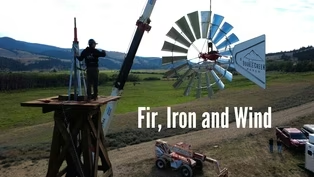
We found some craftsme who are giving these remarkable machines a new lease on life in Montana's Big Sky.
Rising above the landscape.
These simple ye ingenious machines once dotted the American West.
Turning steadily in the wind, they brought life from deep beneath the earth.
Providing water for homesteads, ranches, railroads, and entire communities.
More than a century later, the windmill remains one of the most recognizable symbols of the frontier.
And in Victor, Montana.
One family is making sure that symbol keeps turning.
Founded by Jess Nelson and his wife Anna in 2019.
Big Sky windmills helps carry on the legacy of these machines by building and restoring these pieces of history.
Today, Annas son Connor helps carry the business forward.
>>Connor is my partner in this.
And we wouldn't have accomplished what we have today without working together as a team.
He's I don't think I could replace him.
We accomplish things with the two of us that most crews with 3 or people don't get more work done.
Connor and I are kind of prou to say we're just windmillers.
>>The history of American windmills stretches back more than 170 years.
In 1854, inventor Daniel Halladay developed the Halladay Standard windmill, a self-regulating design whose blades folded inward during strong winds.
Just over a decade later.
Presbyterian missionary Leonard Wheeler designed a rigid wooden wheel and a hinged side vane to regulate itself in changing winds.
The windmill was called the eclipse.
>>Everything was wood.
If you go back far enough, the towers, the wheels, even the axles and some of the bearings, if you really go back, we're all made of wood.
>>The eclipse became one of the most successful water pumpin windmills of the 19th century, helping supply water across the growing frontier.
Capturing the wind was one thing, but using it to convert the spinning motion into an up and down stroke was the key to pumping water from underground.
>>You have to have some type of a gear system to turn that rotational energy into either a pumping motion or to turn a gear that would turn a belt to create power.
>>In about the mid 1850s, they took that rotational motion with a set of gears and turned it into an up and down stroke to drive a simple mechanical pump.
That design really hasn't changed.
Here's the inside of a modern gearbox.
The basic concept of the pump hasn't changed, but the quality and build has.
>>Heres the wind turning the wheel.
And the big bull gears are turning on these two little pinions attached to the main shaft.
Driving this yoke up and down.
So there's an example of the rotational motion being turned in up and down motion.
Because there wasn't a submersible electric pump, you either pumped it by hand or you had a windmill.
And if you've ever pumped much water by hand, it's okay if you're trying to drink, but not if you're watering 50 cows.
>>Across the West.
Windmills made ranching and railroading possible.
>>A lot of these windmills out there.
The big ones pumped water for the steam locomotives, and that one is from 14ft and down, were for the farm and ranch guys.
You'll see a movie set right after the Civil War with the metal wheel in the background.
That's really wrong.
>>Production companies seeking historical accuracy began asking for authentic wooden windmills, that led Big Sky Windmills to create what they call the Eclipse Hybrid.
>>The eclipse wood patent windmill was in about 1867, and we've mounted all that to a modern design gearbox.
>>Building a windmill is one thing.
Raising it is another.
>>So you go out in the mornin and you're building the 12 or 14 or 16ft wheel, and if the wind gusts 10 or 15 miles an hour, it's trying to jump around on you.
So you're praying all morning that the wind isn't too bad while you're on the ground putting it together.
Then you get serious about the praying when it's time to fly that windmill up on top of the tower, because then you have no control over it when it's on the crane, to the point where at 20 miles an hour, you better just wait for another day.
>>On the Nelson property near Helmville, Montana.
A showcase of their craft is being placed on support pads while the crew goes about their business raising the heavy Douglas fir tower into place.
While Jess and Connor attach the 12ft wind engine, they make sure to pay attention to the weather, hoping it cooperates as they do their task.
>>That windmill will make about six gallons a minute without any modern electricity or anything.
On these windmills, it all goes back to a reason and a need.
>>Today that need still exists.
The myriad of projects overseen by Jess are many.
From the building of two towers that support 20ft Samson windmills on the Lazy Bee Ranch near Duncan, Arizona, the childhood home of forme Supreme Court Justice Sandra Day O'Connor, to multiple projects for landowners across the U.S.. The need and desire are there and a testament to the craftsmanship of this family business.
From the woode eclipse windmills of the 1860s to the towering windmills still pumping water today.
These machines helped build the American West and are still turning in the wind.
>>The windmills are like the cowboy and the Winchester rifle and the Colt revolver.
They're a symbol of this country, and there's just something magic about them I'm a windmill nerd.
I, I love them.
Big Skys windmills dot the horizons of 19 states and counting.
Each one proves that sometimes the best ideas are worth hanging on to.
Before we continue with our last profile, I'm going to take you down a little side road, if you please.
The story you just sa was produced by Scott McKinnon, who has been filming and writing and producing stories for North West Profiles since the series began.
To celebrate our 40th season, each program will include a short look back at a past story So it's only fitting that we begin with one of Scott's favorite stories from the vault.
To Gladys Broecker the word flight means something very special.
With 56 years of flying behind her.
She's managed to take to the air in one form or another and master it well enough to teach others.
I feel that I've lived in the very best period of time possible as far as aviation goes.
I didn' get them at the very beginning, but I got in when it was new and I've sold.
I've seen a lot of progress and more or less grew along with it.
It's actually takes no effort at all.
To fly a glider.
I say that now, and I know you can look at me in disbelief, but it's like anything else.
It's, It's doing it enough.
I would compare it to, sail boarding.
If you've ever been out on a sailboat, you know how, relaxed and quiet and that it can be.
And I feel gliding is the same way.
Knowing where to turn when times get tough can make all the difference.
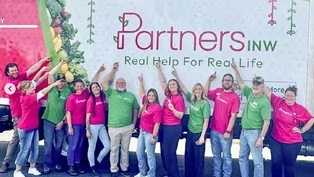
Partners INW brings Spokane Valley neighbors together to help families through life's challenges, as we'll see.
A little kindness can go a long way.
We want people to walk in on their worst day and, and feel like they're getting hugged by their community.
[For generations,] [that sense of community has been at the heart] [of Partners INW.]
Our history goes back, uh, really to post-World War Two.
When uh, Spokane Valley community, saw the need that people were, having hardships.
Families were struggling after the war.
And so they started working together, which is kind of unique.
It was grassroots.
Uh, just to provide for their neighbors.
And that's really where we, where we started.
And then the Valley started growing.
And, it just became a pretty big job.
And so they founded this nonprofit in 1990, and we've been operating, with that charter and that mission since then.
That was given to us by the community.
[And more than 75-years later] [that mission remains much the same.]
Our services include giving away free critical resources.
So it's food, it's clothing, it's diapers, it's hygiene supplies.
Primarily that comes through people giving us things to give to the public.
And they know that anything they donate here, goes to the public for free.
And so they really like that option.
And then most of our diapers we purchase.
We do have some donated, but most of that has to be purchased.
[And keeping those resources stocked] [is a community effort.]
Our website always lists what is urgently needed.
It's never, just one thing.
We always need food.
The amount of people we feed could fill the, Spokane Arena almost twice a month.
So food flows fast.
And we can never have enough.
So, If the public can donate shelf stable food, that gives us more opportunity to schedule how we release that.
[Partners also works with th Central Valley School District.]
[Providing food for its entire Bite-To-Go program.]
Im John Parker and Im the superintendent for th Central Valley School District.
And we serve about 14,300 students.
Across 80 square miles.
And there is a significant poverty issue in Central Valley.
In a place you might not it would be.
We have 47 - point... roughly 5 percent.
Almost one out of every two students are free and reduced lunch.
And for a school district to be able to have someone like Partners come in and fill noticeable gaps beyond what the school distric provides with its lunch program its, its a game changer.
[But, they measure success] [by more than just volume.]
When you serve so many people, its uh, sometimes about the numbers and you get focused on the tens of thousands of people that you're touching, and you don't focus on the penny, the one.
And so for me, success looks like, one person or one family, needs help and they're able to walk through our doors and we can make a significan impact on their immediate need.
I think that's the success.
Is the individual.
[Wether someone needs help,] [wants to give,] [or simple wants to get involved.]
[Partners hopes its name] [means something.]
It's trustworthy.
It's kindness.
It's instant help.
I think those are the things.
Responsiveness.
Yeah, we have certain things that we do; food, clothing, diapers, emergency assistance.
Those are almost cliches or... I don't know, buckets.
But for anything I just if people hear Partners, I want them to feel like thats a safe place for me to get involved.
It's a safe place to donate, safe place to volunteer.
It's a safe place to sen somebody I know who needs help.
That's a safe place.
And you know they're going to help.
Neighbors.
Helping neighbors is a simple idea but one that can change lives.
Learn more about partners INW and ways you can help at partners INW dot org.
To all of our viewers across the great Intermountain West.
Thank you for inviting Northwest Profiles into your homes for the past 40 years.
We think this program is truly something special, but that's only because our viewers are too.
Do you know of someone special somewhere we should explore in the future?
Tell us online at KSPS.org.
I'm Tom McArthur.
See you again soon.
Bye for now.
 New
Video has Closed Captions
Clip: S40 Ep1 | 6m 51s | Watch Silverwood theme park transform into Scarywood—a world of haunted attractions and characters! (6m 51s)
 New
Video has Closed Captions
Clip: S40 Ep1 | 6m 29s | In Big Sky Country the craftsmanship of the past is being used to build machines for the present. (6m 29s)
 New
Video has Closed Captions
Clip: S40 Ep1 | 7m 25s | Meet photographer, cinematographer, and media craftsman, Don Hamilton (7m 25s)
Video has Closed Captions
Preview: S40 Ep1 | 30s | Photographer Don Hamilton, Montana Wind Power, Partners INW, and behind the screams of Scarywood. (30s)
 New
Video has Closed Captions
Clip: S40 Ep1 | 4m 19s | Discover how Partners INW is helping Spokane Valley families through the power of community. (4m 19s)
Providing Support for PBS.org
Learn Moreabout PBS online sponsorship









Support for PBS provided by:
Northwest Profiles is a local public television program presented by KSPS PBS
Northwest Profiles is proudly supported by ICCU