Northwest Profiles
January 2026
Season 39 Episode 3 | 27m 18sVideo has Closed Captions
Daniel Lopez Muralist; Myles Kennedy Musician; Artist Uses Plant Fibers; Marzell Furniture Restorer
We follow the journey of Daniel Lopez, a Spokane based Muralist, building community through art. Myles Kennedy, Spokane’s busiest singer/songwriter, talks life on the road. Learn how one artist creates images on natural fibers, from plants. Marzell Van Vlaenderen, a furniture restorer who’s never met a piece her hands—and heart—couldn’t fix.
Problems playing video? | Closed Captioning Feedback
Problems playing video? | Closed Captioning Feedback
Northwest Profiles is a local public television program presented by KSPS PBS
Funding for Northwest Profiles is provided by Idaho Central Credit Union, with additional funding from the Friends of KSPS.
Support provided by:

Northwest Profiles
January 2026
Season 39 Episode 3 | 27m 18sVideo has Closed Captions
We follow the journey of Daniel Lopez, a Spokane based Muralist, building community through art. Myles Kennedy, Spokane’s busiest singer/songwriter, talks life on the road. Learn how one artist creates images on natural fibers, from plants. Marzell Van Vlaenderen, a furniture restorer who’s never met a piece her hands—and heart—couldn’t fix.
Problems playing video? | Closed Captioning Feedback
How to Watch Northwest Profiles
Northwest Profiles is available to stream on pbs.org and the free PBS App, available on iPhone, Apple TV, Android TV, Android smartphones, Amazon Fire TV, Amazon Fire Tablet, Roku, Samsung Smart TV, and Vizio.
Providing Support for PBS.org
Learn Moreabout PBS online sponsorshipWelcome to an all new edition of Northwest Profiles in the all new year of 2026.
Good to have you with us tonight.
With pleasure.
I'm your host, Tom McArthur.
I expect you know what a mural is.
Those large format paintings applied directly to a surface that decorate, tell a story or convey a message.
Have you ever met a muralist?
You're about to.
And our first story, Daniel Lopez has been wowing people with his murals and oil paintings for many years.
He says murals helped him express his love for our area and connect with people in a big way.
I think one of the most, amazing things that come from my artwork is that it gives me the ability to connect.
My name is Daniel Lopez, and I'm from Southern California.
I've lived up here in Washington for about 15 years now.
Daniel Lopez is a muralist and portrait painter, whose style is built on his life growing up and the masters of the past.
Growing up, I especially remember my dad's tattoos.
He had like these, street Chicano art, prison and, like, pain and love and suffering and all these things, it was almost like a mural to me.
But then I also love the Renaissance work because it's so extreme and so dramatic those two styles just kind of naturally started, like, mending together.
And I could try to smooth everything out if I wanted, but I love all those brush strokes and all these scratches and everything.
Theyre just going to make the painting look even cooler.
The more I paint, I almost will probably start to feel like I know these guys and get more interested in them.
And, you know, I will have actually, like, spent time painting their faces.
I think that's pretty intimate.
You look at people and you guess what their whole story is and what they've been through.
I sketched and I drew a lot in elementary school.
And my grandmother, she really nurtured that.
Daniel lived with his grandmother as a child.
When Daniel was in high school, he fell in love with street art, graffiti, and murals In public spaces.
But towards the end of high school, art drifted out of Daniel's life.
This was when my addiction was starting to really ramp up, I dropped out of high school about 18, and then I was— used until about 31.
Then in 2013, Daniel's grandmother passed away and his life began to spiral out of control.
And I was at a point where I was either going to, like, make a really bad decision, or get some help.
Daniel had family who lived in Spokane, so he decided to relocate and seek help.
He entered Teen Challenge, a faith-based program helping those struggling with addiction.
Afterwards, Daniel began rebuilding his life.
He was hired as a dishwasher at Indaba Coffee.
And I would draw on these little books for, like, an hour before work and people are looking at my artwork and they're like, man, you got to do something with this.
It was 2015, and I had gotten the opportunity to paint my first real mural.
It was the YFC building off of Ash Street, it was like this big long wall, this was my first, whole city block type of mural.
I was trying to get linked up with the Spokane arts, I finally went in with my book and I met Ellen Pitkin.
At the time, she was on the Spokane Arts Commission and an artist.
I showed her my work and she's like, oh, you're the one that did the big mural over there.
Nobody knew who was doing it.
And then it just kind of snowballed.
It was crazy.
Over time, Daniel began connecting with more and more artists and community members, leading to more and more gigs creating art.
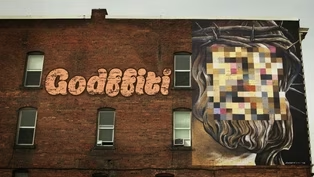
Each piece of art Daniel completes, he signs under his pen name, Godffiti.
The Godffiti is the idea of, if God were a graffiti artist, what would he paint?
I guess in my mind, it's like he would paint more matters of the heart.
Like, things that are meaningful and get people to think I always feel like the community is helping me, as much as I'm, like, giving back and trying to paint something beautiful.
Daniel volunteers at Westview Elementary School, sharing his love of art with the kids.
Yeah, I do Doctor Seuss week every year, Ill go in and I read this book “Im NOT just a Scribble”, and then I'll draw with them, and then I partner with them and the Shadle Park High School.
And they work, they work together.
And I kind of, just back it.
Daniel even designed a mural for the kids to work on together.
I went in and just, like, talked to the kids for a little bit gave them assignments.
And then I came in and just pieced it all together.
Creating art and connecting with his community has helped give Daniel purpose and a sense of belonging.
Its a beautiful journey, and it helped me reflect on my life, and find healing, and reach people, and connect to people.
And so it has been one of the most amazing things in my life to be a painter.
Daniel is also known as Godfiti.
You can find him online by that name, Godfiti dot com, or on Instagram.
Steam can heat buildings, move ships, even cook food.
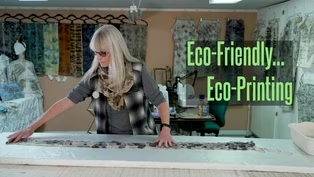
Nan Drye uses steam to imprint plants on natural fibers.
Yeah, she calls it eco printing.
I think you'll agree her heat technique is pretty cool.
Nan Drye creates art by experimentation.
She uses ecologically sustainable methods of printing with plant material and explains the art form.
Eco printing... Eco in this case, stands for ecologically sustainable.
And pulling color out of the leaves themselves.
When you see a leaf shape, that is the color that leaf makes.
There's no ink, there's no paint.
It's a steaming or a boiling process.
And so I'm playing with the chemicals that the plant is producing throughout its growing season.
What you want are the colors in the summer green is what I call it.
Then in the fall, the tree is starting to shut down, and all the last little bit of chlorophyl goes out of the leaves.
And that's when we see those beautiful colors in the fall.
Those leaves are usually still usable as well.
A small portion of Nan's creations cover the walls of her workshop.
That highlights her foray into the eagle print process.
Her interest in the art form through time hasn't waned.
It's only gotten stronger.
It's a form of natural dyeing you're mixing, a mordant, which is, is a metal onto the fabric first.
And then placing the leaves and then rolling the whole thing up under some kind of pressure.
I tend to roll things in a jelly roll, but you can wrap them around rocks and tin cans and all sorts of things.
You want that pressure so that you get a really nice print of the leaf.
And then my method is to steam the roll of fabric over boiling water.
You can boil it as well for different reasons.
I just love the really, beautiful prints you get from steaming and that really good contact between the layers of fabric.
Never steam the stuff inside.
You don't know what fumes are going to come off of it.
This only works on natural fibers.
I personally prefer not any kind of a blend, although theoretically, if it's like cotton and linen, it should work.
I just like it's more of a sure thing if you're using single fibers.
So I work mostly on silk, but it does work on, well, wool, cotton and linen.
that's been the discovery process over the years, waiting for the right time of year for some things.
What leaves you put together in this role actually affect each other as well.
Oak leaves have a lot of tannins in them.
That's going to help make everything else darker.
Experimenting with like, you know, you can't get carried away with metals on fabric because, yeah, rust will make holes in it.
A woman in Australia named India Flint wrote a book called Eco Color.
I ran into it about 2011, and I have not been able to leave it alone since before that I was a clothing maker, and I used synthetic dyes.
But this is so much cooler, and it's just this intriguing blend of science and art.
And I couldn't leave it alone, you know?
Just couldn't leave it alone.
Currently, Nan sells her creations and teaches others the craft that she became enamored with nearly 15 years ago and uses her expertise to create new pieces through trial and error and trial and success.
When asked of her favorite leaves, she uses.
I like them all, but the arrowleaf balsam root makes a beautiful yellow print, even though it's a green leaf.
And then my favorite thing to put with it is spotted knap weed, which is an invasive species.
No one argues with me when I come to get this.
They like to load it into my car and it makes a beautiful orange yellow.
A lot of things that won't really work well on fabric.
They make a beautiful print, but it's going to disappear or it's going to wash out on paper.
It stays.
And so that's a lot of a good way to start experimenting because it's inexpensive.
it's just such a fascinating process.
People don't understand that when you're looking at a green leaf, that all that color is in there.
Right?
Because all we see is the chlorophyl because that's the way our eyes and brain interpret color.
But all those other chemicals are in there.
Nan's last name is Drye with an E. You can find her online at DryeGoods with an e.com.
An octave contains 12 notes.
We know a local singer whose range covers four octaves, 48 notes, comfortably.
Bing Crosby covered two octaves comfortably.
Some say Miles Kennedy is the biggest music star to come out of Spokane since Bing, and he's a multi-instrumentalist.
Miles Kennedy performs on stages around the world, and he's on your screen right now.
The music bug bit me when I was about four after I saw Stevie after I saw Stevie Wonde on Sesame Street Their is superstitious writing on the wall.
That was a really important moment in my life.
Recording artist Myles Kennedy can trace his success to growing up in Spokanes supportive music community I do owe a lot of it to my mother I was probably about ten, and she said, I really would like you to pick an instrument.
And started on the trumpet.
So that was the beginning, During high school, Myles briefly served as a drum major before discovering his true passion for the guitar.
He showcased his musical versatility by playing in a jazz band, a marching band, and even a heavy metal band called bittersweet.
During his junior year.
It's hard to kind of pin me down stylistically because I do enjoy so many different genres.
Bittersweet included Myles friend Zia who continues to play drums in Myles solo endeavors.
After graduating, Myles enrolled in the Commercial Music Jazz Studies program at Spokane Falls Community College.
Inspired by local guitar legend Joe Brasch, with whom Myles had been studying.
and I at one point was in the country combo, I was in the big band combo, I was in the rock comp, I was in another rock combo I was I was like in a fusion combo.
Its just all I wanted to do was play.
And then on top of that, I had bittersweet or whatever I was playing in at night.
my education was just play as much as humanly possible.
it was just a really incredible like minded individuals and teachers who were so important in my musical evolution.
Using the skills he learned at college, Myles joined a jazz group called Cosmic Dust, who released one album.
He then formed a new band called Citizen Swing and began writing his own songs.
But they follow you anyway The group released two albums, with the second one written entirely by Myles.
In 1996, Kennedy formed The Mayfield Four.
The band created a demo to secure gigs, and one song from the demo, Don't Walk Away.
Started gaining attention in the music industry.
Dont walk away before we know it, we had all these labels coming to our shows Labels began competing to sign them.
But ultimately they chose Epic Records after the label's president flew to Seattle to catch one of their shows.
You know, I flew all the way across the country to see your band.
That's how bad I want your band.
I didn't fly to see Pearl Jam or Rage Against the Machine, but I flew out to see your band, and I was like, okay, we're signing with this guy.
However, the band soon faced the harsh realities of the music industry.
By the time Fallout, their first record, was released the key person who had brought them in was no longer at the label, so they didn't receive the support they needed to succeed.
During the band's 15 month tour in support of Fallout, They opened for Creed on a handful of dates, which is how Myles first met lead guitarist Mark Tremonti.
And was it five years later?
You know, I get a call and Hey what's going on?
You know, long time no see.
Would you be interested in doing something?
And, flew to Orlando about a month later and 20 some odd years later, we're still doing it.
In 2009, Myles received a call from Slash, of the legendary Guns n Roses band.
Slash invited him to add vocals to a couple of tracks for his solo album.
This opportunity led to touring with Slash and eventually expanded into a permanent gig.
Slash featuring Myles Kennedy and The Conspirators, has released four albums to date, with another one on the way.
And then the Conspirators and that whole thing happened and it became a team, a band.
15 years later, been a great ride.
Myles embarked on a solo career in 2018, releasing the deeply personal album Year Of The Tiger, In the year of the tiger.
a reference to both the Chinese calendar year of 1974 and the year his father passed away.
Since then, he has released two additional solo albums, all while successfully juggling his many creative projects.
I just enjoy it and we've managed to make it work because we have agents and managers who can who can communicate and carve out windows of time and, there's like this whole ecosystem now between Slash and the Conspirators, Guns n Roses and then Alter Bridge and then both Mark and I have our solo bands now.
Now they've got the Creed thing back together.
It all just kind of works.
you're basically planning two years in advance though, like you always know what's what's happening for at least 12 months, but usually, you know, about two years.
Myles also enjoyed a once in a lifetime moment in 2008, when he had the chance to jam with members of Led Zeppelin.
so I was lucky enough to be brought into the fold for a while.
And it was, yeah, it was, it was, it was amazing.
music In 2014, Myles and his wife Selena wanted to combine her work with childrens mental health, with his love of music.
music was my thing, I love music and like, you all have discovered the power of music and how it makes you feel.
Together with his former music teacher Joe Brasch, They started the Future Song Foundation.
We are very passionate about music education and making sure that young people in particular have access to, whether it's musical instruments or instruction or whatever it is to help you achieve what you'd like to achieve as a young musician.
Over the past decade, the foundation has donated dozens of guitars, keyboards microphones and more.
to area schools.
it's addictive that giving.
t's just been really fun to see what it's turned into.
with the success Kennedy has achieved, he could have settled anywhere, but chose to stay in Spokane.
He loves the area and believes that staying here made all the difference for his career.
A really great place as a creative.
And I knew that if I moved to LA or Manhattan, which I almost did, a number a number of times, came really close.
I knew that that would affect the work.
Overall, Myles Kennedy remains profoundly grateful for his career and isn't slowing down any time soon.
I mean its been an insane run.
so I don't want to be greedy, but because I feel if it all ends tomorrow, I'm good.
It's been a it's been a great run.
I, it's exceeded my expectation.
Myles band Alter Bridge just released its eighth studio album and is currently on tour in Europe.
That's something to croon about.
Learn more at Myleskennedy.com.
Finally tonight, picture this.
A more than 100 year old dining room table.
Years of wear, some damage, even some flood damage.
If your family had owned that table since new, you might consider it priceless.
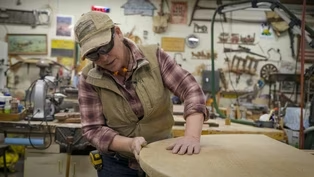
A master furniture restorer like Marzell Van Vlaenderen, can bring this cherished family heirloom back to life.
And I don't believe there's anything that can not be repaired.
Or at least I haven't met anything that couldn't be repaired yet.
[Meet Marzell Van Vlaenderen,] [a master furniture restorer] [who believes every piece carries a story worth saving.]
Most of my clientele, almost every one of them is going to pass something on or got something passed on.
And that's, that's where I come into play and, and just make sure that it's structurally sound and, and looks good.
[For Marzell, restoration isn't about perfection.]
[It's about] [preserving meaning, memories and craftsmanship] [passed from one generation to the next.]
I was raised in the mountains of Montana, and, uh, the timber industry was all around me.
My mom and dad were on the ranch.
They, they made cedar shakes.
And then on the side, my mom would refinish other people's antiques.
They ended up turning it into a business.
My mom got sick in ‘08, and at the end we were just going to close the business.
And at that time my factory was closing.
So, um, it was a great opportunity.
I had the shop.
I, I had most of the equipment.
I was amazed how much knowledge I had.
And I still had my dad.
So, uh, I took it over from my family in ‘08 and went public with it in ‘09.
Uh, and now I love it.
And I, you know, I feel like I'm fairly good at it, so, uh, it's an enjoyable thing.
[When we visited Marzell's shop,] [she was immersed in a deeply personal project.]
[Restoring a century old dining table that once belonged] [to a woman affectionately known as Grandma Mac.]
This was her table, and she had it for many, many, many years, using it every day in the farm.
And my client inherited it in terrible disarray.
It's from the late 1800s.
It's seen a lot of wear and tear, through the years.
And its last 20 years have been stored in a basement that flooded.
Has a lot of issues with rotten wood, veneer popping up everywhere.
We're going to work on this throughout this process.
[Marzell's approach favors strength over surface.]
[Honoring a piece's history] [while ensuring it can be used for decades to come.]
So now that I've got the clamps off of this chair, you can see this gusset that I put in here.
And when I'm done, the only reason you're going to tell the difference is because this is brand new wood, and this is 100 plus aged wood.
And when you mix the two, you will definitely always see it.
Do I care?
No.
This is a family heirloom.
To be able to sit down at this table again is more important to most people than whether or not you can see a repair or not.
[Beyond the shop, Marzell sees her work as a responsibility.]
[Passing on hard earned knowledge so that traditional] [craftsmanship doesn't disappear.]
After 20 years of me and the dog and... my shop, I needed a little bit of social.
So I spend a couple of days a week at Woodcraft.
Using my mind, sharing my information, just... trying to teach people, anybody that wants to learn.
Eventually, I'm not going to be able to do this anymore.
And this craft, I believe, should carry on.
So for that to happen, I have to start opening my mouth and teaching people.
So I feel it's really important to, to keep passing it on and to do it in a way that people can, can enjoy doing it and not... kill themselves expense wise.
I give my business cards out all the time.
If you have a question, if you have a thought, if you just want to talk to someone, call me up, send me a text, send me a picture.
We'll talk about it.
I had to have someone do that with me.
Why can't I pass that on to.
I don't have to charge you to talk to you.
So a lot of times I do a lot of consulting.
Just... Just to help pass it on.
[Even after decades of experience,] [handing a piece back to its owner still comes with nerves.]
There's not been one time that I haven't had a client come pick their stuff up, that I was not nervous.
I am always nervous.
And I don't know what that is.
Confidence?
I, I don't know.
Buut it's, yes, for me, it's nerve wracking.
I have this theory that, again, nothing goes out of my shop unless the client's happy.
And if they're not happy, that means I'm wasting money.
I'm losing money.
So, it's nervous for me in that sense, but more in the sense of “oh crap, youre disappointed.” That disappoints me.
I think it's kind of like an artist selling their stuff.
You just, you don't know if it's... liked or worthy until it sells.
So.
It's a hard one to get past.
I never have figured out how to do it.
[Every piece that leaves the shop] [carries a piece of Marzell with it.]
[Repaired,] [respected,] [and ready for its next chapter.]
Okay.
So, [Oh my Gosh!]
chair.
[Marzell!]
Chair.
[Oh, my!]
[Oh, woah, woah!]
Chair.
[Oh my gosh!]
[Oh, Marzell!]
[Beautiful!]
[Grandma and Grandpa Mac...] [would be so proud.]
[Grandma would be tickled to death.]
That's awesome.
This is why I do it.
This is why my family did it.
For this right here.
And my mom and dad were so more about the people and the story than they were about the furniture.
So, hopefully I'm passing that on, because it's not just a piece of furniture.
It's a part of everybody's history that sits around it.
Marzell is part of the Eastern Washington Makers community.
A community workshop where artisans and woodworkers can collaborate, Rent shop time and take classes with local experts.
Yeah.
They're online.
EWmakers.com.
Well, we're a month into 2026 already.
100 years ago, A.A.
Milne wrote Winnie the Pooh.
Do you have a favorite quote?
Here's mine.
You're braver than you believe.
Stronger than you seem and smarter than you think.
Some old advice for a new year.
Thank you for inviting Public Television in tonight.
I'm Tom MacArthur.
See you next month.
Bye for now.
Video has Closed Captions
Clip: S39 Ep3 | 4m 47s | Nan Drye work with plants and plant dyes on natural fibers to make beautiful, useful things. (4m 47s)
Video has Closed Captions
Clip: S39 Ep3 | 5m 48s | Follow the journey of Daniel Lopez, a Spokane based Muralist who turns hardships into beautiful art. (5m 48s)
Heirloom Revival with Marzell Van Vlaenderen
Video has Closed Captions
Clip: S39 Ep3 | 6m 24s | A flood-damaged 1800s dining table gets new life from master restorer Marzell Van Vlaenderen. (6m 24s)
Hometown Headliner: The Story of Myles Kennedy
Video has Closed Captions
Clip: S39 Ep3 | 7m 34s | Platinum recording artist Myles Kennedy grew up in Spokane with music, mentorship, and community. (7m 34s)
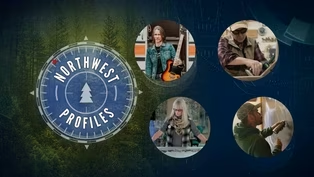
Video has Closed Captions
Preview: S39 Ep3 | 30s | Daniel Lopez Muralist; Myles Kennedy Musician; Artist Uses Plant Fibers; Marzell Furniture Restorer (30s)
Providing Support for PBS.org
Learn Moreabout PBS online sponsorship










Support for PBS provided by:
Northwest Profiles is a local public television program presented by KSPS PBS
Funding for Northwest Profiles is provided by Idaho Central Credit Union, with additional funding from the Friends of KSPS.