
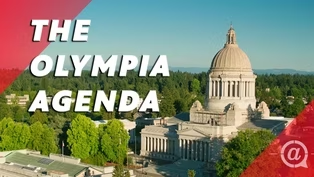
The Olympia Agenda
Episode 3 | 28m 30sVideo has Closed Captions
Spokane legislators give us a preview of issues on their mind going into the 2026 session.
Spokane area legislators Timm Ormsby, Marcus Riccelli, and Suzanne Schmidt discuss the upcoming Washington State legislative session with Doug Nadvornick. The state faces a 2 billion dollar budget deficit so raising taxes or cutting services are part of the debate. So is soaring insurance costs for thousands of residents affected by the impending federal Affordable Care Act (Obamacare) cuts.
Problems playing video? | Closed Captioning Feedback
Problems playing video? | Closed Captioning Feedback
AT ISSUE is a local public television program presented by KSPS PBS
The Olympia Agenda
Episode 3 | 28m 30sVideo has Closed Captions
Spokane area legislators Timm Ormsby, Marcus Riccelli, and Suzanne Schmidt discuss the upcoming Washington State legislative session with Doug Nadvornick. The state faces a 2 billion dollar budget deficit so raising taxes or cutting services are part of the debate. So is soaring insurance costs for thousands of residents affected by the impending federal Affordable Care Act (Obamacare) cuts.
Problems playing video? | Closed Captioning Feedback
How to Watch AT ISSUE
AT ISSUE is available to stream on pbs.org and the free PBS App, available on iPhone, Apple TV, Android TV, Android smartphones, Amazon Fire TV, Amazon Fire Tablet, Roku, Samsung Smart TV, and Vizio.

At Issue: Poison on the West Plains
PFAS chemicals have left Spokane's West Plains residents without safe drinking water.Providing Support for PBS.org
Learn Moreabout PBS online sponsorshipWashington State is facing a significant budget hole.
The projections for the current two year budget cycle range from a billion and a half dollars shortfall to upwards of 4 billion or higher.
And after a contentious session last year to pass a budget with a combination of cuts and new taxes, this year's session will surely result in more tough decisions for Washington lawmakers.
Hello.
Thank you for joining us for this legislative preview on At Issue.
I'm your host, Doug Nadvornick from Spokane Public Radio.
On January 12th, our Washington state legislators will return to Olympia to address the drop in revenue and a growing budget deficit, not to mention other important issues from education and health care to housing and transportation.
So joining me today to talk about the issues are Representative Timm Ormsby, who is a Democrat from the third legislative district, longtime Democrat.
SenatorMarcus Riccelli, also a Democrat from the third legislative district.
District three covers much of the city of Spokane and also with us Representative Suzanne Schmidt, Republican from district four, which covers the Spokane Valley and the northeast part of Spokane County.
Thanks, everybody for joining us.
As we as we speak.
You're going to work in a few days.
And I'm just curious about what is the big issue where we're hearing about budget is the important thing.
And so I'll start with you, Representative Schmidt.
What what would top of your agenda, budget, issues.
Mine are a little bit different than Representative Ormsby.
I'm on, the labor committee.
So, labor workplace standards.
That's where we deal with issues with ESD.
So employment security, paid family medical leave, workers comp, all of those, rates are going up and we have some, some, coming down the pike.
We're looking at some insolvency issues.
So I've been working on that a lot during the interim, working with ESD and with my counterpart, the chair of the committee, Representative Berry, trying to come up with some solutions of how we're going to, we really need to adjust rates.
On the paid family medical leave plan.
And so we need to figure out what's going to work best for both employees and employers.
So that's kind of where I'm looking at the budget.
But the budget is also, you know, a big issue really, no matter what committee you're on.
Because I believe what we'll look at, and we were looking at last session, is every bill that is presented, any policy that's presented to a committee, we're looking at the fiscal note.
And if there's a big fiscal note or even a small fiscal note, those bills are, you know, are having a hard time going forward.
So, budget is really honestly, front, you know, front for, on my mind.
And Representative Ormsby, you're right in the middle of that as chair of the the House Appropriations Committee.
In an off year like this, what is your job?
You wrote a two year budget last year.
What do you do this year?
We have to make adjustments to what has occurred in the meantime.
And, those adjustments, have not favored Washington State.
So, I have been also as representative, Schmidt, been focused on the budget.
As of the taping of this, the governor has not released his budget.
Have a couple of, inklings of what he might be interested in doing.
And I think he's stated publicly that he will be doing a no new revenue budget.
And, that is not how I'm approaching this, because I want to adjust and sustainable budget.
Yes.
But I also want to make sure that we are providing for the expectations of our constituents and the third legislative district by several measures.
Is among the lowest income in the state.
And I want to make sure that the things we do take care of the people that are my friends and neighbors.
So, Senator Riccelli over on the Senate side, do you view budget as the biggest thing that you're looking at this year?
Yeah.
I mean, I think a budget is a reflection of our values as a state and how we prioritize matters.
What I'm hearing from our constituents is go to work.
And I think we can do that in a number of ways.
We have to scrub the budget.
We have to look for ways that we can reduce costs and enhance efficiencies.
I think that we need to maintain our essential services.
And for folks in the third district and from Spokane, when I hear about is health care, housing affordability, food access and education.
And then we have to, put ourselves on a sustainable track.
And I think, what he was talking about was, you know, how do we address what is an upside down regressive tax code?
Whether we can do that in 60 days, it's unsure.
But I think those discussions are important to, to promote long term sustainability.
So let's let's get to the question of taxes.
Senator Shaun Scott, Democrat from Seattle, has proposed a, I guess, a payroll tax.
Companies with more than 50 employees and payroll in excess of $7 million would pay a 5% payroll tax.
Representative Ormsby, are you is this something that you would support?
How do you view?
I'm not familiar with Representative Scott's proposal.
I know a lot of folks have looked at it.
I work closely with the House finance chair, Representative April Berg, from the 44th district in Snohomish County.
And it is a much more higher level discussion.
We're just trying to figure out big chunks.
And, I favor, I favor a high earners income tax is my preference.
So, you know, I think the number that I've heard bandied around and this there is no bill, there is no policy that can be scrubbed and scrutinized at this point.
But if your earnings are over $1 million, the first dollar after a million, there will be, percentage tax on, anything over $1 million.
And we have a lot of wealthy people in this state.
I think this only applies to, you know, a handful of folks in Spokane County, maybe a little more, but it is largely a Western Washington phenomenon.
And, this is where Representative Scott is from, the Capitol Hill area and the 43rd district.
I think it's a reflection of his constituents interests.
Representative Schmidt, I'm guessing you look at this a little bit differently than.
Yeah.
So I'm not I'm not familiar with, Representative Scott's bill, either.
I've perused it, but I'm not.
You know, I haven't looked deep into it.
However, I know that it was fashioned after the head tax for Seattle, and we know that that didn't work in King County.
We had a lot of businesses leaving King County and moving over to Bellevue.
So I don't know that that is, you know, if that's a good way to move forward.
Also, I don't I don't agree with the income tax on the higher income.
I, you know, I, I would love to be able to figure out how we could restructure our tax, our tax structure.
So it isn't so regressive.
But at the same time, we have to keep businesses in the state.
And if we don't have businesses, we aren't going to be able to collect any taxes.
And I think that that's some of what we're seeing with, you know, with the forecast being lower than what we had anticipated.
I know that over the interim, I've spoke with probably 100 businesses that have, you know, some of them have told me that they've already, you know, they're in the process of moving to Idaho or they're certainly thinking about it.
Others have closed.
They just, you know, they really couldn't, you know, survive under the pressure of of all of the taxes that are going into place as far as, you know, the, you know, the workers comp is one, the, unemployment, paid family medical leave, the CARES act, all of those things are, you know, contributing to making it difficult for small businesses to, to perform and to be successful in the state.
So I, you know, I don't have the answer to how, you know, how we look at that.
But I don't believe that income taxes is the right way to go.
I know that we've voted for that in as a state.
Several times, over the last hundred years and every time it's been voted down.
So I don't think that that's a direction that my constituents want to go.
I have been receiving already quite a few emails saying no new taxes, no income tax.
So, that's not the direction that I would like to see the state going.
So, Senator, it's really just following up on that just in terms of messaging to the to the public at a time when the economy is slowing down.
So it's not a very good time to be talking about new taxes or restructuring taxes.
What about the messaging?
I mean, here's the message for me.
The federal government is trying to sweep the legs of working people when it comes to health care access.
If we want think about businesses going out of business, particularly our small business owners, what we're looking at the federal level with H.R.
one, in our community to rip affordable health care from so many small business owners.
What that will do to our communities when we talk about Ritzville Hospital that's on the brink of closure.
Those are the things that I think are going to impact us, and we need to have an honest conversation.
What I really appreciate is Representative Schmitt has brought forward what we haven't heard, for a number of years, but it's been building up and is that is an openness to at least a discussion to know that we are not on a sustainable path.
I think both sides understand that, and I think the people of Washington do.
But I'm really concerned about, all the loss of services and particularly we've banked our future on the health care sector in this community, not just providing those services which are essential, but also the jobs that go along with it.
So in a 60 day session is a realistic to think that you can have a pretty comprehensive discussion about the state's tax structure and come up with some sort of resolution this year.
You know, I was taught really early on the rule of 50, 25 and one.
It's what, 50 House members, 25 senators and a governor think that isn't 50 Democrats or Republicans.
That's just 50 members, in the House, 25 in the Senate and a governor, we can bump the numbers if we're going to override the governor.
But, other than that, that's so I think anything's on the table.
And that's our process to put good public policy interventions out into the marketplace of ideas and have that discussion, how far they go is really what kind of traction?
The people from those districts, people of Washington, get behind these measures and what those individual members do in these discussions.
So I'll go to your colleagues.
What about a 2026 discussion about taxes?
Tim, you've been around long enough to understand that a lot of these things have been talked about for years and years and years.
We can do hard things, Doug.
We can do hard things.
We've demonstrated that time and again this past session, very difficult.
The 2025 session, we just showed up every day and we did the next thing.
And if you just keep doing the next thing, pretty pretty soon, or eventually, there are no more next things to do.
And with that attitude lacing up our boots, section of uptight and getting out there and and putting on our tools and doing the work, we know how to do that.
And the the best thing we can or the worst thing we can do is be complacent and think that it's going to figure itself out.
This is going to involve, digging in deep and getting our hands dirty.
So, Representative Schmidt, you can talk about having that discussion in 60 days, and it sounds like both sides are interested in talking about it, but are they going down in the same direction that you feel like you can come to some resolution in 60 days?
I think that there are some where there's some shared direction there.
Yes, I do, and I think that we you know, we've talked about looking at, you know, looking at the budget and what we're spending money on and, and some of those cuts and working together on those cuts.
I know that my caucus is not in favor of raising taxes.
They're looking you know, they're looking more towards cuts.
But I think that in the end, what we will do is what's best for the state of Washington.
And I will, you know, when I go to Olympia, I will be representing the fourth legislative district, and that will be my you know, that will be the voice that that I make heard there.
But I think, you know, we have, you know, 49 different districts in the, in the state of Washington.
And when we come together, to do what's best, really, for our state.
And I don't doubt that anyone in the, in the House or the Senate, don't love our state and don't care about it and want it to be successful.
So I agree with representative Hornsby.
We're going to have to do some really hard things and it's going to hurt.
But we also need to remember what our goal is.
And our goal is, is to make sure that the people in the state of Washington are successful, that they're happy, healthy and happy and have opportunity.
So last year, the legislature approved an extension of the sales tax to certain services.
And maybe I'll ask you, Representative Ormsby, to explain a little bit more about what that was all about.
What what is now taxed that wasn't taxed before.
So just a little background.
We have traditionally come from a production economy, right.
Where we manufactured people purchase those manufactured products.
There was a sales tax associated.
We have really shifted, enormously towards a service oriented economy and many of the things and I'm no believe me, I'm no expert.
Doug, to unpack the tax package here, but a lot of, digital advertising and other things where, commerce was exchanged and it had previously not been taxed.
And given that we're going down this road of a service economy, those services now are our products.
And if we're not getting sales tax revenue generated, to the point where we have traditionally, seen from, manufactured goods, durable goods, we've got a, modernize the tax code.
That was part of what the move was.
And apparently there has been, confusion as some of the business community saying, we're not sure what's taxed, what's not, talk about a little bit about how you would fix what was passed last year to make it more, if not more palatable, or at least more understandable.
And anybody can jump in on this one.
I mean, I definitely I actually had a meeting with, Department of Revenue today, and they're definitely, bringing forward bills, a bill, that is looking to kind of clarify and streamline a number of things from a technical aspect.
I think first and foremost, that's what we can do to help clean things up a little bit is provide clarity.
Whether or not you agree with some of these taxes or not that were brought forward, a lot of the businesses I speak with, first and foremost, they just want it to be clear and straightforward, and across the board and, implemented it whether you're in Spokane or whether you're in Republic or whether you're in Kent.
So, so I think that that's something that is being brought forward.
But I think along with that, there will be a number of, proposals brought forward, to look and I know, both, finance chair in the House and, our team in the Senate, they're looking at different things and how they're impacting individuals and how they might be modified, streamlined, to be more successful.
So, Representative Schmidt, in your in your introductory remarks, you were talking about changing some taxes, I believe.
Is this sort of along the line of what you're thinking about?
Yeah.
This is one of the things that was brought to my attention really early on.
And it was really it was brought to my attention by ESD 101.
So that's the Education Service, district, in our district, the Eastern Washington.
And that was something that they were really concerned about is as being a sales tax on providing, training and, you know, in online classes and things like that.
So I did go also to the Department of Revenue, and at that time it was so early on they weren't really sure either.
And they were basically very, I thought very honest, very forthcoming with me in saying that is we're not exactly sure we're going to have to make calls as big as, you know, as we see things come through.
But I'm really happy to hear that they are that they have came up with legislation to make it more clear, because that's what I'm hearing as well, is that folks just really want to understand what exactly is tax and what is not.
But I think that some of those taxes that we put in place that are going to hurt, like school districts, things like that, I believe that there's plans to you know, backtrack that and, you know, work on what is more, you know, more equitable for the schools.
And we don't want to hurt, you know, our public school system and other other entities in our state, you know, by putting this tax in place.
And I want to give a little slack to the Department of Revenue.
Just like at the federal level, we've been waiting on guidance on any number of things.
And I know that Dr., is hard at work at getting resolution on those and has, as Representative Schmidt said, been very forthcoming about this is the this was not anticipated.
This is something that we did not expect to see.
So, we're going to be getting more guidance from Department of Revenue.
I like to also say, you know, we don't get it 100% right.
The whole process is to improve and perfect.
Congress has not decided yet whether to extend the Obamacare tax cuts in terms of people who want to buy from the state exchange.
If that doesn't happen, what kind of effect is that going to have in the legislative in your debate with a lot of people deciding we can't afford to buy on the state exchange anymore, what's the effect of that?
I'll start with you, representative.
Honestly, I I'm I'm not sure what I mean.
I know that the effect will be devastating.
It will be really difficult.
I know I saw numbers today, you know, families in eastern Washington that are paying $500 a month or, you know, would be paying $2,800 a month if we lose those, you know, those subsidies for the for the, health exchange.
So, you know, I think that this is a huge conversation that needs to happen.
I think that there are some problems with the Affordable Health Care Act, but I really hope that Congress, is able to work out some of those issues and, do that before.
What do we have until the end of January?
Because it is it's a burden on our state that we can't afford right now.
We just we just can't afford it.
Would you would you support an extension of those tax cuts a year or 2 or 3?
I would actually I would, support an extension to the point, you know, with, I would say with a, with the caveat that we will be working on ways to correct.
But I don't feel like ripping the bandage off is the best way to go when we're talking about people's lives and their health.
That's, you know, there's some things that it is, you know, that we just need to rip the bandage off and just go forward.
But there are other things where when we're talking about health and like what Senator, Riccelli said in the beginning is watch or not Washington, but Spokane and Washington, but Spokane in particular.
That's a big part of our economy.
You know, the health care system is a huge part of our economy.
And so, you know, we don't want to devastate that.
We have thousands of people that are employed with our hospitals and our medical schools.
And so it's it's it's an issue that I think we, you know, that we need to work on and we need to talk about it needs to be bipartisan.
And yes, I think we need that runway.
How much of that is driven?
And, Senator Riccelli you've been part of the health care committee for a long time.
How much of that is driven at the federal level, and how much can you do at the state level in terms of changing the health care system to make it more affordable and more predictable?
It's a great question.
We actually are leverage significantly as Washington state, because we went after every matching dollar possible.
We could and we were successful at that.
But now, with what's moving at the federal level, it puts our budget at real risk, billions of dollars that we cannot come up with.
So we're looking to be unique and creative, where we can also look, just because maybe we don't like things going on at the federal level.
We're not turning a blind eye to opportunities.
So we went forward going after rural transformation grants and things like that.
But those are not going to fill in the hole.
And this really goes counter to our whole idea of going upstream.
And so now people aren't going to have health care access.
They're not going to go in and get the primary care in the need it.
They're going to end up in the emergency room and our already unsustainable trajectory of health care costs is going to rise even more.
And honestly, more people are going to get sick and perish.
There's going to be a lot of people that will lose their lives unwittingly, because we're not able to get them the care they needed and go upstream.
So I do I do want to say it has been heartening to see at the federal level, some of the, bipartisanship trying to move forward on the health subsidies.
And then at the state level, a number of my Republican colleagues signed the letter to federal elected saying, hey, you know, let's make a move on this.
And that's that's I think the understanding broadly that this is important to Washingtonians.
So if hundreds of thousands of Washingtonians lose their do you anticipate the legislature being able to put some money toward that, or are you in a year right now where you just say, we just can't afford to help out with that?
It would be very speculative about what would make a difference, what investments could be made that are going to provide that shoring up, for health care access and, and good outcomes for patients?
The dust is not settled at the federal level.
I mean, we know about the subsidies, but we don't know about the follow on effect of what's going to happen for physician visits.
And other access points, for individuals, the state will have a very limited, opportunity to, backfill, as they say, or to fill in the gaps on some of those, because, as Senator Kelly said, we have really counted on our partnership with the federal government.
And they seem to be less and less willing to be partners with states.
Okay.
I want to get to one other issue.
In the last few minutes, and that pertains to Spokane in the waste energy plant in terms of, what that could mean for, future rates here in Spokane, I'll have one of you explain this to me because it's it's somewhat complicated, but anybody want to jump in because this went before the legislature in 2025, didn't get passed.
How do you explain to to to your your voters?
I'll give it a shot.
Mark says a little more.
Senator Vitale has a little more time on this, but the waste to energy plant is designated as, a site that would have to purchase, variances, which are the cap and trade of variances that are auctioned.
So it's a market based system.
Spokane, unlike landfills, landfills are exempt, regardless of how much emissions they have.
The waste to energy plant not being a landfill technically is going to be subjected to having to purchase those allowances.
The I so that's kind of the background.
And if that spurs other questions and that would trickle down then to ratepayers, ratepayers in Spokane County paying a little extra because of that.
I think to the tune of I think I, understood the estimate to be about $8 million annually to ratepayers and City of Spokane.
And the idea is, yes, we will.
We'll get 97% forgiven over a period of time, then 94 to like 2030.
And so we're just ease into so technology and innovation can catch up to catch, the culprits at the stack, that Department of Ecology and, Climate Commitment Act, intended to address.
So the policy sounds good in order to try to to try to keep greenhouse gases out, but for the ratepayers is not so good here in Spokane.
How does how do the two sides -are Republicans united with the Democrats from Spokane on this?
So I can't speak for, you can speak I can speak for myself.
And I would say, yes, I am united on this.
This is something, again, that I feel like we need to do for our community.
And, we don't want to impose these rates.
And we're talking about, you know, raising more taxes.
And where are we going to get those taxes?
But at the same time, I don't want to burden our, constituents or the people in Spokane County with more, utility costs because of that.
So I am supportive of it.
I think that, you know, yes, the I, you know, the clean, Clean Energy Act, I think, you know, we're moving forward.
But I also think that there's a lot of different opportunities where we could I don't necessarily want to put on the brakes, but stair step it in.
I think that we may have been, maybe too, you know, too aggressive in the beginning and, and, need to just stair step some things in.
so in our last couple of minutes, Senator Kelly, you are a co-sponsor of a bill regarding Kevin Coe and the desire not to allow folks like Kevin Coe to be released from state custody.
Why are you supporting this?
Yeah, I mean, I think it was a traumatic, situation for our community.
I think, violent sexual predators, if they show no remorse and they have not gone through treatment, that that should be, something that's been considered when they're, could potentially be released to the community.
I think that this probably would not come up many instances, but, the victims of this community don't deserve to be retraumatized.
And I think it's just another standard with all the things considered that should be brought in.
And again, that is that if someone is a violently sexual predator, that they should show remorse and they should engage in treatment, willingly.
The prime sponsor is Mark Schoesler, a Republican from Ritzville.
In a short session like this, does a does a bill like this that's not related to the budget or something like that?
Is this does this ever see the light of day?
I mean, is this is this an important enough bill to get the legislature's attention this year?
I think it has folks attention.
I've had conversations.
You know, that's up to us as legislators.
That's just up to us as a region to show that there's a prioritization.
And, and, we'll see.
There's a lot of different things in the mix.
But it certainly has our community's attention.
I've had people who I who aren't very politically engaged come up and they're referencing this bill.
So it's one of those things that strikes a chord in our community.
And again, has a lot of history.
So I think it will be brought up for discussion.
And now we have to, you know, work to get a hearing and, and see if we can move it forward in the process.
Again, a bipartisan bill we're talking about.
All right.
Yeah.
Senator Marcus Riccelli, a third legislative district.
Thank you for coming in.
Thanks.
Representative Timm Ormsby, also from the third district.
Thank you for coming in.
Suzanne Schmidt, representative from the fourth district.
Thank you for being part of the conversation today.
And, good luck.
You've got a full 60 days.
The 60 days?
Is that 60 contiguous days or is it 60 business days?
60 contiguous days?
So, it begins on, 12th, the 12th of January.
And I have not ticked off the dates, but it will end sometime in mid-March.
All right.
Very good to stay informed about on the issues we talked about today and other legislative issues.
You can watch The Impact and insight Olympia from our friends on TV Sunday mornings on KSPS PBS, and Saturday mornings at 5 a.m.
on Spokane Public Radio for you early birds.
Were continuing the conversation at the At Issue podcast.
Dropping tomorrow.
A conversation with the city of Spokane and Spokane County to learn more about the priorities they're advocating for this year, you can watch for news updates on the After the Show blog.
And as always, you can watch previous episodes of At Issue with host Dana Haynes any time online from all of us here at KSPS PBS and Spokane Public Radio.
Thank you for joining us for the Olympia Agenda.
I'm Doug Nadvornick.
AT ISSUE: The Olympia Agenda | Preview
Video has Closed Captions
Preview: Ep3 | 30s | Spokane legislators give us a preview of issues on their mind going into the 2026 session. (30s)
Providing Support for PBS.org
Learn Moreabout PBS online sponsorship
- News and Public Affairs

Top journalists deliver compelling original analysis of the hour's headlines.

- News and Public Affairs

FRONTLINE is investigative journalism that questions, explains and changes our world.












Support for PBS provided by:
AT ISSUE is a local public television program presented by KSPS PBS