
Scientific Clues
10/29/2026 | 26m 46sVideo has Closed Captions
Tracking fish, Hurricane Erin’s impact, seagrass meadow loss and an NC museum’s bug collection.
Scientists tag, release and track fish to their spawning grounds, Hurricane Erin’s impact on the NC coast and UNC Research investigates why seagrass meadows in North Carolina’s coastal waters are shrinking. Plus, Adrian Smith of the NC Museum of Natural Sciences shows where the museum stores its vast collection of insects and bugs, some since the 1800s.
Problems playing video? | Closed Captioning Feedback
Problems playing video? | Closed Captioning Feedback
SCI NC is a local public television program presented by PBS NC
Sci NC is supported by a generous bequest gift from Dan Carrigan and the Gaia Earth-Balance Endowment through the Gaston Community Foundation.
Scientific Clues
10/29/2026 | 26m 46sVideo has Closed Captions
Scientists tag, release and track fish to their spawning grounds, Hurricane Erin’s impact on the NC coast and UNC Research investigates why seagrass meadows in North Carolina’s coastal waters are shrinking. Plus, Adrian Smith of the NC Museum of Natural Sciences shows where the museum stores its vast collection of insects and bugs, some since the 1800s.
Problems playing video? | Closed Captioning Feedback
Where to Watch SCI NC
SCI NC is available to stream on pbs.org and the PBS app.
Related to This Episode
Providing Support for PBS.org
Learn Moreabout PBS online sponsorship- Coming up on Sci NC, the surgery helping fish find their way home, how hurricanes can batter our coast without ever making landfall, and the hidden meadows vanishing beneath our coast, next.
- Quality public television is made possible through the financial contributions of viewers like you, who invite you to join them in supporting PBS NC.
- Sci NC is supported by a generous bequest gift from Dan Carrigan and the Gaia Earth Balance Endowment through the Gaston Community Foundation.
(gentle music) ♪ - Hi, and welcome to Sci NC.
I'm Laura Smith.
We're glad you're here.
Hey, something fishy is going on along the North Carolina coast.
In the best way, though.
For centuries, the Atlantic sturgeon, striped bass, and American shad have swum the Cape Fear River to spawn until three dams got in the way.
Now scientists are slipping tiny tracking tags inside the fish through surgery in hopes of guiding them home.
Here's Sci NC's producer, Evan Howell.
(water splashing) - [Evan] Meet the Atlantic sturgeon, a living fossil that's been swimming the Cape Fear for millennia.
But after 200 million years, the last hundred have turned into the biggest fight this fish and his neighbors have ever had.
- The problem is there are impediments to migratory fish passage.
And these fish are trying to reach their natal spawning grounds upriver.
- [Evan] The fish are called anadromous, born in the river and grown in the ocean, now back to spawn where they started.
And these impediments are dams running up the river toward Fayetteville.
This is the first, built in 1915.
And every migrating fish in this river, sturgeon, American shad, striped bass, has had to get past them.
And engineers have tried a few things.
- There have been fish ladders that have been tried that are similar to what you'd see out in the northwest for salmon.
And they just, they didn't particularly work here.
They don't have the leaping ability that salmon do.
- [Evan] So in 2012, they built the Rock Arch Rapids, staggered stones mimicking the natural rapids these fish would have found here a century ago.
And for American shad, it worked.
Seventy percent made it over.
But for striped bass, just 26 percent.
Not what the engineers were hoping for.
Catching, counting, tracking.
This flotilla of scientists is working to bring these fish back.
But first, they have to know where the fish go and what they do.
So there's a system.
- Don't put your hands in the water.
- [Evan] It's called electrofishing.
Electric field at the front of the boat strong enough to stun a fish for a few minutes.
Not strong enough to hurt it though.
- Oh, there's a big one.
- [Evan] The Wildlife Commission has been at this for about 25 years.
- That's an American shad.
It's going right into the live well.
American shad right there.
That's a striped bass.
Great.
- So it's important to track the That's a striped bass.
Great.
- So it's important to track the abundance and the health of the population of these migratory fish, especially in light of all the impediments that they have here on the Cape Fear, to those fish getting to their historical spawning grounds, which would be upstream of the Fayetteville area.
- [Evan] After the electrofishing, we headed downriver to meet the team that takes these fish next, which means a visit to some surgeons.
- I'm going to try not to run into y'all.
- What are we doing here?
- We're about to tag some striped bass with acoustic transmitters.
So we have a little receiver array set up with listening stations.
So when we put like one of these little tags, we put it into their abdomen.
- [Evan] The transmitters work like a lojack for fish.
Every time the fish passes a listening station along the river, a signal gets sent.
- So we can know where that fish was, what time of day, exactly where it was located, and then we can track their movements throughout the whole river system.
- There we go.
And you can see that's a striped bass.
- [Evan] A little water mixed with clove oil, natural anesthesia, helping the fish nap through the surgery.
- And then the total length is 6-0-1.
So once I have a little section, then I just really slowly use the scalpel.
So then I just put the tag into this small incision here.
- [Evan] The sutures will dissolve over time, but that transmitter is expected to last about two and a half years.
- I'm trying to look at ways to restore their migratory routes.
Right now the dams aren't being helpful at all, so we're looking at multiple different ways.
It's already biting me.
- Yeah.
- [Evan] The fish returns to the well to recover for a minute.
Then it's time to say goodbye.
- I lost him.
He left.
- [Evan] But there's another part of this story, and it starts about 120 miles upstream.
And this year, the dams aren't the only problem.
The river itself is running low.
This is Jordan Dam, near the top of the Cape Fear Basin.
- We have a nationwide joint program called the Sustainable Rivers Program, where the Nature Conservancy and the Army Corps decided to try and work together at Army Corps Infrastructure to think about environmental flows.
- [Evan] Environmental flows, or pulses.
Extra water can be sent downstream to help fish swim over the dams 100 miles away.
In a pulse, the dam is opened, releasing a few inches of water.
But by the time it reaches Lock and Dam number one, for example, the river can swell to about five feet.
But first, Mother Nature has to cooperate.
- Our goal is to do these pulses whenever we have the enabling conditions.
And what that takes is one to two inches of rain in the upper basin.
If we are in a drought, we do them only if we have the water.
- This is the tail race.
- Tail race.
- [Evan] Demistra's counterpart at the Army Corps is Ashley Hatchell, a hydraulic engineer in Wilmington.
She's the one who makes the call on when to do a pulse.
But the dam has a lot of jobs to do, and helping fish is only one of them.
- If nature doesn't give us quite enough, then we're making decisions to give more releases on top of nature's flows.
We don't own it.
We can't just make any release that we want to support the fish.
- [Evan] Which is why the tags matter.
Every time a pulse gets released, the listening stations downriver tell scientists which fish made it and which didn't.
- On my right-hand side, the river you see coming in is the Haw River.
The other arm you can see from here is actually the New Hope River.
- [Evan] When Hatchell does make that call, Dana Maddox is the one who pulls the lever.
- There we go.
- Okay.
- [Evan] But with 26 years in this dam, the weight of it hasn't gotten any lighter.
- I had a manager in my young days tell me that when you go to the tower to make a gate change to increase releases or do anything, if you don't have some butterflies in your stomach, you need to take a minute and stop and think.
- [Evan] Today, there's no call to make, no release coming, just a baseline flow.
As of April 2026, North Carolina has 61 counties now in extreme drought, groundwater near record lows and rainfall 10 inches short of where it should be.
- Our current release this morning is about 330 cubic feet per second.
Now a cubic foot is about a basketball's worth of water, is the best way to talk about it, or about 7.5 gallons.
So if you do the math, you can figure out how many gallons that is per second.
It is a fairly low release for us because we are in a drought currently.
- [Evan] This dam changed the whole system.
Before I was here, a few species traveled every mile up this river to spawn.
And one of them swam right up to where we're standing.
- Or the most resilient group of fish in the world, I would consider the sturgeons.
- [Evan] Way down back on the water, the sturgeon team is led by Fred Scharf.
They've been laying nets for hours, pulling them up one at a time.
It wasn't until the fifth and final net that they finally got what they came for.
- We got one.
- Nice.
Oh, look at that.
Oh my gosh.
Beautiful.
- [Evan] This one's already tagged, showing up in April at the same dam.
The sturgeon would normally get tagged with an acoustic transmitter like this.
So far, around 81 have received them since 2010.
There's evidence the Cape Fear isn't just a river of these fish randomly pass through.
It's a river they choose, which raises a larger question for every river on the East Coast.
- So what we're not sure about is just how important, on a relative basis, one river is to another.
- [Evan] Scientists are still working out the answer, but when they look at the Cape Fear, they see something they don't see anywhere else.
- They think that up north they maybe have a little bit of a longer lifespan and get a little bit larger because of the cold water.
But down here, we think that they have a bit of a faster life cycle, so maybe 30 years or so.
- Really?
[splashes] - And so we think that this river, because historically it's supported such a really important commercial fishery for many, many years, we think that this river holds a greater level of importance maybe than even some of the other coastal systems.
- [Evan] Scientists working the Cape Fear this April keep counting, tagging, releasing.
Waiting on rain, waiting on fish, on a river their grandfathers knew differently.
- I grew up fishing, which was part of it, but the traditions of my family, like my grandfather, my great-great-grandfather on the Chowan River, they were anglers, they were commercial fishers, boat builders, farmers.
They didn't understand, they didn't have the data that we do now to understand that fish populations just can't withstand a certain amount of pressure.
- Let's go ahead and stay at the coast, where the water isn't always so friendly.
Hurricanes don't have to make landfall to cause damage.
Just look at 2025's Hurricane Erin.
The massive storm stayed offshore, but its sprawling 600-mile-wide wind field still left its mark.
Here's Sci NC's Evan Howell.
- [Evan] Hurricane Erin was the first major hurricane of the 2025 Atlantic season.
It even briefly became a Category 5 storm.
Fortunately, it didn't make landfall, but North Carolina still felt its effects up and down the coast in the form of storm surge that took out not just homes, but made roads like Highway 12 impassable.
What happened?
To find out, we talked with Dr.
Jana Haddad, who's a coastal resilience specialist and an expert on wind and waves.
- So Hurricane Erin, it was miles out, but we felt it here.
Can you talk about that a little bit?
- Sure.
That's right.
Hurricane Erin never made landfall, but a hurricane doesn't have to make a direct hit for us to really feel its effects.
And that was the case with Hurricane Erin because it was a really big storm.
It had a really, really big wind field.
- [Evan] The wind field of a hurricane is the distance winds are felt from the eye.
Some wind fields are relatively small, like 15 miles in the case of Hurricane Charlie, which hit southern Florida in 2004.
Hurricane Erin's eye traveled 200 miles off the North Carolina coast, but its wind field was between 600 and 650 miles wide.
And only in size to Hurricane Sandy, which hit New Jersey hard in 2012.
- Hurricanes are essentially pushing water toward our coastline.
So that causes a storm surge.
For Erin, more importantly, was how much wave energy it drove toward our coastlines.
And that's also wind driven.
So the wind from the large wind field of Erin pushed a lot of wind over the surface of the ocean, driving big swells, large waves that were created where the storm was, but propagated on shore.
- [Evan] The North Carolina Outer Banks, those low-lying and narrow barrier islands, took much of the brunt from Erin.
Even though the storm was far offshore, houses were lost, dunes were flattened, and Highway 12, the only artery that links the island, was washed over.
- Those homes were not built on a beach face.
They were built probably next to a roadway.
They were built at a time when the beach was still far out, but has since eroded.
And so Hurricane Erin is again another reminder of the kind of precarity that they are in.
- [Evan] Haddad says beach nourishment and parts of the coast are helpful, but it will take a long-term effort to ensure those precarious parts of the North Carolina coast remain stable and able to withstand the constant changes.
- We simply can't allow the dune and beach system to naturally move the way that it would.
We need to protect those folks.
And so as a result, we need to make sure that our dune and beach system is as robust as it can possibly be, or, you know, enact other coastal resilience strategies on top of that.
- Making our coasts stronger, that's for sure.
Just like Erin battered the coast, we can see, but beneath the surface, there's another part of it slipping away.
Just offshore lies the entire meadows most of us have never seen, and they're shrinking.
Seagrass shelters the life that keeps our whole coast healthy.
So UNC shows us what it takes for it to survive right down to a single seed.
- Eelgrass, if you can imagine, just grass outside your house.
Just like that, but underwater.
It's a nursery habitat.
When the organisms are young, they need somewhere to be protected from predators.
So they spend a lot of their younger years in the seagrass.
- Eelgrass is really important for our coastal ecosystems.
The meadow forms that structure, that habitat that everything else relies upon.
They need seeds to be able to replenish and grow.
There's a multitude of them released, but only a fraction of them actually become new individuals.
My name is Heather Brooke.
I'm a PhD student at UNC's Institute of Marine Sciences.
When stingrays go for buried prey, they'll make these massive feeding pits, and it's a huge indentation in the sand.
We don't really know what happens to seeds that were once in that sediment.
So that's what my project is trying to uncover.
Last summer, I found that there is much, much fewer seeds within that pit than undisturbed sediment.
I'm trying to find a reason for that difference.
I believe that it's because the stingrays make almost a suctioning motion when they're creating a feeding pit.
When they're doing such an intense, disturbing mechanism, seeds are inadvertently becoming consumed and entering their body.
So I'm putting a stingray in a tank.
I'll have seeds mixed in with the sediment.
I will find food that the stingrays go after and create a feeding pit.
And then I'll count the number of seeds after that event has happened.
So let's say there's 100 seeds when it starts, but only 50 after this feeding pit is created.
To me, that's a sign that there is nowhere else for the seeds to have gone except inside the stingray.
I'm also going to keep the stingrays for a couple of days to see if the seeds are still intact when they pass through the stingray.
I don't want to just leave it at, are the stingrays consuming the seeds?
I also want to see, are they somehow helping with the dispersal process?
- Heather and I are both trying to understand what's happening to the seeds.
So I'm kind of looking at the landscape level.
Maybe there's less seeds in this location compared to this location.
I'm Nadya Gutierrez.
I'm a PhD student at the UNC Institute of Marine Sciences.
I study seagrass fragmentation.
Seagrass used to be fairly continuous in this region, and now we're seeing an increase in patchy seagrass meadows.
My project is looking at seed bank dynamics.
Essentially the seed bank is just seeds in the sediment.
When you go from a continuous meadow to a patchier meadow, you've got increased amount of edges because each patch now has an edge.
And it could be that these edges aren't producing quite as many seeds.
Maybe they want to fill in the gaps between the seagrass patches.
So we could be seeing a lower overall production of seagrass seeds, and that could make it harder for the seagrass to come back the following season.
I've got about 250 plots out, and at each plot I've taken these big vegetative cores.
I'm looking to see the number of reproductive shoots, the number of different species of seagrass that could be competing, and maybe that's changing the seed production.
I'm also looking at below-ground biomass.
So maybe if they're trying to spread out, they're going to allocate more energy to that than making seeds.
This research will benefit anybody who appreciates or relies on healthy seagrass meadows through understanding what the causes of seed loss may be.
If we lose our seagrass, we could lose our shrimp or our blue crabs or fish that we like to eat.
It's really important to understand how these systems are changing so that we can better prepare our fisheries industry, fisheries management, and coastal zone management.
- Some beautiful views in that story.
I'm ready to get to the coast now.
Hey, when you visit a museum, you see what's on display, but the real treasure is often the part you don't see.
Behind the scenes at the North Carolina Museum of Natural Sciences is a library like no other, rooms of preserved specimens, each one with a story to tell.
Here's Adrian Smith.
- So my lab is part of a museum, and I think the coolest part of this museum, the real core of what natural history museums are, are their collections.
But most of those are off exhibit, so it can be hard to see and appreciate what they are and why they're important.
So in this video, I want to show you them.
I want to bring you down to the collections to meet some of our collections-based scientists and hear straight from them what collections are and why they're valuable cultural assets.
Okay, first, let's start with ichthyology.
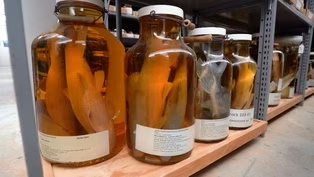
- So I am Gabriela Hogue, and I'm the collections manager of fishes here at the Museum of Natural Sciences.
And you are now in the fish collection.
In this wonderful room, we have over a million specimens, closer to one and a half million specimens.
All of these specimens are kept in 70% ethanol.
They're first preserved in a 10% formalin solution, and then we transfer them to 70% ethanol.
And that maintains them for the long haul.
In and of themselves, each of these fish specimens are beautiful.
They're all unique.
They all have these incredible features to them.
But then when you add all of the data that accompanies them, where they were collected, how they were collected, who collected them, what the environmental factors were when they were collected, all of that is such a huge amount of metadata that's attached to every specimen.
So we make all of that globally accessible because we know that each of these specimens has a story to tell.
I can't tell that story.
I can tell the story about some of them, but not all of them.
But if we put the data out there, we know that globally and collaboratively, we can all tell the story about these specimens.
- So our really big stuff doesn't fit in a jar.
It has to go in these big stainless steel tanks.
I'm Dr.
Lily Hughes.
I am the curator of ichthyology here at the North Carolina Museum of Natural Sciences, which means I study fish.
This is a tank of the Carolina red horse.
This is a big, mighty female.
These are in a group called red horses and suckers because they have these lips at the bottom of their mouth that they use to suck on the bottom.
And you can actually tell most of the species apart by the different shapes on their lips, the different kind of structures they have on their lips.
So this one is very special because this is going to be the holotype of the species.
And that means it sort of bears a scientific name.
All other specimens are sort of compared to it to see if they are most similar to the characteristics of a Carolina red horse.
So when we are describing new species, we're not looking just in depth at that particular species or specimen.
We're also looking at lots and lots and lots of different kinds of species that co-occur with it, maybe seem similar in some characteristics.
So museums are really important sort of repositories of all of these different kinds of specimens that we can use to make these comparisons.
So a lot of the ways that we conserve species are tied to the idea of a species and formal scientific recognition.
So when this species gets a name, it will probably be eligible for more conservation protection.
- Next up is paleontology.
Now this collection is interesting because it's not based on a single group of organisms.
Instead, it's any kind of fossilized life.
- I'm Sean Moran.
I'm the collections manager of paleontology here at the North Carolina Museum of Natural Sciences.
I think the reason I like my job so much is it spans the gamut.
So I get out, I do fieldwork, I do research, and I get to see every single specimen that comes into this collection and record all of the data associated with those specimens in our database.
Yeah, so our paleo collections are scaled differently than a lot of collections.
So in terms of taxonomy, we have everything from plants all the way up to dinosaurs and whales.
In terms of size, we have microfossils that are barely visible to the naked eye, all the way up to complete dinosaur skeletons.
So it's a really fun collection because the breadth is really wide, both in terms of scale and size and what animals and plants we're looking at in the fossil record.
My research interests primarily lie in these 34 million year old mammals.
Let's see, here's an example of a rhino that we collected this past summer.
These are mammals that are living during one of the greatest shifts in climate of the past 66 million years since the extinction of the dinosaurs.
One of the things I'm trying to look at is how these mammals are adapting to this climate event in terms of changing their body size, changing the shape and morphology of their teeth or ankle bones, changing diets.
So our paleo collections are important so that we can look across these really large timescales in deep time and figuring out how species are evolving, going extinct, adapting to change across their landscapes and tying that back to today's life.
What can we glean from these fossil collections in the past that can inform us about the future of us, of our ecosystem, of our environment?
- Finally, let's go down to mammals and meet Lisa Gatens.
She's a researcher who took me out in the field while she was catching and tagging bats so I could catch and film their bat fly ectoparasites.
- I've been working with this collection for almost 26 years.
In this row of cases, we have a lot of rodents and well, rabbits here, rodents start down here, rodents go all the way down until we pick up carnivores.
We have our bat cases.
Natural history specimens represent the species occurrence from a place in time.
And as our collection shows, some of them are quite old, 100 years or so.
So we can look at the specimens from different time points and look at changes in species composition in a particular place over time.
And so this is part of the value of natural history collections.
So our collection is not just skins.
We keep skulls and other skeletal components as well as tissues.
And I'm developing a key using skull characters to identify bats to species within this genus.
There's currently not a way to identify bats based on skull characters.
And this is more important now because the vast majority of bats that have been killed by white-nose syndrome are bats in this genus.
This is going to help us identify the actual impact of this disease on these species of bats.
Why is it important for us to exist and to maintain research collections like this?
Because we don't know what kinds of questions we might have about changes and distribution or ecology over time.
And the information is in these specimens.
We can take a few hair samples and look at isotopes or look for contaminants, toxins over time, for instance.
And because they are permanent and because they're properly cared for and housed, the information that's here, inherent in each of these individual specimens, is still going to be available after hundreds of years.
- Okay, so I hope you enjoyed that behind-the-scenes tour of some of our collections.
And I hope after this, it's a little bit easier to understand why museums like this are important and why the collections are so valuable.
Thanks for watching.
- We enjoyed it, Adrian.
Thanks so much.
And that's it for Sci NC this week.
If you want more Sci NC be sure to follow us online.
I'm Laura Smith.
Thanks for watching.
Have a good one.
(gentle music) ♪ ♪ - Sci NC is supported by a generous bequest gift from Dan Carrigan and the Gaia Earth Balance Endowment through the Gaston Community Foundation.
- Quality public television is made possible through the financial contributions of viewers like you, who invite you to join them in supporting PBS NC.
Video has Closed Captions
Tracking fish, Hurricane Erin’s impact, seagrass meadow loss and an NC museum’s bug collection. (20s)
Providing Support for PBS.org
Learn Moreabout PBS online sponsorship New Episode
- Science and Nature

Explore scientific discoveries on television's most acclaimed science documentary series.
 New Episode
- Science and Nature

Capturing the splendor of the natural world, from the African plains to the Antarctic ice.




 New Episode


Support for PBS provided by:
SCI NC is a local public television program presented by PBS NC
Sci NC is supported by a generous bequest gift from Dan Carrigan and the Gaia Earth-Balance Endowment through the Gaston Community Foundation.