Washington Grown
River & Vine
Season 13 Episode 1305 | 26m 46sVideo has Closed Captions
Western Washington, where climate, craftsmanship, and community flourish.
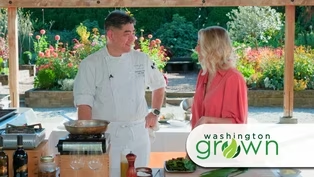
At Pomeroy Cellars, passion meets innovation in every bottle, while the Underwood Conservation District shows how sustainability is shaping local farms. We enjoy the artistry of Woodinville’s Barking Frog Restaurant and the bold flavors of Ninevah Assyrian in Olympia, then uncork the history of Vancouver, revealing its lasting role in Washington’s agricultural story.
Problems playing video? | Closed Captioning Feedback
Problems playing video? | Closed Captioning Feedback
Washington Grown is a local public television program presented by KSPS PBS
Washington Grown
River & Vine
Season 13 Episode 1305 | 26m 46sVideo has Closed Captions
At Pomeroy Cellars, passion meets innovation in every bottle, while the Underwood Conservation District shows how sustainability is shaping local farms. We enjoy the artistry of Woodinville’s Barking Frog Restaurant and the bold flavors of Ninevah Assyrian in Olympia, then uncork the history of Vancouver, revealing its lasting role in Washington’s agricultural story.
Problems playing video? | Closed Captioning Feedback
How to Watch Washington Grown
Washington Grown is available to stream on pbs.org and the free PBS App, available on iPhone, Apple TV, Android TV, Android smartphones, Amazon Fire TV, Amazon Fire Tablet, Roku, Samsung Smart TV, and Vizio.
Providing Support for PBS.org
Learn Moreabout PBS online sponsorship- "Washington Grown" is made possible by funding from the Washington State Department of Agriculture and the USDA Specialty Crop Block Grant program, and by the Potato Farmers of Washington.
Learn why Washington is home to the world's most productive potato fields and farmers by visiting potatoes.com.
- Hi everyone, I'm Kristi Gorenson, and welcome to "Washington Grown."
Today, we are in southwest Washington, celebrating the original home of Washington agriculture, including Fort Vancouver.
And Washington agriculture deserves to be celebrated with Washington wine.
So join me today as we talk about wine and more in this corner of the state.
I'm visiting Pomeroy Cellars and their living history farm, where they're making amazing wine and preserving history.
- This isn't just about our history and the family history here.
It's all of our history.
- And I'm making a special duck dish at Barking Frog in Woodinville.
I'm gonna dream about this, chef.
It's just so good.
Then I'm visiting Vancouver, Washington, where much of our state's agriculture got its start.
They've traced the earliest grapes in Washington back to here.
All this and more today on "Washington Grown."
[gentle music] Cooking with Kristi.
Sweet Pete!
- Jiminy G. Willickers.
- Watch my bangs!
Go big or go home.
- Ah!
Right in my eye.
You made me a believer.
Oh, I am a making a mess!
- Oh, Val, I love you.
- Heaven on a plate.
That's yummy.
- We're gonna get a to-go cup for this?
- Yeah!
- You keep talking.
I'll keep eating.
[gentle music] If the hustle and bustle of the city is too overwhelming, you don't have to go far for some peace and quiet.
Nestled into the heart of Washington wine country in Woodinville, Willow's Lodge is offering a gorgeous, serene retreat from the world outside.
But that's not all.
They're also home to Barking Frog, where tasty and eye-catching dishes are served with extra flare.
- It's very warm and inviting.
- Having the open kitchen, seeing the chefs working, just adds that perfect amount of ambience.
- They care about the food on the table.
They care about how they're presenting it to you.
And they know what they're talking about.
- What's in the ground is what tells us what goes on the menu.
- Executive Chef Lyle Kaku knows that the prettiest plates contain the freshest ingredients.
And with so much amazing food grown so close, he makes sure his menu puts freshness first.
- We really try to hit on grown in Washington.
Very local, very hyper seasonal.
If something's gotta travel halfway around the world, that means the tomatoes are ripening in the box instead of ripening on the vine.
- Tastes as if it was just handpicked yesterday.
- Local, fresh, amazing.
Truly amazing.
- Good food, good wine, and- - Grown in Washington.
- Grown in Washington.
Exactly.
- That's perfect.
Stay tuned for later in the show when Chef Lyle and I make a special braised duck dish.
And there's something to be said by cooking with the wine you want to drink, right?
- Yeah, for sure.
[upbeat music] - With all the amazing grapes grown in the state, it's no surprise that you can find amazing wine anywhere you go.
Today, I'm visiting Pomeroy Cellars in Yacolt, where they celebrate the pioneers of the past and the grapes of the present.
- I just started making wine as a hobby.
That hobby got out of control real quick.
- Dan Brink is the wine maker at Pomeroy Cellars.
As a fifth generation Pomeroy, Dan became interested in wine after taking some college courses.
From there, his education was up to him.
- As far as a winemaker goes, I am trained in the school of hard knocks.
When I started, I was a mad scientist in the basement with a bunch of small batches, trying to kind of figure it all out and what I liked.
People like kind of the velvety elegance of my wines.
They're very smooth and easy to drink, but they have a lot of depth and complexity.
- Now let's try some of these fabulous wines.
Should I get down on the floor and he can just like open up?
[Kristi chuckling] - So I'm gonna draft off the sample valve here a little bit of our Lucia No.
47 blend.
- Thank you.
- Single vineyard blend from DuBrul Vineyard in the Yakima Valley.
- I can see why people love your wine.
- In this wine in particular, you get a lot of the dusty cherry.
That's something that DuBrul is really known for.
That's the only vineyard in the state that gives this unique dusty cherry, - Dusty cherry.
- Cherry flavors.
- That's interesting.
- Yeah.
- But wine isn't the only interesting thing going on on the property here.
I'm meeting up with Tommy Miller, the Operations Manager for Pomeroy Cellars, as well as the board president for the Pomeroy Living History Farm.
So what is a living history farm?
- A living history farm takes what we know with our history and shares it with the public.
So we actually have folks that dress in character and teach school kids about what life was like in the 1920s.
- Our first stop was the rebuilt log house where the family lived.
I just stepped back in time.
This is so cool.
- This isn't just about our history, and the family history here.
It's all of our history.
- So I bet the kids love all of this fun stuff.
- They do.
This one is used primarily for our school programs.
We see about 3,500 to 4,000 school kids through our school programs.
- Okay, we're moving on.
[bell tolling] Our next stop was the blacksmith shop.
- At that time, you couldn't run down to the hardware store and just grab a box of nails.
Anything and everything that was needed around the farm they could make it in here.
- To finish the tour, I met some new friends.
- This is probably one of the favorite activities - Of course!
- For people visiting the farm.
- You already got some.
- We have Myrtle and Ginny.
- Who's this?
- This is George.
- Hi, George.
You're very handsome.
There's a lot going on here.
- There is.
And it's really a treat to be able to have this and to be able to share this.
So this is the kind of place where, your kids can bring their kids back, and their kids into the future.
- Yeah, and don't forget about the wine.
- And don't forget about the wine.
- That's good stuff.
- Thank you.
- Okay, bye George.
See you later.
In Olympia, a local favorite is bringing the taste of the ancient Near East to the Pacific Northwest.
This is Nineveh, where traditional Assyrian cuisine is being served using fresh Washington-grown ingredients.
- Assyrian food is made by Assyrian people.
We are indigenous to northern Iraq, parts of Syria, Turkey, Iran.
I noticed that there was like a lack of Middle Eastern food in this town.
If nobody else is gonna do it, I have to be the person that brings Middle Eastern food to Olympia.
- Yeah.
Lisa David and her brother Jacob opened Nineveh as a food truck in 2011, but expanded to a restaurant in 2024, allowing the Davids to share more of their culture's flavors while utilizing Washington-grown herbs and vegetables.
- I want my customers to experience a taste of our home.
I love sharing our family history.
I love sharing food with people.
- Today, Lisa is making me Nineveh's watermelon feta salad, as well as hand-rolled dolma.
- Dolma has herbs, parsley, dill, some cilantro and mint.
It gets rolled up in a vine leaf from a grapevine and then cooked in lemon and olive oil.
- Right.
That sounds amazing.
- Very tart, a little bit sweet, a little bit salty, a little bit delicious.
A lot of delicious.
- That's so good.
- So we have a watermelon feta salad.
It has whipped feta, watermelon, cucumbers, some urfa peppers, and then a lemon sumac dressing.
- Watermelon and feta is such an awesome combination.
- Yeah, that's a very traditional, hot Baghdad daytime thing to eat 'cause it's so refreshing.
[upbeat music] - The first grapes were planted in the state of Washington in 1825.
Do you know where?
- I'll have the answer right after the break.
- Coming up, I'm making a delicious duck dish at Barking Frog in Woodinville.
And there's something to be said by cooking with the wine you want to drink.
Right?
- Yeah.
For sure.
- Then I'm learning how one vineyard is working with their local conservation district to make wine with organic practices.
- Why do we go to all this extra trouble?
Because we're making high end premium wine.
[upbeat music] - The first grapes were planted in Washington state in 1825.
Where?
- They were planted at Fort Vancouver by the Hudson's Bay Company using seeds brought from England.
- We're back at the Barking Frog and Willows Lodge in Woodinville.
Don't let the artistic presentation on the plate fool you.
There's nothing intimidating here.
At Barking Frog, every guest is welcomed with open arms, and a nice glass of wine to match.
- Fantastic food, local grown.
- French, but with a Northwest flair.
- I love all of it.
- We obviously create some beautiful dishes, and we play artfully on the plate, but it's very simple and elegant to me, and that's my style of cooking.
- Executive Chef Lyle Kaku created his menu to reflect the peacefulness of the grounds.
Just like the scenery, every bite should feel like a breath of fresh air.
- Even though we're just 35 minutes away from Seattle, when you drive out here, it's peaceful.
We're in the middle of the day and you can hear the owls or the birds chirping, and the ducks quacking across the way.
It's a getaway within a getaway, I guess.
Middle of wine country out here.
- Yeah.
- So good wine, good food.
- Right, we need to go get some wine.
- Yeah, for sure.
- What are we doing?
- Let's go.
[both laughing] - Now it's time to cook a special dish with Chef Lyle.
Everything looks gorgeous.
Even the bees are joining us today.
- Yeah, well, we're gonna start off with some duck legs here that we're gonna braise.
- Okay.
- What we're gonna do is we're gonna pair it with some beautiful vegetables that we have from the farm just down the road, literally like a mile away, called Equilibrium Farms.
- Once the duck has started browning, we remove it and cook some onions, carrots, celery, and garlic cloves in the duck fat.
Then we add in some aromatics, like cinnamon, star anise, juniper berries, cloves, blackberries, and coriander seeds.
- So here's our beautiful wine from our friends, Paul Golitzin.
They strictly do Cabernet Sauvignon, and this is a 100-point wine by multiple- - That's amazing.
- Yeah.
- And there's something to be said by cooking with the wine you want to drink.
- Yeah.
- Right?
- For sure.
Cooking with it and adding those flavors to give good depth to it.
- Yeah.
- It's amazing.
- We add some duck stock and veal stock, then add the duck legs back in.
Into their happy little bath.
- Into their sauna they go.
- We put our duck legs in the oven for an hour and a half.
While that cooks, we work on our mushroom conserva.
We cook some chanterelle mushrooms with olive oil and garlic, then add sherry vinegar and some extra olive oil.
Next we grill some fennel and some chard stems and sauté the chard leaves.
Does it limp up like spinach?
- Like spinach.
Yep.
- Limp up?
Limp down?
- Cook down.
- Said it wrong.
Gonna limp it up.
Our final step is to make the sauce, starting with some Washington-grown blackcurrants.
- I think the richness of the duck pairs well with berries, fruits, apples, it's just a classical pairing.
- Once our duck is done, we strain the juice into our berry sauce, and then there's one final touch before we plate.
- What we're gonna do is finish with just a touch of butter.
This butter just silkens everything out and makes it better.
- Everything's better with butter.
[upbeat music] - That's gorgeous!
All right.
- And then we have some lovely Quilceda Creek wine here that will pair extremely well.
- Okay.
It's so good.
There's a lot of flavor going on.
- There's a little tanginess in the wine, which goes well with the duck, I think.
And then the chard, - It's just so good!
I'm gonna dream about this, chef.
- Cheers!
- To get this and other recipes adapted for the home chef, visit us at wagrown.com.
[gentle music] In Lyle, Washington, just a stone's throw from the Columbia River, we're visiting COR Cellars, a specialty wine vineyard that's utilizing organic farming practices to help grow the perfect grapes for their customers.
- Why do we go to all this extra trouble?
Because I'm not making grocery store wine.
I'm making high-end premium wine.
We make a certain type of wine for a certain customer.
They expect you to use natural sources.
We'd rather do that anyway.
- Adrian Bradford is the father of COR Cellars' owner, Luke Bradford.
Today, Adrian is showing me how nothing goes to waste at COR Cellars, but returns to the soil to support the crops.
It looks like a pile of poo.
- Actually, there's only very little bit of poop.
It's just wine skins, stems, and seeds.
This is just pure plant food.
That's three years old and it's all been turned and turned and it's ready to put back to work.
It's loaded with all different types of various nutrients for growth.
This is all it needs, and then we'll spread it in the rows.
- Once this nutrient rich fertilizer is spread in the rows, Adrian and his family will plant legumes as a mid row cover crop.
These practices can be difficult with the narrow space between the vine rows, so they turned to the Underwood Conservation District for help.
- That thing sitting over there belongs to them.
That is a compost spreader.
Real little narrow ones are really hard to find.
I wouldn't have any kind of a spreader to do it with unless it was them.
- We're here to help conserve natural resources, and what we found was through the tools, was really just a way to have a whole toolbox, literally, that could apply to all different types of land uses.
We call it the Food and Farm Tool Library.
- Tova Tillinghast is Director of the Underwood Conservation District.
With the help of her team, over 100 tools are available to rent from the tool library.
This includes specialty tools that can assist farmers like the Bradfords achieve their sustainability goals.
- This is the no-till seed drill.
It's a very unique one in that it's narrow, so orchardists and vineyards can pull it in between the rows.
That gives them the opportunity to plant cover crops.
And I know that Adrian here seeds legumes, and they help fix nitrogen into the soil.
And also it helps with the water runoff so that water isn't pouring down the hill.
- Yeah.
- And taking soil with it.
- They're a valuable resource.
And then also they have a lot of information, data, information we can use.
So they're very valuable to not just to me.
I mean, everybody uses Underwood Conservation around here.
- That's awesome.
Coming up, I'm visiting Vancouver, where much of Washington agriculture got its start.
- They've traced the earliest grapes in Washington back to here.
[upbeat music] [upbeat music] - Hey everybody.
AnnaLu and I are here in South Bend, Washington, with one of my great friends, Jason Nelson.
And we're also joined, of course, by my daughter AnnaLu and, Jason's son, Will.
And Will, we're actually here today because you're gonna cook us a little something, right?
- We're cooking some oysters.
We're gonna put 'em on the grill, and then afterwards, we're gonna put all these toppings on them.
- Today we're using homemade garlic butter, green onions, Parmesan cheese, bacon, and of course, oysters from South Bend.
Now, I know those of you that have watched the show know I'm not a huge seafood fan, but when it comes to coming to the oyster capital of the world, then when in Rome, you might as well go for it, right?
All right, so we're gonna throw these on a 450 grill right now.
[upbeat music] Okay, shucking.
Show me how a guy from South Bend shucks an oyster.
Now it was time for AnnaLu and Will to finish shucking the oysters so we can then add our delicious toppings before sending them back to the grill.
- More bacon.
[upbeat music] - So you guys ready to try these?
- Yeah.
- Yeah!
- Let's pick one up.
Jay get the big one.
- I'm gonna go with this midsized one.
[upbeat music] - Mm.
That's actually really good.
- Yeah.
- That was pretty good.
This was great.
Thank you guys so much for having us down here and cooking us some oysters.
- Yeah.
- If you're looking for some of the best oysters in the state, you gotta come to South Bend, and this is where you're gonna find 'em.
This is great, guys.
Cheers.
- Cheers.
- Cheers.
- I'm going to have another one.
To learn how to make this recipe and many others, head on over to wagrown.com.
- Nestled on the banks of the Columbia River, Vancouver, Washington, is a city of striking beauty.
From the distant rise of Mount Hood, to its lively downtown, there's something here for everyone.
Yet few know that Vancouver is also home to the roots of some of our favorite crops.
- We're at Fort Vancouver.
It's one of Vancouver's biggest attractions, I would say.
It really tells the history of the area.
The Hudson's Bay Company came here and established this for fur trading, and you can go in and there's a fur trading house and a bake house.
- Erica Lindemann with Visit Vancouver Washington is guiding me through the Vancouver area.
At Fort Vancouver, we get a glimpse into our state's agriculture.
- They've traced the earliest grapes in Washington back to here.
Also the first hop crop.
I think it's safe to say that really beer and wine.
This is one of the many places that it started, and it's neat to see all of the wineries and the breweries pop up in town.
- Fort Vancouver tells the story of where the city began, but step outside its gates, and you'll find a community that's got a lot to offer.
- Vancouver has a lot to offer in a way of having that history, but also having that modern waterfront.
There's dining, there's beer, there's wine.
Really, anything, you could use Vancouver as a base camp to get to Mount Saint Helens, Columbia River Gorge.
And we're just really close to a lot of things.
- This is really beautiful.
I mean, look at this!
- Yeah, it's pretty special.
I think even our neighbors to the south, Portland, they don't quite have this kind of activity and places to hang out on the water.
So a lot of people will come over the river to have a bite to eat or a sip of wine.
I think it's just really cool that there's these pockets of Vancouver that you really can experience as a visitor.
- Yeah.
- And then we have some of our local favorites too, that we're kind of still yet to be discovered.
- Yes, and wine.
Vancouver has a wine trail?
- Yeah.
We started a Clark County Wine Trail a couple years ago.
Pass holders can get a discount at every winery that they check into, and then they are incentivized by prizes.
So it's really fun to get the tourists involved or residents involved in the wine community.
- A short walk from the river brought us to Valo Winery to try the product of the fruit that got its start in Washington only a few miles away.
Owner and chef Michael Ruhland started Valo in 2018 with wine maker Matias Kusulas.
Together, they're putting Vancouver wine on the map.
- Valo sources the majority of its fruit from a vineyard called Conner Lee, out of right in between Wahluke Slope and Royal Slope, north of the Tri-Cities as you're heading towards Spokane.
The vineyards that are over there are absolutely fantastic, and Matias is the head viticulturist for where we get all our fruit.
So we watch everything from vine to bottle.
- So he's a phenomenal wine-maker.
He got Winemaker of the Year from International Wine Report for the state of Washington last year for what he does for us.
- So you get a chance to kind of use your love of cooking too?
- Absolutely.
- Within the winery.
- Yeah.
So I keep my fingers in the culinary world quite a bit by every month, I do a wine dinner here, where I try and feature as much Washington food as possible and the menus that I write.
And then I also have little small plates and different stuff like that right here in the tasting room as a whole, so... - That's great.
Now what is this one here?
- So this is our 2024 Sauvignon Blanc.
- Oh, okay.
- You have Cinsault Rose.
So it's our 24 Cinsault Rose.
- Really great wine.
- Absolutely.
- I think we should cheers to that.
There we go.
And to Vancouver!
- Absolutely.
[gentle music] - When you think of Washington grapes, wine might be the first thing that comes to mind.
And for good reason.
Washington is the second largest wine-producing state in the country, a distinction we've earned through our ideal climate and a lot of hard work.
But grapes made their way to Washington long before wineries gained popularity.
The rich history of grape-growing in the state spans 200 years.
[gentle music] To really start this story, we have to go back to the 1820s, when Hudson Bay Governor, George Simpson, carried grape seeds from England to Fort Vancouver tucked away in his vest pocket.
Dr.
John McLoughlin, who ran the fort, planted them in the fort in its very first farm.
McLoughlin also sent seeds to outposts throughout the region where they were given to settlers for free.
It didn't take long until grapes were growing all over Washington.
Today the state mainly grows two different types of grapes.
Juice grapes and wine grapes.
Concords are one of America's best known juice grapes.
They were first developed in 1849 by Ephraim Wales Bull on his farm in Concord, Massachusetts.
Years later, New Jersey dentist Thomas Bramwell Welch used those grapes to make a pasteurized, non-fermented wine for church communion.
His son Charles turned that invention into the Welch's brand we know today.
Concord grapes were first planted in the Yakima Valley in 1904, and they spread throughout eastern Washington.
The region is ideal for growing Concords and other types of grapes, including those that are used for wine.
[gentle music] When Concord grapes began to thrive in Washington, they helped spark the state's wine industry.
- The wine industry is actually closely linked to Concord grapes.
- Okay.
- And you could say essentially that they helped put us on the map.
They started us.
Back in the early 1900s, there were little pockets of grapes, all types of grapes grown in the state.
But very few European varietals, the vitis vinifera.
Most of the grapes being grown were Concords, labrusca, American hybrids.
There was a very small, but it was growing, but a very small little industry.
Because you can make wine out of any fruit, obviously.
- Yeah.
- So it was a little different style of wine than what we drink today.
Very sweet wine.
- Out of the Concord grapes.
- Out of the Concord grapes.
- Okay.
- And they just blended all the grapes.
And things were starting to grow.
And then came Prohibition.
- Okay.
- 1919 screeched it to a halt, put the brakes on.
- Yeah.
- But there were not wineries legitimately that could sell their product.
- Legitimately.
Yeah.
- But it was a boom for grape growing in Washington state.
- Really?
- Because you could, as a home owner, make 200 gallons of wine in your home without a permit.
- After Prohibition ended in 1933, Dr.
Walter Clore arrived in Washington.
- Dr.
Walter Clore was the reason why we have such an awesome wine industry today.
He studied the science of plants.
- Yeah.
- And plant physiology.
- Yeah.
- And he was working with irrigated plants and crops, and he saw potential in our state as a premium wine producer.
- Yeah.
- And he went throughout the state and planted, worked with growers and planted a few trials, few grapes here and there, and planted vitis vinifera, the European grapes.
Cabernet, Riesling, Chardonnay.
I think he planted in all, about 300 different types of varieties.
- In the 1970s, the Washington wine industry took off, due in large part to Walter Clore's research.
The state is now known as a premier wine-growing region.
And Walter Clore is known as the father of Washington wine.
In 2015, the production of wine grapes surpassed juice grapes.
And by late 2019, there were over 1,000 authorized wineries in the state.
Washington's juice grape industry is still going strong.
Welch's processes much of the state's crop in the Yakima Valley, where the juice is concentrated, stored, and shipped around the world.
From the first Concord vines, to today's world class vineyards, grapes have taken root in Washington, and they're here to stay.
- You can find amazing Washington vineyards and Washington wine in every corner of the state.
That's it for this episode of "Washington Grown."
We'll see you next time.
Video has Closed Captions
Preview: S13 Ep1305 | 30s | Western Washington, where climate, craftsmanship, and community flourish. (30s)
Providing Support for PBS.org
Learn Moreabout PBS online sponsorship

- Food
Christopher Kimball’s Milk Street Television
Transform home cooking with the editors of Christopher Kimball’s Milk Street Magazine.







Support for PBS provided by:
Washington Grown is a local public television program presented by KSPS PBS