Washington Grown
Pulse of the Palouse
Season 13 Episode 1312 | 26m 46sVideo has Closed Captions
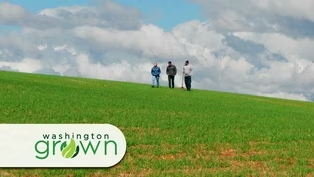
Visit the Palouse, where vibrant green fields of peas and lentils define the spring landscape.
Visit the Palouse, where vibrant green fields of peas and lentils define the spring landscape. At Clark Farm, we learn how growers lead the way in sustainable pulse production. See the Palouse Conservation District’s FLOURISH program. Explore Pullman’s small-town charm, enjoy local fare from Beef and Co., and uncover how this remarkable region helped shape Washington’s agricultural identity.
Problems playing video? | Closed Captioning Feedback
Problems playing video? | Closed Captioning Feedback
Washington Grown is a local public television program presented by KSPS PBS
Washington Grown
Pulse of the Palouse
Season 13 Episode 1312 | 26m 46sVideo has Closed Captions
Visit the Palouse, where vibrant green fields of peas and lentils define the spring landscape. At Clark Farm, we learn how growers lead the way in sustainable pulse production. See the Palouse Conservation District’s FLOURISH program. Explore Pullman’s small-town charm, enjoy local fare from Beef and Co., and uncover how this remarkable region helped shape Washington’s agricultural identity.
Problems playing video? | Closed Captioning Feedback
How to Watch Washington Grown
Washington Grown is available to stream on pbs.org and the free PBS App, available on iPhone, Apple TV, Android TV, Android smartphones, Amazon Fire TV, Amazon Fire Tablet, Roku, Samsung Smart TV, and Vizio.
Providing Support for PBS.org
Learn Moreabout PBS online sponsorship- "Washington Grown" is made possible by funding from the Washington State Department of Agriculture and the USDA Specialty Crop Block Grant program, and by the Potato Farmers of Washington.
Learn why Washington is home to the world's most productive potato fields and farmers by visiting potatoes.com.
- Hi everyone I'm Kristi Gorenson and welcome to "Washington Grown".
The Palouse region of Eastern Washington leads the way in pea and lentil production.
In this episode, we take a look at how sustainable practices are keeping our farms thriving.
Val's visiting Clark Farms to learn about growing legumes.
- The diversity is so key to our cropping system.
The more crops we can grow, the better off our farm is.
- And I'm making a roasted poblano dish at Indicana in Spokane.
- Ugly delicious is a thing, so I don't care about the color if it tastes amazing.
- Right?
I love that.
It's ugly delicious.
- Yeah.
- Then I'm learning how a conservation district is helping farmers experiment with new soil techniques.
- They said, "In one year, I can learn what it would take me on my own to learn in 27 years."
- All this and more today on "Washington Grown".
[cheerful uplifting music] Cooking with Kristi.
Sweet Pete.
- Jiminy gee willikers!
- Watch my bangs.
Go big or go home.
- Ah, right in my eye.
You made me a believer.
Oh, I am making a mess.
- Oh, Val, I love you.
- Heaven on a plate.
That's yummy.
- We're gonna get a to-go cup for these.
- Yeah.
[all laughing] - You keep talking, I'll keep eating.
[cheerful uplifting music] Tucked into the Perry District in Spokane, there's a restaurant that's shaking things up for any foodie in town.
Indicana is doing something new, blending Indian and Mexican cuisines in a way that will have you wondering why you've never seen this before.
- It's really creative, it's eccentric.
- I ate all of mine, so obviously I like it.
- She has a lot of things that will just rock your world once you've had 'em.
- We are doing flavors of India and Mexico, but creating completely unique dishes, inspired by the two cuisines.
- Chef and co-owner, Noreen Hiskey, knew that Spokane's foodies would fall in love with the concept.
She just had to prove it first.
- We had started off this whole thing and done a concept tasting where one person said to us, "This might work in Seattle, but not here."
And it kind of just drove the whole, "Why not here?"
It's comforting, it's warm.
They use very similar ingredients and cooking styles.
I was like, "Yeah, why not?"
- We were just blown away with the fusion.
- It's unique.
You've gotta try it.
- You know the fusion's perfect.
I don't know why there isn't more of 'em.
- Yeah, this is a special experience.
- They're colorful cuisines on a plate, they're colorful cultures to represent.
- Stay tuned for later in the show when Chef Noreen and I make Indicana's "Stuffed Poblanos".
- Masala in India is like a different spice mix.
This one's got a lot of- - All of it?
Sorry.
I should have asked that before I started dumping it in.
- Yes, all of it.
All of it.
[both laughing] [cheerful upbeat music] - Today I am visiting Clark Farms here in the Palouse, where a special crop is working its magic in the soil, while also growing amazing food.
In order to grow such a special plant, it takes special people.
For Ian Clark and his family, growing things is a part of their history.
- My great-great grandpa's house is right there.
- My great-grandfather and grandmother came here about 1883 and started living in this area.
- So this fourth generation?
- I would be the fourth.
He's the fifth.
- Fifth, okay.
Yeah.
- That's the sixth over there.
- We got the six coming up.
And it turns out family doesn't just mean the people.
Oh, a little puppy.
[Ian chuckles] Oh, what a cutie.
- We are dry land farmers, so we don't water any of our crops and so this is a garbanzo field or a chickpea field, so we just get what falls from the sky and we're really lucky here in the Palouse we have these beautiful hills that are covered in soil and they hold that water for us, so we get all our, most of our rain in the winter months.
These plants get to use it and tap into it with their deep roots all season long.
Unfortunately, we're very dry, so things aren't growing like we wish they would.
- Right.
- But it's part of the nature of dry land cropping.
These beans are a really large, what's called a Kabuli type bean, and they're the ones that you'd see in a salad or in a can of garbanzo beans or whatnot, that would be these beans from here.
- Mm.
- So something like a can of Bush's beans or any garbanzo bean, there's a chance that came from our farm.
There's a good chance that came from this region.
- Right.
- So we raise lots of wheat.
- Right.
- We also raise barley and canola, garbanzos we have lentils just across the- - Ooh, lentils.
- Creek over there.
- Yeah.
- And the diversity is so key to our cropping system.
The more crops we can grow economically, the better off the soil, the better off our farm is.
- These beans are a legume, which means that underneath the ground, there's some special things happening.
- What makes it a legume is a family of plants that fixes all their own nitrogen.
So we actually don't put any fertilizer on these.
This is just a little bit of the root system of the garbanzo plant.
These little nodules are where the rhizobacteria live.
They take nitrogen from the air and they convert it into a form of nitrogen that plants can- - Ooh.
- Plants can actually- - It's bleeding.
- Yeah, and it looks like blood a little bit.
That's where it actually happens.
It looks a lot like hemoglobin in blood, so you need nice pink nodules and the pinker your nodules, the more you're fixing nitrogen.
- Alright.
- This plant seems to me like it's doing pretty good.
It's got lots of nodules.
- But the truth is Ian didn't always wanna be doing what he's doing today.
- I didn't wanna be a farmer.
I wasn't looking back at 18.
I was excited to get out.
It really took until my 20s and kind of got hooked on growing things and then, here I am.
It took a while.
- Just nerded out on it, right?
- Yeah, exactly.
I do love growing things.
- Yeah, you do.
- I like the biology of it.
You know, watching things grow every year is just different.
Every day is different.
- Yeah.
- Yeah.
- When visiting Pullman, if you follow your nose, chances are it'll lead you straight to Beef & Co, where husband and wife, Anthony and Marie are working tirelessly to bring you the best sandwich in town.
- Neither of us come from a culinary background.
- Okay.
- I was in automotive service.
She still currently works in banking, so this was more a labor of love than anything else.
- We definitely use high quality beef.
We have a local ranch that we use for our specials and we just like to use other businesses in the communities.
- Today's special is "The Palouse".
That's right.
Name for the majestic landscape surrounding it because it's made with Mediterranean salad, feta and hummus harvested right from these hills.
First off, that is a hearty sandwich and that looks beautiful.
- This is from the plate, which is the belly of the animal.
So this is very similar to flank steak or skirt steak.
- Okay.
- The key to it is that it can toughen up if you overcook it.
Our solution to that is cooking everything sous vide.
So this has been cooked for 36 hours.
- Fantastic.
I can't wait.
I gotta take a bite of is right now.
- That hummus, what a great idea.
When I heard that we were doing this and you guys were applying hummus to the sandwich, I thought why I haven't I done that before.
That hummus is delicious.
It's the first thing that comes out and that beef, like you said, super tender.
If this isn't on the menu, it should be.
[all laughing] All right, now let's see what others have to say about "The Palouse" sandwich.
- It's got the hummus.
- Yes.
- We're gonna be a little healthy.
- Which is a great idea.
Nice, good, hearty bite.
That's the way it should be.
Just let that sink in for a touch.
- So many flavors.
- I would talk to you more, but hold on.
- Take another bite.
That's good.
- The meat just falls apart as soon as you take a bite.
- The ciabatta is fresh.
- I am a hummus connoisseur.
It adds so much to the sandwich.
- Any sandwich you get is good.
This is up there.
- This is up there.
- Yeah, this is up there.
- That's "The Palouse," ladies and gentlemen.
You heard it right here.
[cheerful upbeat music] - Washington is a big producer of dry peas.
What other pulses does Washington grow?
I'll have the answer for you right after the break.
- Coming up, I'm making a roasted poblano dish at Indicana in Spokane.
- Ugly delicious is a thing, so I don't care about the color if it tastes amazing.
- Right?
I love that.
It's ugly delicious.
Then I'm learning how a conservation district is helping farmers experiment with new soil techniques.
- They said, "In one year I can learn what it would take me on my own to learn in 27 years."
[cheerful upbeat music] - Each year, Washington growers produce lots of different types of pulses, including dried peas, dried beans, lentils, garbanzo beans or chickpeas.
- We're back at Indicana in Spokane.
Delightful plates come out of the kitchen like little pieces of art, drawing from Indian and Mexican cuisines to create something truly special.
- It was a surprise.
- I've never seen anything like it.
It truly is fabulous.
- I call myself an accidental chef.
- Chef and co-owner Noreen Hiskey, started as a food blogger, then did pop-up restaurant concepts before she and her business partner sparked the idea of Indicana.
- We both are huge foodies and just looking for new, exciting places to eat in the city.
India and Mexico have very similar cuisines and it just kind of sparked a, "Yes, this could work."
- We can't stop eating and so much so that we're trying to figure out what we will take home to the people we left at home.
- It's exciting to me to use those flavors to be inspired by the produce around here.
We buy a lot from the farmer's market.
It's kind of India, Mexico, and the PNW because it's always better to use stuff that's local.
It's better to use fresher ingredients.
You can add flavors from anywhere, but still stay true to what is grown here and what is the best.
You and I get to cook together today.
What are we gonna make?
- We're gonna make a "Stuffed Poblano" which has lentil curry sauce on the bottom called Dhansak, which is Indian.
- I can't wait.
[chuckles] - Today we're using two types of lentils.
We're using split red lentils and split pigeon peas.
- Pigeon peas?
- Yes.
- I haven't heard of that one before.
- Yeah, it's a very common lentil in India and I'm excited that there's a bunch growing like- - Right here in Washington?
To make the curry, we add onions into hot oil and let them caramelize.
- I like to call it a clean out the fridge kind of curry.
- Yeah, that's awesome.
- 'Cause you can add any vegetables you have available.
Today we've got zucchini, carrots, and acorn squash.
- Awesome.
- Acorn squash is where you can use the peel.
Doesn't give you the best color, but ugly delicious is a thing, and so I don't care about the color if it tastes amazing.
- Right?
I love that.
It's ugly delicious.
- Yeah.
But definitely vegetables that are starting to show signs of not gonna last in your fridge are- - There you go.
- It's a great way to use it.
- Yeah.
- Over here we've got a ginger garlic paste.
- Okay.
- A little chopped up Thai pepper and then turmeric.
- Okay.
- Just for a little color.
This is our Dhansak Masala, which masala in India is like a different spice mix.
This one's got a lot of- - All of it?
Sorry.
I should have asked first before I started dumping it in.
- All of it, yes.
All of it.
[chuckles] More flavor the better.
- We add our lentils, curry base, and veggies into an Instapot and let it cook.
Once it's done, Noreen will blend it up.
But in the meantime we roast up some poblano peppers.
- We have a little stuffing.
Today we're doing quinoa and it's got roasted poblanos in it.
- Oh okay.
- And roasted corn.
- Yeah.
- Onion.
Don't be shy with the cheese.
- Okay, I won't.
We broil the peppers to melt the cheese.
Then it's time to put it all together.
- So we have our curry that we made.
It's super smooth, it's creamy with the lentils without adding any cream.
We're just gonna spread that around there.
We do a zucchini salsa.
- Okay.
- And then we garnish it.
We do two types of pickled onions here.
We do a Mexico and an India pickled onion.
Both cultures love cilantro, so you gotta top it off with a little cilantro.
- Gotta do that.
- There we have it.
- Look how beautiful that is.
- It is so colorful.
Just like both cultures.
- Yes.
And just popping with flavors.
- Yeah.
[cheerful upbeat music] - It's like an explosion of so many different flavors.
- It's a warm spice.
Yeah, we don't do a lot of like sharp heat, but we definitely don't skimp on the flavors.
- And it makes me happy.
I love how warm it makes you feel.
- Yeah.
- Oh, this is delicious.
This is just like comfort food at a whole new level.
For more chef inspired recipes like this one, visit us at wagrown.com.
Here in Uniontown, south of Pullman, the Palouse is teaming with springtime life.
Pretty soon these hills will be covered in beautiful crops of all kinds.
- We're pretty diverse, so we grow wheat and peas, barley, alfalfa, canola, flax.
- Farmer Allen Druffel is what you might call an experimentalist, but not every project he's tried has been successful.
In an effort to regenerate nutrients in the soil, he tried planting cover crops in a field and brought in some cattle.
- We did a big field, did 90 acres, brought in a whole bunch of cows and it went as poorly as you could imagine.
Our cows made great friends with our neighbors and we're rarely in our fields.
- Oh no.
- I said there will never be another cow on the farm.
And as any good farmer, our memories are short, and so that winter, the Palouse Conservation District called and said, "You know, we have this new project.
It's called 'FLOURISH.'
It would enable you to have cover crops and cows.
We'll help subsidize it.
We'll bring data in from other producers and so you guys can share.
We'll have meetings, we can talk about it.
You can learn, and most importantly, it would help cover the cost and offset the tuition of learning how to raise cover crops and have cattle."
- As conservation districts, we have the best opportunity.
We just get to work with the local land managers and bring them resources that help them do their conservation work.
- Jennifer Boie is the Director of the Palouse Conservation District.
As she explained what the "FLOURISH" program is, we got an unexpected guest.
- Cute cat.
- Hi.
- You're coming in too?
- I mean, of course the cat is walking back and forth.
That's just what cats do.
- "FLOURISH", the acronym is my favorite acronym as well.
It's "Farmers Leading Our United Revolution In Soil Health."
[both cheering] Like the revolution for soil health.
- Exactly.
- The farmers have the opportunity to create what's gonna work on their farm.
They can decide, "Hey, I wanna learn a little bit more about how to bring life back into my soil in this way."
And so each of those 27 producers are trying something different or slightly different, and then they're learning from each other.
- One of the goals of the "FLOURISH" Project was to kind of offset the risk, and so we provide financial resources to help do that.
- Ryan Boylan is the Research and Monitoring Program Manager at the Palouse Conservation District.
He's worked closely with Alan and other producers seeing the success of the project firsthand.
- So after the first three years, we found that the farms that have been integrating cattle with the cover crop, we've seen changes in soil pH, and then these soil health parameters that are related to carbon and nitrogen, and that's been across all 27 farms.
- I remember talking with one of the farmers that's participating and they said, "In one year, I can learn what it would take me on my own to learn in 27 years."
- Wow.
- Right?
"'Cause I get to learn from my peers."
- Yeah.
- We're trying to farm not like my father, not like my grandfather, more like my great great grandfather farmed where they put the cattle on, we rotate through the different crops and we start, like I said, that life cycle back under the soil.
Next year's a 150 years on this farm.
I'd love for this property to be as prosperous as it was back then.
- Cows and cover crops.
Could be a band name.
- Pretty bad band.
[Kristi laughing] - Coming up, Tomás and Val are learning all about Pullman.
- We are a welcoming small community, but with metropolitan amenities.
[cheerful upbeat music] [cheerful upbeat music] - Well, hello everyone.
And as you can see, the sun has set and we're about ready to go to bed for the night.
Are you tired?
- Yes.
- So we thought today that we would make some overnight oats.
That way you can mix some cool ingredients in there.
You can toss in your cooler when you wake up the next morning.
Breakfast is served.
[both chuckle] Tonight we're using old-fashioned oats, almond milk, peaches, Greek yogurt, chia seeds, and some spices and honey.
- We begin by adding oats to a jar.
I'm so excited.
Peaches are my favorite fruit.
- Good.
- Then after our peaches, we add some almond milk.
Chia seeds and Greek yogurt.
- There we go.
- Then we finish it off with some cinnamon and nutmeg and then a little bit of honey.
Then it's time to seal it up and give it a good shake.
- Now the hardest part about all this is waiting till the morning.
So we're gonna go ahead and put these in our coolers and when we wake up, we're gonna open up our oats and we're gonna enjoy a little oatmeal before we hit the trail.
[ethereal music] [birds chirping] Good morning, everybody.
It is a beautiful quiet morning here in the Cascade Mountains and now it's time to eat our oats.
- I'm excited.
- All right.
[chuckles] Here we go.
Oh, look at this.
Good morning.
Wow.
- The peaches are a really good touch.
- That is so good.
All right, and that is all you need to get your day started off right, so you can hit the trail and see more of what Washington state has to offer.
We'll see you guys next time.
To learn how to make this recipe and many others, head on over to wagrown.com.
We all know Kristi is a diehard Coug fan, and a Washington State University graduate, and she never ceases to remind us what a gem Pullman is.
So Val and I decided to visit Pullman for ourselves to see what all the hype is about.
Now here, everyone knows Pullman is associated with WSU.
Our co-host, Kristi Gorenson is a Coug.
- Go Cougs!
- That's right.
But Pullman has so much more than just the university.
There's incredible recreational opportunities with the Snake River over here.
- Right.
There's also all the delicious oats and grains that they grow over here for the beverages and the delicious food.
- Speaking of that wonderful food, we checked out a scenic spot on the Palouse Ridge Golf Course.
Here, The Table served us some mouthwatering appetizers all while we learned more about Pullman.
- Pullman is a surprise.
I think people do come here and they immediately think about WSU, but we are a welcoming small community, but with metropolitan amenities.
- Alexis Foran is the Tourism Promotions Manager for Visit Pullman and the Pullman Chamber of Commerce.
Although she isn't from Pullman, she knows how special this community really is.
- What attracted you to this area?
- Oh, well, I mean small town charm and community.
I'm very community focused.
I have three children.
I wanted them to live in a place that was walkable and safe and that neighbors knew one another and that your impact mattered and Pullman offered all of these things.
- I think maybe we should partake a little bit of this.
- Then maybe go get an ice cream.
What do you think?
- I love that idea.
- All right, let's do it.
- Cheers.
- Cheers.
- Any WSU grad will tell you that the best place to get ice cream in Pullman is none other than Ferdinand's.
All right, here we go.
So what are your favorites?
What are you looking for?
- Oh, I love the "Cougar Tracks."
They're definitely one of my favorites and I love the "Huckleberry."
- I think I'm gonna be really, really basic and do vanilla.
[Tomás laughs] Okay you get Mr.
Choosy here.
- I'm just going strawberry so I'm not much- - Yeah that's not further from vanilla, you know?
- But I'm gonna go on the waffle cone, please.
Holy moly.
- Holy moly.
- Look at that.
How does like the student population impact the town of Pullman throughout the year?
- We see an influx of students, thousands of them coming in, brand new Cougs and returning Cougs every August, and we like to welcome them by hosting the National Lentil Festival the same week of welcome.
- Like you said earlier, Pullman has so much to offer.
- I am so excited that you were able to explore Pullman and we wanna welcome you back anytime.
- All right.
- Awesome.
Thank you very much.
[all laughing] [spirited music] - Lentils, peas and garbanzo beans are nutritious and delicious.
They're often used as meat substitutes and vegetarian diets because they're so full of protein and essential vitamins.
These crops are known as pulses, which are the edible seeds of a plant in the legume family.
Washington has grown pulses for more than a century with the Palouse region once earning the title of the lentil capital of the world.
Lentils are one of the greatest domesticated plants.
Evidence suggests people were cultivating them in what is now northern Syria as early as 8,000 BCE.
Lentils came to the Americas through Spanish and Portuguese explorers in the early 16th century, but it took hundreds of years for lentils to catch on in Washington.
In 1916 Adventist farmer, JJ Wagner from the town of Farmington planted the first lentil crop of the Palouse.
He eventually sold his lentils to a wholesale house in Spokane for a little under 10 cents a pound.
Wagner also developed a successful mail order business for his lentils, shipping most of his crop to Adventist schools, businesses, and congregations.
In the 1920s, dry pea production got its start in Washington while the lentil industry continued to grow.
The Spokesman-Review would end up calling the small town of Farmington, the largest lentil producing area in the world by the late 1930s.
Lentil production held steady throughout World War II because pulses were important sources of protein when meat was rationed.
As the pulse industry flourished, Palouse farmers quadrupled the acreage of lentils in almost a decade, going from about 3,000 acres planted in 1948 to 12,000 acres in 1957.
[uplifting music] Those numbers only continue to climb.
Washington hit 37,000 acres of lentils by 1960.
- These are lentils.
- Okay.
- So these are called small brown lentils.
- Small brown lentils.
- Yep.
They are tiny and they have beautiful purple and brown colors.
- Yeah, they're really pretty.
- These lentils don't turn to mush, so different lentils will perform differently and these ones hold texture.
- Chickpea production in Washington began in the early 1980s, and today Walla Walla is known for its abundant harvests.
- Our climate's perfect for us.
We've got the Palouse raises them, and they do well.
We're warmer, which means in a normal year, we can get 'em off earlier without any rainfall problems or late weeds or something like that.
We have a very deep soil up here.
We have 23 inch rainfall.
A lot of neighbors below me will raise them in a 18 to 20 inch rainfall.
- With the rising popularity of hummus, chickpeas have become an important rotation crop for our farmers.
- When the rest of the United States caught onto the fact that legumes are the number one rotation crop, to me, in the world, they do such a good job of promoting the next crop and keeping it healthy.
- Right.
- That when that was discovered outside of the Pacific Northwest, this whole thing started to explode.
- Chickpeas are a fantastic rotation crop.
- They're a crucial part of our rotation because lentils, being a legume, are a nitrogen fixing plant, and so they put nitrogen back in the ground, and so it's a really healthy part of our farm rotation.
- The profile for pulses continues to rise as people look into healthier diets, since lentils and chickpeas are chock-full of nutrients, - I would say, especially in the last 15 years, we have seen a tremendous jump in acreage and interest in chickpeas and what it's really been driven by, the export market's always been there, it's being driven by new uses in the United States and this hummus craze we're on right now.
- Yes.
- Yeah.
- Washington's legacy of pulse farming isn't just history.
It's happening right now.
Today our state ranks among the top three lentil producers in the nation and is home to some of America's largest producers of green peas and chickpeas.
In recent years, pulses have become one of Washington's leading food exports.
From fields here at home to tables across the US and around the world, Washington farmers continue to deliver peas, lentils, and chickpeas of the highest quality.
- The Palouse region is such a great place for some small town charm and some of the best food in Washington.
That's it for this episode of "Washington Grown".
We'll see you next time.
Video has Closed Captions
Preview: S13 Ep1312 | 30s | Our team visits the vibrant green fields and small town charm of this region. (30s)
Providing Support for PBS.org
Learn Moreabout PBS online sponsorship
- Food
Christopher Kimball’s Milk Street Television
Transform home cooking with the editors of Christopher Kimball’s Milk Street Magazine.



Support for PBS provided by:
Washington Grown is a local public television program presented by KSPS PBS