
Northwest Profiles
Music-Thanatology
Clip: Season 31 Episode 3105 | 6m 44sVideo has Closed Captions
Music and medicine unite to care for those in need
Music-Thanatology isa musical/clinical modality that units music and medicine in end of life care. Using harp and voice, the thanatologist serves the physical, emotional and spiritual needs of the dying and their loved ones with prescriptive music.
Problems playing video? | Closed Captioning Feedback
Problems playing video? | Closed Captioning Feedback
Northwest Profiles is a local public television program presented by KSPS PBS
Funding for Northwest Profiles is provided by Idaho Central Credit Union, with additional funding from the Friends of KSPS.
Support provided by:

Northwest Profiles
Music-Thanatology
Clip: Season 31 Episode 3105 | 6m 44sVideo has Closed Captions
Music-Thanatology isa musical/clinical modality that units music and medicine in end of life care. Using harp and voice, the thanatologist serves the physical, emotional and spiritual needs of the dying and their loved ones with prescriptive music.
Problems playing video? | Closed Captioning Feedback
Where to Watch Northwest Profiles
Northwest Profiles is available to stream on pbs.org and the PBS app.
Providing Support for PBS.org
Learn Moreabout PBS online sponsorship♪♪ A Thanatologist is a person that works with meeting the needs of people that are dying.
Thanatos was the Greek word for the being of death, so people that are thanatologist work with death and dying and a Music-Thanatologist does that with music.
It is a wonderful practice and it brings a lot of peace to people.
People think of it as a new field and so to speak it is within the last thirty years or so.
The idea of using music in healing is something that is very old and so it's actually something that we're going back to rather than something that were inventing.
The harp is integral to the program and it's not just because it's a heavenly symbol that's not why we use the harp, we use the harp first of all because of its sound.
The sound of the harp is so soothing it goes right to the heart.
It's not an invasive kind of instrument like a like a horn, even piano can be harsher than the sound of the harp.
Music is very intrinsic to the human being.
We live in a universe that's full of sound and rhythm our bodies themselves beat.
They vibrate, they sing.
Our whole the skin system is like a big drum head were very attuned to being made of music and we have rhythms in our body rhythms in the universe.
So when we play for people that are very ill very vulnerable and who for some can't really even comprehend words to hear music is like a coming home, is like a something that is so much a part of who we are as human beings and I think that's why it works so well.
Music-Thanatology is important to me because I heard it as a call.
I'm doing exactly what I was created to do.
Music-Thanatology is doing as being very deeply present every deeply contemplating someone else's whole person.
A key thing of how we practice is, it's not about the music it's not about me it's about what's happening in that moment with that person.
The choices I'm gonna make right here are how are those in alignment with what I see and can receive from that person.
That's us being present very deeply to everything that I've ever read in your chart everything I've heard from your family, from staff, everything I see happening with you right now, your eyes ,your skin, your forehead, your jaw, your breathing, your hands, your arms, anything any movement in your body, any distress you might be in, all the subtle signs.
I don't know what it is to be you inside you and you can't speak for yourself a lot of times when you're at the end life or you're in a pain crisis.
Because with the contemplative discipline it also means that it's not strictly clinical information that I could write down and measure.
So there's an element of mystery.
♪♪ Our goal is not to make it all better it's to support people in their process.
I am very comfortable and intimate moments, birth and death and very respectful of those times.
I'm hopefully playing to them, I"m meeting them where they are.
♪♪ There are times when it's feels like it's more for the family than it is for the patient.
There may be a conflict in the room.
Some people not ready to let their loved one go some people ready and how does music bring that together.
There may be people having trouble releasing their emotions and often times when the harp plays tears come freely.
When it's close to the end.
A person might be having some challenge letting go?
It's like, the rhythm let's go, it becomes non rhythmic, it may become just several notes ,it becomes unfamiliar, so that there's nothing for them to hang on to and invite them to release and let go.
We can come in with all our training and all our knowledge, but in the end it is being deeply with the patient, seeing them deeply, not looking at them but seeing them and intuiting what it is that they need, or what it is the family needs, and how can we serve that with our music.
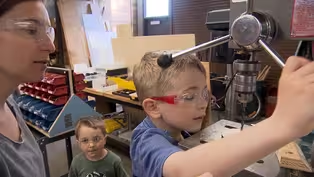
Video has Closed Captions
Clip: S31 Ep3105 | 6m 47s | Visit a Coeur D'Alene maker space encouraging artistic and tech-driven skills (6m 47s)
Preview: S31 Ep3105 | 30s | Creativity flourishes in ways old and new. Music-Thanatology unites music and medicine. (30s)
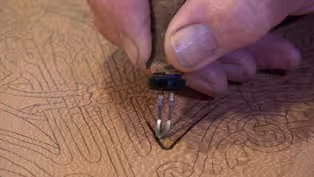
Video has Closed Captions
Clip: S31 Ep3105 | 5m 40s | Jerry White has a hot hand and a burning desire to make art! (5m 40s)
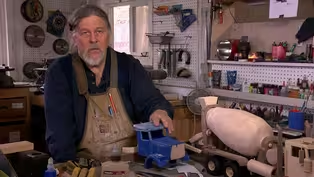
Video has Closed Captions
Clip: S31 Ep3105 | 6m 46s | Discover the meticulous work of wood model maker Rick Klovski (6m 46s)
Providing Support for PBS.org
Learn Moreabout PBS online sponsorship













Support for PBS provided by:
Northwest Profiles is a local public television program presented by KSPS PBS
Funding for Northwest Profiles is provided by Idaho Central Credit Union, with additional funding from the Friends of KSPS.