
Great Performances at the Met: Madama Butterfly
Season 51 Episode 28 | 2h 50m 43sVideo has Closed Captions
Soprano Asmik Grigorian stars as Cio-Cio-San in her Met Opera debut.
Soprano Asmik Grigorian stars as Cio-Cio-San in her Met Opera debut as the loyal geisha at the heart of Puccini’s devastating tragedy. Tenor Jonathan Tetelman stars the callous American naval officer Pinkerton, whose betrayal destroys her. Acclaimed maestro Xian Zhang makes her Met debut conducting Anthony Minghella’s vivid production, and Anthony Roth Costanzo hosts.
Problems playing video? | Closed Captioning Feedback
Problems playing video? | Closed Captioning Feedback
Major series funding for GREAT PERFORMANCES is provided by The Joseph & Robert Cornell Memorial Foundation, the Anna-Maria and Stephen Kellen Arts Fund, the LuEsther T. Mertz Charitable Trust, Sue...
Great Performances at the Met: Madama Butterfly
Season 51 Episode 28 | 2h 50m 43sVideo has Closed Captions
Soprano Asmik Grigorian stars as Cio-Cio-San in her Met Opera debut as the loyal geisha at the heart of Puccini’s devastating tragedy. Tenor Jonathan Tetelman stars the callous American naval officer Pinkerton, whose betrayal destroys her. Acclaimed maestro Xian Zhang makes her Met debut conducting Anthony Minghella’s vivid production, and Anthony Roth Costanzo hosts.
Problems playing video? | Closed Captioning Feedback
How to Watch Great Performances
Great Performances is available to stream on pbs.org and the free PBS App, available on iPhone, Apple TV, Android TV, Android smartphones, Amazon Fire TV, Amazon Fire Tablet, Roku, Samsung Smart TV, and Vizio.
Buy Now
Great Performances Newsletter
Subscribe to the Great Performances newsletter to keep up with the latest full episodes to stream, exclusive content, and more!Providing Support for PBS.org
Learn Moreabout PBS online sponsorshipMore from This Collection
Explores the works of Puccini on Great Performances at the Met.
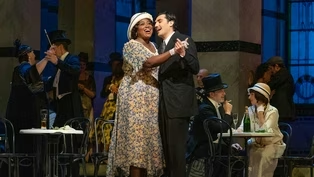
Great Performances at the Met: La Rondine
Video has Closed Captions
Puccini’s love story stars soprano Angel Blue as the French courtesan Magda. (1h 54m 27s)
Providing Support for PBS.org
Learn Moreabout PBS online sponsorship♪♪ ♪♪ ♪♪ ♪♪ ♪♪ ♪♪ ♪♪ ♪♪ ♪♪ Major funding for "Great Performances" is provided by... ...and by contributions to your PBS station from viewers like you.
Thank you.
-Hi.
I'm Anthony Roth Costanzo and I'm thrilled to be your host for today's presentation of "Madama Butterfly."
Director Anthony Minghella's theatrical fantasy inspired by Japanese aesthetics is an ideal match for Puccini's heartrending tragedy, especially when you have a leading lady who is up to the challenge of portraying its timeless heroine.
Cio-Cio-San, or Madama Butterfly, is one of Puccini's greatest characters, who undergoes a harrowing emotional journey from blissful innocence to uncertainty to utter despair.
All of this needs to be captured with great vocal splendor and total dramatic commitment.
Today, we're fortunate to have the consummate singing actress Asmik Grigorian, who is making a sensational Met debut.
Asmik stars opposite the rising tenor Jonathan Tetelman as Pinkerton, the dashing American naval officer who toys with her affections.
They're joined by Elizabeth DeShong as Butterfly's loyal maid Suzuki, and Lucas Meachem as the world-weary American consul Sharpless.
Maestro Xian Zhang is ready to go in the pit.
Here is "Madama Butterfly."
-Maestro to the pit, please.
Maestro to the pit.
[ Applause ] [ Applause ] [ Orchestra plays ] ♪♪ ♪♪ ♪♪ ♪♪ ♪♪ ♪♪ ♪♪ [ Singing in Italian ] ♪♪ ♪♪ ♪♪ ♪♪ ♪♪ ♪♪ ♪♪ ♪♪ ♪♪ ♪♪ ♪♪ ♪♪ [ Singing in English ] -Whiskey.
♪♪ -[ Singing in Italian ] ♪♪ ♪♪ [ Singing in English ] -[ Singing in English ] [ Singing in Italian ] ♪♪ ♪♪ ♪♪ ♪♪ ♪♪ [ Women singing in Italian ] ♪♪ [ Women singing in Italian ] ♪♪ ♪♪ ♪♪ ♪♪ ♪♪ ♪♪ -[ Chuckling ] ♪♪ ♪♪ ♪♪ ♪♪ [ Chorus singing in Italian ] -Shh!
♪♪ ♪♪ [ Dramatic music plays ] ♪♪ ♪♪ ♪♪ ♪♪ ♪♪ ♪♪ ♪♪ ♪♪ ♪ Hip, hip!
♪ ♪♪ ♪♪ [ Gong strikes ] [ Gong strikes ] ♪♪ [ Singing in Italian ] [ Dramatic music plays ] [ Chorus singing in Italian ] ♪♪ ♪♪ ♪♪ ♪♪ -[ Crying ] ♪♪ ♪♪ [ Woman singing in Italian ] ♪♪ ♪♪ [ Singing in Italian ] ♪♪ ♪♪ ♪♪ ♪♪ ♪♪ ♪♪ ♪♪ ♪♪ ♪♪ ♪♪ ♪♪ ♪♪ ♪♪ ♪♪ ♪♪ ♪♪ ♪♪ ♪♪ [ Music swells ] ♪♪ ♪♪ ♪♪ ♪♪ [ Applause ] ♪♪ -"Great Performances at the Metropolitan Opera" is brought to you by... ...and by contributions to a PBS station from viewers like you.
Thank you.
[ Instruments tuning ] [ Indistinct conversations ] -At the end of the previous act, Butterfly and Pinkerton have fallen in love and married.
But as Butterfly faithfully waits for Pinkerton's return, we will see that one's true love is just another's passing fancy.
Here is the shattering conclusion of "Madama Butterfly."
[ Applause ] [ Applause ] [ Orchestra plays ] ♪♪ ♪♪ ♪♪ ♪♪ ♪♪ ♪♪ ♪♪ ♪♪ -[ Singing in Italian ] ♪♪ ♪♪ ♪♪ ♪♪ ♪♪ ♪♪ ♪♪ ♪♪ ♪♪ ♪♪ ♪♪ ♪♪ ♪♪ [ Cheers and applause ] [ Applause continues ] ♪♪ ♪♪ ♪♪ ♪♪ -♪ Grazie ♪ ♪♪ ♪♪ ♪ Grazie ♪ ♪♪ -[ Laughs ] [ Laughter ] -♪ Orni ♪ -♪ Thology ♪ ♪♪ ♪♪ ♪♪ ♪♪ ♪♪ ♪♪ ♪♪ ♪♪ -♪ Padrone ♪ ♪♪ ♪♪ ♪♪ ♪♪ ♪♪ ♪♪ ♪♪ ♪♪ [ Dramatic chord plays ] ♪♪ ♪♪ [ Music swells ] ♪♪ ♪♪ ♪♪ ♪♪ ♪ No, no ♪ ♪♪ ♪♪ ♪♪ ♪♪ ♪♪ ♪♪ ♪♪ ♪♪ ♪♪ ♪♪ ♪♪ -[ Groaning ] -[ Screams ] ♪♪ -No!
♪♪ ♪♪ ♪♪ [ Cannon fires in distance ] ♪♪ ♪♪ ♪♪ ♪♪ ♪♪ ♪♪ ♪♪ ♪♪ ♪♪ ♪♪ ♪♪ ♪♪ ♪♪ ♪♪ ♪♪ ♪♪ ♪♪ ♪♪ ♪♪ ♪♪ ♪♪ ♪♪ ♪♪ ♪♪ ♪♪ ♪♪ ♪♪ ♪♪ ♪♪ ♪♪ ♪♪ ♪♪ ♪♪ ♪♪ ♪♪ ♪♪ ♪♪ ♪♪ ♪♪ ♪♪ ♪♪ ♪♪ ♪♪ ♪♪ ♪♪ ♪♪ ♪♪ ♪♪ ♪♪ ♪♪ ♪♪ ♪♪ [ Cheers and applause ] [ Orchestra plays ] ♪♪ ♪♪ ♪♪ ♪♪ ♪♪ ♪♪ ♪♪ ♪♪ ♪♪ ♪♪ ♪♪ ♪♪ ♪♪ ♪♪ ♪♪ ♪♪ ♪♪ ♪♪ ♪♪ ♪♪ ♪♪ ♪♪ ♪♪ ♪♪ ♪♪ ♪♪ ♪♪ ♪♪ [ Male chorus singing in distance ] ♪♪ ♪♪ ♪♪ [ Chorus fades ] ♪♪ ♪♪ ♪♪ ♪♪ [ Birds chirping ] ♪♪ ♪♪ ♪♪ ♪♪ [ Chirping continues ] ♪♪ ♪♪ ♪♪ ♪♪ ♪♪ ♪♪ ♪♪ ♪♪ ♪♪ ♪♪ ♪♪ ♪♪ ♪♪ ♪♪ ♪♪ ♪♪ ♪♪ ♪♪ -Oh!
♪♪ ♪♪ ♪♪ ♪♪ ♪♪ ♪♪ ♪♪ -♪ Suzuki!
Suzuki!
♪ -No!
♪♪ ♪♪ [ Sobs ] ♪♪ ♪ Sì ♪ ♪♪ ♪♪ [ Crying ] [ Dramatic music plays ] Sì.
♪♪ ♪♪ ♪♪ ♪♪ ♪♪ ♪♪ ♪♪ ♪♪ ♪♪ ♪♪ ♪♪ [ Music swells ] ♪♪ ♪♪ ♪♪ ♪♪ ♪♪ ♪♪ ♪♪ ♪♪ [ Dramatic music plays ] ♪♪ ♪♪ ♪♪ ♪♪ ♪♪ ♪♪ ♪♪ ♪♪ ♪♪ ♪♪ ♪♪ ♪♪ -♪ Butterfly ♪ ♪♪ ♪♪ ♪♪ ♪♪ [ Cheers and applause ] [ Cheers and applause ] [ Cheers and applause ] [ Cheers and applause ] [ Cheers and applause ] [ Cheers and applause ] [ Cheers and applause ] [ Cheers and applause ] [ Cheers and applause ] [ Cheers and applause ] [ Cheers and applause ] [ Cheers and applause ] [ Cheers and applause ] [ Cheers and applause ] [ Cheers and applause ] [ Cheers and applause ] [ Cheers and applause ] -Hi, Asmik.
-Hello!
[ Laughs ] -Wow, wow, wow.
What a stunning first act.
It is such a pleasure to meet you, and welcome to the Met!
-Oh, I'm so happy being here.
I'm so excited.
-It's a thrill to witness this monumental debut.
Now, I know you take a very personal approach to interpreting the characters you portray.
How do you interpret Butterfly?
What's unique about your perception of her?
-I never think about any character as "her."
All my characters is living inside of me.
It's just a situation which I can imagine myself being in.
-Yeah.
-And that's my only interpretation I can be 100% honest with.
-That's so important, and we feel that honesty from you.
It's incredible.
-Thank you.
Thank you so much.
-The next two acts, they're kind of a marathon, with one dramatic moment after another.
Can you describe a little bit what Cio-Cio-San, what you will go through in these next two acts?
-I think, you know, probably the most important thing for me in "Madama Butterfly" is ability to keep the hope until the last moment.
This is probably the biggest challenge because also the music is written so dramatically and there is really lots of those changes.
And so for me also, as a person, this ability to keep the hope till completely last moment, till she dies -- this is the biggest challenge.
-Oh, it's heartbreaking.
-Yeah.
-And at the top of the act, we get this incredible "Un bel dì" -- something we all look forward to.
It's one of Puccini's most beloved arias.
What goes through your head as you're singing something like that?
-It goes a dream.
-Mm.
-My own dream, um, my imagination of her dream.
So, you know, it's always a mixture of the text which is written, the musical material which is written, and my own personal story.
-Now, I can't think of another soprano with as wide a range of repertoire as yours.
I mean, how do you do it?
How do you modulate between all these different roles?
-Till now, all my roles were still living in me.
So, it's just -- or I have a very good imagination, putting myself in different situations, or I just have pretty big life experience, I don't know.
[ Laughs ] So -- so, till now, really it was never a difficulty to find the role in myself.
Probably bigger challenges are to find them in my voice.
But, again, this is something which makes me very happy, always trying to find new colors, new -- new techniques and everything.
-Well, speaking of life experiences, your parents, Gegham Grigoryan and Irena Milkeviciute, both performed here at the Met.
-Yes.
-And they sang "Butterfly" together elsewhere.
-Yes.
-While your mother was pregnant with you?
-Yes.
By the way, I just was watching the video of them as an inspiration again to just come here.
-That must be so incredible.
I mean, did you -- did you always want to be an opera singer?
Did you know you were going to sing Cio-Cio-San?
-Definitely not.
[ Laughs ] -No?
-No, definitely not.
And I think as 90% of children, we always want to escape [laughs] from everything that our parents do.
But at some point I understood that, okay, in opera I can do also differently and I can find my own way.
And I think I was pretty successful in finding my own way in this business.
And today, of course, you know, I'm so, so, so happy when I really, I go to the theaters where my parents were performing and suddenly somebody runs into my dressing room and says, "You are the daughter of Gegham?"
I said yes.
"Oh, my God!"
[ Laughs ] You know, so somehow, people don't even really put us together and -- yeah, it's a joy.
-Well, you're forging a new path, and we're so happy to follow in it.
-Thank you.
-Asmik, what a tour de force.
Brava for your much-anticipated Met debut, and in bocca al lupo for the rest of the performance.
-Thank you so, so much.
Thank you very much.
It's such a pleasure being here.
Thank you.
-Today's production of "Madama Butterfly" was created by the late filmmaker and stage director Anthony Minghella, and it was hailed as an instant classic at its premiere in 2006.
Now, one reason for this and its success are the breathtaking costumes by Chinese designer Han Feng.
She recently reminisced about her work on the production.
[ Laughs ] [ Laughs ] -[ Singing in Italian ] ♪♪ -So, now I get to speak with our Pinkerton, tenor Jonathan Tetelman.
Jonathan, hi!
-Hello.
-And wow.
That is just so amazing.
So, congratulations on your debut season at the Met.
-Thank you.
Pinkerton is a role that you have performed with great success on a number of opera stages.
What is it like performing in this iconic production?
-Ooh, well, this one -- there's many challenges in this one.
First of all, we have a really raked stage.
It gets even more raked the further -- the further back you get.
-Yeah.
-You've got to kind of pray.
I don't know how Butterfly does it with that huge dress.
But the raked stage and then we have all these kind of, these panels flying through, and I mean, but also the simplicity of the stage really accentuates the music that Puccini is writing for us and these characters.
So, this kind of lacquer box and we're all like, kind of toys inside of it.
And just filling the dramatic elements of the opera with this wonderful music.
-And I think it's safe to say that Pinkerton is kind of an antihero.
So, as we witness Acts Two and Three, do you have anything to say in his defense?
-Oh!
[ Laughs ] You know, I think Pinkerton is one of those good old boys.
You know, he's just doing what all the guys do and he kind of has to fess up for everything that went wrong, not only in his life, but he's kind of ruined everyone's life.
And that's really -- the trio and the aria is really all about him coming to terms with how he's really destroyed the lives of all the people that have really, you know, embraced him and were polite to him and helped him marry this beautiful woman.
-And Puccini writes some of his most beautiful music for Pinkerton in the love duet we heard in Act One.
Can you tell us a little bit what it's like to sing with Asmik Grigorian?
-Well, I have been dying to sing with Asmik since we did "Macbeth" in Salzburg last summer, where she was more of the antihero in that.
[ Both laugh ] -Right, right, yeah, exactly.
-So, this time I get revenge.
-Yeah.
-But it was -- it's a real treat and honor.
She has such an amazing interpretation of this character.
Vocally, she's so devoted to the lines in the style of Puccini.
I am so grateful that I could be her first Pinkerton, her bad husband.
[ Both laugh ] -You are making magic together, so thank you.
Congratulations again.
-Thank you.
-Asmik Grigorian is not the only artist making her Met debut with "Madama Butterfly."
Our conductor, Xian Zhang, is also performing with the company for the first time this season with this opera.
Maestro Zhang recently spoke to us about the unusual aspects of Puccini's immortal score.
-[ Singing in Italian ] ♪♪ ♪♪ -Welcome back.
I'm Peter Gelb, the general manager of the Metropolitan Opera.
Before returning the hosting duties to Anthony, I wanted to take this occasion of our final cinema transmission of the season to pay homage to Donald Palumbo, our beloved chorus master, who is stepping down after 17 seasons.
Hi, Donald.
-Hello, Peter.
-You know, we couldn't let you ride off into the operatic sunset without honoring you in front of your worldwide fans, of which you have many millions.
As one of the greatest opera chorus directors in the history of the Metropolitan Opera, in the world of opera in general, what are some of your fondest memories of being at the Met?
-I had a feeling you were going to ask this, so I did some thinking.
I think the two Philip Glass operas that we did here, "Satyagraha" and "Akhnaten" -- -Which, of course, Anthony starred in.
-Exactly.
And great productions by Phelim McDermott.
And music that I hadn't -- had never performed, and a challenge, but I thought we rose to the occasion.
The other thing is maybe the three Wagner productions that we did with Francois Girard -- "," "Flying Dutchman," and then last year, the "Lohengrin" with Maestro Nézet-Séguin.
It happened to be my first "Lohengrin."
In my entire career, I'd seem to miss "Lohengrin" productions at different companies.
-I didn't realize that.
What would you say was the most challenging of them all?
-Oh, maybe the one we're performing right now, the "El Niño," John Adams -- -Right.
-...which was an oratorio to start with, and we've memorized it and we've staged it and it's a wonderful culmination also of the work of John Adams that we've done in the past 17 years.
-Right.
But, hopefully, one of these days we'll get to transmit "El Niño" to movie theaters as well.
-That would be great.
-Yeah, one of my proudest achievements, I would say, as the Met general manager, was actually hiring you.
-Thank you.
-Actually, I think it was the first thing I did when I took this job.
-I remember you came to Chicago.
I think I met you there while I was still working in Chicago.
-But the chorus, you know, back then was good, but it never was anything approaching the level that you brought it to over these past 17 seasons.
How do you make the chorus so great?
-Well, I think it's important to realize that once I got here, the house, you, Maestro Levine were extremely supportive in wanting the chorus to be one of the best in the world.
And so we hired wonderful young singers.
We had great conducting.
We had great productions.
You gave us a great repertoire to sing.
And the chorus just dug in, and I think it's been a culmination of a long time, but I think now we've gotten to such a point I'm very proud to turn this chorus over to my successor.
-I've never met anyone who works as hard as you do.
It seems like, you know, every day and every night you are in this theater.
And maybe that's why you finally want to take a little bit of a breather.
-It's just a breather.
I'm not, I'm not giving up -- -I know.
-...giving up music, but, yeah.
-What's a typical working day for you like, though?
-Well, here at the Met we can start at 10:30 onstage and do a stage rehearsal and then go to a music rehearsal in Liszt Hall and come back for a performance at night.
So, when I tell people that a three-service day is the normal routine for this chorus, five days a week, and then two performances on Saturday and often a Sunday, I don't think people realize how much singing is involved, other than just performing, that the chorus has to do on a daily basis.
-And in the evening when I come backstage, you're often backstage conducting.
What are you doing during "Butterfly" today?
-Oh, "Butterfly" is one of my favorites because I get to work on the entrance music, which is extremely difficult in this production, I think as everyone saw.
We're pretty much a mile away on Amsterdam Avenue and the women have to climb up these stairs with Butterfly and yet coordinate with the orchestra.
And then, of course, the Humming Chorus at the end of Act Two is one of my favorite duties as a chorus master.
-You'll be backstage conducting them?
-Yes, I will.
-It's so beautiful.
You know, we can't let this occasion go without giving you a gift, one of many gifts we're going to be giving you before you end your career at the Met.
-Oh.
-So, this, is a box of ancestral figures.
And it says on the box, "'Madama Butterfly' ancestral figurines presented to Donald Palumbo in honor of his incomparable 17-year career as Met Chorus Master, May 11, 2024."
Today.
And I can just show you, if I can open this thing... -Thank you, Peter.
Oh, my... -So, there -- there are your figurines.
-Oh, my goodness me.
I can't tell you how much this means to me.
I think this opera is the one I've performed the most in my career.
Again, it's the way -- it's the way that companies program operas.
But this is very special.
-Well, it's a good memento.
-Thank you so much.
-So, many, many thanks for everything you've done for the Met and to help it be the great company that it is.
And I know I join everyone here when I say how much we'll miss you.
But I'm very glad you're coming back next season to prepare "Aida," our new production of "Aida."
So, thank you so much.
-Thank you, Peter.
-For many years, the Metropolitan Opera has engaged top contemporary visual artists to create new work connected to Met productions.
The latest to participate is the Iranian-born, New York-based artist Hadi Falapishi, who created this Gallery Met Short inspired by "Madama Butterfly" and featuring its famous Humming Chorus.
♪♪ ♪♪ ♪♪ ♪♪ ♪♪ ♪♪ ♪♪ ♪♪ ♪♪ ♪♪ ♪♪ ♪♪ ♪♪ ♪♪
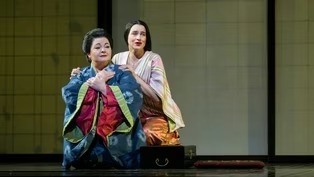
Asmik Grigorian performs “Un bel di”
Video has Closed Captions
Clip: S51 Ep28 | 2m 27s | Asmik Grigorian performs “Un bel di” from "Madama Butterfly." (2m 27s)
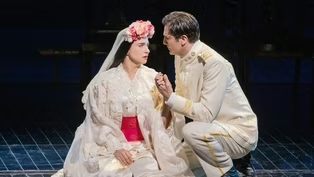
Great Performances at the Met: Madama Butterfly Preview
Video has Closed Captions
Preview: S51 Ep28 | 30s | Soprano Asmik Grigorian stars as Cio-Cio-San in her Met Opera debut. (30s)
Providing Support for PBS.org
Learn Moreabout PBS online sponsorship

- Arts and Music
The Best of the Joy of Painting with Bob Ross
A pop icon, Bob Ross offers soothing words of wisdom as he paints captivating landscapes.









Support for PBS provided by:
Major series funding for GREAT PERFORMANCES is provided by The Joseph & Robert Cornell Memorial Foundation, the Anna-Maria and Stephen Kellen Arts Fund, the LuEsther T. Mertz Charitable Trust, Sue...