
Signature Dish
BBQ Bonanza
Season 4 Episode 8 | 28m 59sVideo has Closed Captions
Bark in Stevensville, MD, DCity Smokehouse in Anacostia, Smokecraft in Arlington, VA
In this episode, Seth follows the aroma of smoke across the DMV. Kicking off his journey across the Bay Bridge, he enjoys a pork belly sandwich at Bark in Stevensville, MD. Next, he heads to DCity Smokehouse in Anacostia to dig into The Big Snoop, their loaded twist on the classic half-smoke. He wraps up at Smokecraft in Arlington, VA for a pitmaster’s modern take on cedar plank salmon.
Problems playing video? | Closed Captioning Feedback
Problems playing video? | Closed Captioning Feedback
Signature Dish is a local public television program presented by WETA
Signature Dish
BBQ Bonanza
Season 4 Episode 8 | 28m 59sVideo has Closed Captions
In this episode, Seth follows the aroma of smoke across the DMV. Kicking off his journey across the Bay Bridge, he enjoys a pork belly sandwich at Bark in Stevensville, MD. Next, he heads to DCity Smokehouse in Anacostia to dig into The Big Snoop, their loaded twist on the classic half-smoke. He wraps up at Smokecraft in Arlington, VA for a pitmaster’s modern take on cedar plank salmon.
Problems playing video? | Closed Captioning Feedback
Where to Watch Signature Dish
Signature Dish is available to stream on pbs.org and the PBS app.
Providing Support for PBS.org
Learn Moreabout PBS online sponsorshipANNOUNCER: And now, "Signature Dish," a WETA original series.
SETH: Today on "Signature Dish," it's a celebration of smoke.
We're firing up the barbecue, getting a helping of global flavors.
BERJ: That's the beauty of barbecue.
It's a love language that you can see in any part of the world.
SETH: And it's got me in hog heaven.
We'll pair old-school barbecue with a capital classic.
SHAWN: Pork shoulder's the best thing to go with that half smoke.
SETH: Oh, just falling right apart.
SHAWN: Easy money.
SETH: And bring a taste of the Pacific Northwest to the Mid-Atlantic.
DREW: This is cedar.
It's got great aromatics.
Puts off a really nice earthy flavor into the salmon as it cooks.
SETH: Wow.
I'm Seth Tillman, WETA producer and DC native, and I love good food.
Nice to meet you.
That's why I'm traveling to restaurants across the DMV, at each stop looking for the one thing you just gotta try... that Signature Dish.
We're starting this barbecue bonanza with a long drive out to Stevensville, Maryland.
It's here that you'll find Bark Barbecue Cafe, an out-of-the-way spot for top-notch 'cue, led by pitmaster and co-owner Berj Ghazarian.
BERJ: I grew up in an Armenian family.
I'm a first-generation Armenian-American.
I've been around food my entire life.
I grew up in the restaurant industry.
My dad's been in food manufacturing for over 45 years, and the foundation of what he did was gelato and sorbetto in Italy, so my earliest memories were standing next to my dad, batching gelato.
When I was in college, we visited my roommate's brother who lived in Austin.
After a football game, they say, "We're going to a barbecue place," what I later found out was called The Salt Lick.
And the smells and the smoke and just the sounds, everything, I fell in love.
I think for me, barbecue spans every culture.
Probably the first food we ever ate as humans was some sort of meat cooked over a fire.
When I moved back to Maryland, I said, "I need to figure out how to make this kind of barbecue."
I bought a smoker from Home Depot and started cooking in the backyard.
SETH: As Berj honed his barbecue skills, in 2010 he and his father opened Itaberco, a specialty foods business in a Stevensville office park.
BERJ: So we manufacture artisan flavorings and mixes for the dessert and beverage industry, and Bark just became a addition to that.
We wanted to build something for our staff and for the local community, then became more of a destination place for barbecue, and so it kind of took a life of its own.
What bark means in barbecue language is really that outside crust that you form from low and slow cooking, where you have this really beautiful browning of the outside of the meat, coupled with the spices and gives it this beautiful crust.
SETH: To get a taste of Bark, you first have to find it.
BERJ: We're 45 minutes from Washington, DC.
We're right off of 50.
It's become kind of this little treasure hunt to try to find it, and it's easy to remember, right?
It's the one barbecue joint across the Bay Bridge in a business park.
It's a great pit stop, no pun intended, on your way to the Eastern Shore.
We have the Terrapin Trail Park right behind us.
So since we have to-go, just grab your sandwich, get on the trail, hike to the beach, and enjoy your barbecue with your family.
SETH: Since there's no distance I won't travel for great barbecue, I'm setting off on my journey to Bark to taste their signature pork belly sandwich.
All right, so here's the business park.
Huh, the Paul Reed Smith Guitar Factory.
That's pretty cool.
But where's the barbecue?
Oh, wait.
What's that?
Ah, there we go.
Chef.
BERJ: Seth, how are you?
SETH: I'm doing pretty well.
Followed my nose right to the smoke.
BERJ: The smoke signal.
It gets them every time.
SETH: So here at Bark, are we talking about one particular region, style of barbecue?
BERJ: So Bark was really inspired by Central Texas, so brisket was kind of the bedrock.
But today we've been inspired by places all over the world.
Today we're working with pork bellies.
We're going to treat the pork belly similar to how we treat brisket.
We're going to cook it for almost 10 to 12 hours.
The idea here is to focus on bark.
SETH: Of course.
BERJ: Hence the name.
We're going to butcher this down into quarter pieces.
I'm going to go right down the center first.
SETH: And you got that nice fat cap on the top of this.
BERJ: Yeah, and it's going to render really well, keep our barbecue moist.
The reason we quarter these is because we want to get bark on all four sides.
This is an important step for us.
We're going to just lightly score the skin.
SETH: When I think pork belly, I'm thinking bacon.
But do we see a lot of pork belly in the barbecue world?
BERJ: You're starting to see it a lot more.
I mean, for bacon, we'd have to cure this, right?
And we're going fresh.
Because for me, Central Texas barbecue, the beauty of it is the meat speaks for itself.
SETH: All right, so you got your beautiful scored pork belly.
Now you're going to season these guys up?
BERJ: Now the magic starts.
So this is garlic toum.
It's my mom's recipe.
Kind of famous in the Levant region in Middle East.
So this is our binding agent.
And we're going to mix it with some olive oil.
SETH: And a lot of brisket would use mustard as a binding agent?
BERJ: Some people use mustard, but for me, this is our signature.
That's the beauty of barbecue nowadays.
It's a love language that you can see in any part of the world.
So we're going to move on to seasoning now.
SETH: Awesome.
Looks like we have a little pork rub right there.
BERJ: Yeah.
So unlike brisket, which is salt and pepper, with pork, we can do a little bit more flavor.
So we make this in house.
We've got some brown sugar in this.
We've got coriander.
We've got black pepper, salt.
And we've got a couple secret ingredients as well.
We're going to go heavy, heavy coating, and what this is going to do, it's going to create a beautiful crust.
SETH: Yeah, this thing is fully encapsulated with flavor right now.
BERJ: Exactly.
All right, Seth.
We've got all four seasoned up.
Let's put them on the smoker.
SETH: Beautiful.
Let's do it.
All right, we got a couple monster smokers here.
BERJ: This is our thousand-gallon Moberg smoker.
It's called an offset smoker, so firebox is over there, and it's pulling through using convection heat.
SETH: It's definitely getting pulled through because as soon as you opened that lid, getting a lot of it right in the face.
But it's just such a great smell.
BERJ: Yeah, and your closet's going to smell like it tonight.
So these are going to cook for about 12 hours.
We don't want to cook it too fast so it doesn't get tough.
SETH: And I see we got the wood close in hand.
What are you working with here?
BERJ: We cook with white oak.
SETH: No shortcuts when it comes to barbecue.
BERJ: No shortcuts.
No gas, no electricity, just wood.
All right, Seth, we're going to close this up so these can cook, but I'm going to show you what else we've got on the smokers.
SETH: Awesome.
BERJ: Take a look.
SETH: Smoker number two.
BERJ: Smoker number two.
SETH: Oh-ho!
BERJ: Yeah.
SETH: All right, some more bark right here.
BERJ: Some more bark here and here.
So we've got our briskets that went on at 5:30 this morning.
We kind of judge barbecue by how many espressos we have in the day.
So we start at 5:30 with one, we've got one at lunch, and then we've got one at night when we're about to go home.
So it's an all-day affair.
SETH: And probably dream about barbecue?
BERJ: Dream about barbecue and espresso.
Yeah.
All right, I've got one more meat I want to show you.
So this is something special.
So our ribs, most people like to cook them whole.
We actually butcher them into individual bones.
We want bark on all four sides.
SETH: Bark everywhere here.
BERJ: Bark everywhere.
And so right now they're braising, and so these are going to get nice and tender.
And right before serving, we're going to glaze these with a little bit of a Korean gochujang glaze, so some honey in there as well.
It'll be nice, tacky, smoky.
SETH: So we're talking about some more global flavors here?
BERJ: Absolutely.
So after the pork bellies have cooked for 12 hours, we let them cool.
It's going to help us slice those.
And then we're going to sear those on our flat top so that we get a nice sear, and it's going to have a nice crunch to it as well.
And then we're going to assemble the sandwich.
We're going to have a peach hoisin sauce, and then we're going to have some carrots that are pickled in rice vinegar, pickled cucumbers, some fresh basil, crispy shallots, and then we bring that all back together with some jalapeños to give it a little bit of a kick, and we'll be ready to eat.
SETH: All right, all that time at the smoker definitely worked up my appetite.
Can't wait to get right to it.
BERJ: Let's dig in.
I hope you're picking up those different layers of flavor, the sweet, the acidity, a little bit of that spice from the jalapeño and that smoke.
SETH: Wow.
I'm picking it all up, and it's got me in hog heaven.
That is a terrific bite of sandwich right there.
And there is a real nice sweetness coming from that hoisin, but also those shallots are giving it a nice crunch.
BERJ: Yeah.
I think a good sandwich is a balance of everything, right?
Needs some spice, it needs some sweetness, needs some crunch.
SETH: Get that in spades.
Having that little herbs, a little pickle, really, really nice balance.
BERJ: Brings it all together, yeah.
SETH: And, chef, there's so many other good-looking things on the table here.
What are these potatoes right here?
BERJ: So these are our laser potatoes.
They're kind of a play on batata harra, kind of a Lebanese, Armenian dish that we have.
So it's just thinly sliced potatoes, cooked, compressed, chilled, and then fried to order.
And it comes with our chipotle mayo.
SETH: That is delicious.
Real nice crunch on the outside, but nice and tender on the middle.
And some interesting looking rice, I guess with some more crispy shallots right there?
BERJ: Yeah, exactly.
This is our grandma's red rice.
So my grandma, Tamar, we grew up eating this and probably one of the first things I learned how to cook.
And this is kind of at any dinner table in an Armenian household, so it's something near and dear to my heart.
SETH: So you're having a little fun with the sides, too.
BERJ: Yeah, exactly.
And I think sides at a barbecue restaurant help you be able to play with other flavors.
Whereas barbecue sometimes you have to stick to tradition.
So that means you've got to have some fun sides and keep it fresh.
SETH: And I got to imagine I'm not the only one who thinks they're a little bit lost when they come in here.
You know, what's it been like for you to draw people to your little neck of the woods?
BERJ: Yeah, it's been wonderful.
I mean, this was a little bit of an accident, and so when we opened this, it was really for the community, and it just turned into something a little bit bigger than that.
So I'm thankful for everyone who makes the trek and comes over that bridge and has some barbecue with us.
SETH: Oh, it is a trek worth making for sure, and I can't wait to come back and try some more awesome dishes from your menu.
BERJ: We can't wait to have you, Seth.
SETH: Thanks, Chef.
For our next stop, I'm back in the nation's capital, this time in Anacostia.
I'm checking out DCity Smokehouse, a second location for the pioneering barbecue spot headed up by owner, Melvin Hines.
MELVIN: I'm born and raised in Capitol Heights, Maryland, and I actually live in Anacostia.
My grandparents, they have their roots in North Carolina.
I spent a lot of summers in Virginia, North Carolina, and some of my fondest memories are barbecues.
You know, we would have these large family gatherings, and so when I created DCity Smokehouse, it was really with that in mind: you know, family, food, fellowship.
SETH: DCity's smokers are tended to by pitmaster Shawn McWhirter.
SHAWN: I'm from Washington, DC.
I'm from the Northeast side.
I used to get in trouble a lot as a kid, and they used to put me in the kitchen with my grandmother.
She would give me peas to shuck, peel potatoes and stuff like that.
Kitchen always keep you out of trouble.
SETH: DCity's first location in Northeast DC opened in 2013.
MELVIN: When we originally started here in Washington, DC, there's maybe one or two other barbecue places.
So our taste, our little bit of sweet, little bit of heat, resonated with a lot of our customers.
SETH: The Anacostia outpost opened its doors a decade later.
MELVIN: The decision to open up in Anacostia was really based on the love of the neighborhood.
It was very important to open a restaurant that had sit-down capability, because we lacked those resources here in Anacostia.
It just meant a lot to me to bring the same great taste that we were experiencing on the other side of the river, being part of this exciting, re-imagined Anacostia.
I feel like DCity Smokehouse really represents DC.
We take different elements of barbecue really from all over, but we condense it here in our own little way.
SHAWN: Everybody trying to put a finger on it, "What is DC barbecue?"
It's good food.
That's what it is.
It's the best thing ever.
You got a little bit sweet, little bit heat to it.
And it's important to the city to have a barbecue scene, because I want to be known like Texas.
I want to be known like North Carolina, Kansas City.
From the guys to the back, from the people to the front.
This is what we do.
We make things happen.
We make people happy.
And that's it.
SETH: I'm off to DCity to try a sandwich starring DC's most iconic food: the half smoke.
Shawn.
SHAWN: Seth.
SETH: Good to meet you.
SHAWN: Good to meet you.
Welcome to DCity Smokehouse in Anacostia.
SETH: All right, well, I'm excited to be here.
What do you got cooking up today?
SHAWN: Today we're going to show you all about our signature dish, the Big Snoop.
That's a half smoke, pulled pork, coleslaw, and fried onions.
SETH: All right, that sounds mighty good.
And a lot of times, a half smoke, you know, there's going to be some chili, there's going to be some cheese on top, but we're talking pork shoulder?
SHAWN: Pork shoulder is the best thing to go with that half smoke.
It gives like that extra juiciness to it.
SETH: And your pork shoulder, are we talking kind of a Carolina style here?
SHAWN: Nah, more of a DCity Smokehouse style more than anything.
So we just want to just rub the seasoning that we have right here, and what we have is salt, pepper, brown sugar, of course, and you have your little garlic.
I like to put a little cayenne in and just put that little bit of heat that people love.
SETH: And that scoring on top, you're going to be able to work that seasoning into that.
SHAWN: Right all up in there.
That's where magic is.
If they told you fat was bad for you, they lied.
So once we finish seasoning everything up, we going to let it sit for like a good 30 minutes before we even put in the smoker, but I took one out already just for you.
Ah.
SETH: So this is what I've been smelling all this time.
SHAWN: All this time this is what you've been smelling.
SETH: Wow.
And how much time did this spend in the smoker?
SHAWN: So it's been six hours, low and slow.
SETH: Oh, just falling right apart.
SHAWN: Yeah.
Easy money.
So as you can see, all this good juice coming off of here, that's goodness right there.
Nothing but heaven.
See, I want you to taste, just to take... Be careful now.
SETH: Oh, man.
Smokey, juicy.
There is a decent amount of actual spice there too.
SHAWN: It definitely is.
Got that caliente.
I like that kick to it.
You feel me?
So now that we got all this shredded up, we're going to add our signature juice.
And you have a little bit of vinegar, a little bit of apple juice, and we just toss it right in there.
Now we done with the pulled pork.
Now it's time to move on to the half smokes.
SETH: All right.
SHAWN: Can you hand me those for me?
SETH: There you go, Chef.
SHAWN: All right.
Hey, you ever wonder where does the name half smoke come from?
SETH: I sure have.
SHAWN: Everybody has their own theory.
So Seth, this is half beef, half pork.
It's going to have a nice snap to it when you bite into it.
SETH: And the name half smoke, I know everyone's got their theories, but is it coming from these things actually already being smoked?
SHAWN: No.
What we going to do is we going to throw them in the smoker for five minutes and then we get to assemble our signature dish, the Big Snoop.
SETH: All right.
Let's throw them in.
SHAWN: All right.
All right, Seth, welcome to the smoker.
Can you hold this for me?
SETH: Happy to do the honors.
SHAWN: So the moment you been waiting for.
SETH: I want to see that smoke.
SHAWN: Ta-da.
SETH: I wanted to see it, and I'm feeling it too.
SHAWN: Right.
Right?
SETH: Wow.
And then what kind of wood are you using?
SHAWN: So we're using post oak, always, and we using charcoal to get everything started.
So once my charcoal gets piping hot, I will add my post oak to my fire.
Lay that right there because we're going to let that go.
SETH: And this is kind of a 24/7 operation here because you got to be constantly checking on these things to see how they're doing, right?
SHAWN: This is a 24-hour job.
But let me let you know something, you got your cameras on.
If y'all wasn't in here right now, I'd have the music playing, like some old-school type of music.
I'm always listening to some James Brown, some Temptations.
I'll be talking to my brisket.
I'll be rubbing everything down.
I don't cook for today.
I cook for tomorrow.
I'm always prepping for the next day.
Got to talk to these like people out here.
You know what I mean?
My friends.
My friends come and go.
We're going to close this all up so the show can go on and we can get to this Big Snoop.
We're going to let our half smokes finish smoking, and then we're going to take them out.
We're going to take the half smoke, we're going to split it down the middle, and we're going to fry it.
So we're going to toast the bun, and then we're going to fry our crispy onions, and then we're going to take the half smoke, and then we're going to put our nice juicy pulled pork right there on top.
After that, we take the coleslaw, we're going to take our crispy onions, and we're going to hit it with the barbecue sauce.
And that is our signature Big Snoop.
SETH: All right, gentlemen, there are sandwiches, and then there's this Big Snoop.
SHAWN: That's right.
SETH: I'm going to try my best.
MELVIN: Go for it.
SHAWN: Take your time.
SETH: Here we go.
MELVIN: As long as you have your paper towel close by... SHAWN: You are all good.
MELVIN: ...you're good to go.
SHAWN: Some people say you need a knife and a fork.
SETH: Oh, yeah.
That is unreal.
It's also dangerous because it is two meals in one.
I got room for a bite of pulled pork in one bite, and then I got to go back for the half smoke in the next.
I'm just loving the snap that you get, like any good half smoke.
Good amount of spice and a little bit of sweetness in that barbecue sauce.
And of course, the coleslaw giving it that nice kind of acidic note to round it all out.
MELVIN: It's a celebration in your mouth.
It really is.
It's a little bit of everything that just comes together in the perfect taste profile.
SETH: And also, I got to ask, the Big Snoop, where's that name coming from?
MELVIN: You want to talk about it?
SHAWN: When we first started, everybody had their own sandwiches, and this is the Big Snoop, and that was one of my OGs that I really looked up to.
He really showed me a lot, taught me a lot, showed me about patience.
But this is his signature dish, and it's for him.
SETH: And barbecue is a team effort.
SHAWN: Definitely.
MELVIN: It is.
And everybody has their way of doing things, so we just try to take those elements, a little bit of sweet, a little bit of heat, put it all together.
The Big Snoop speaks to that directly.
It is... SHAWN: Timeless.
MELVIN: ...everything that we do under this roof on a bun.
SETH: It sure is.
And we carrying over that flavor profile to some wings here as well?
MELVIN: Oh you know, I say it all the time that our wings are the best around the city.
Yeah, just taking a nice dusting of seasoning and smoking it off.
Didn't even put any sauce on it.
SETH: It doesn't need any sauce because you guys are not shying away for some sweet flavors, because you get a little brown sugar, molasses flavor on that.
MELVIN: A little sugar, little sweetness, right?
That's right.
The trick behind our wings, we also do a quick flash fry, and that just gives it that crispiness right on the outside.
SETH: Getting kind of the same snap you're getting with the half smoke with the chicken wings as well.
MELVIN: That's right.
That's right.
SETH: And you know, I'm from DC.
I remember a time not too long ago there just wasn't really a barbecue scene here.
Do you think we've now found a DC style of barbecue?
SHAWN: You got to ask somebody else about that.
Like I think that for us, I think we made the most noise when we first came out the gate to establish what DC is about, not following everybody else's tradition.
We have other businesses out here that been around, but they ain't make no noise like us.
We here to stay.
SETH: Well, I'm loving this unique stamp that you guys are putting on the DC barbecue scene here, and I'll be coming back again real soon.
Thank you both so much.
MELVIN: Thanks for coming in.
SHAWN: Welcome to the brisket squad, cuz.
SETH: Hey, thanks, Shawn.
SHAWN: Always.
SETH: For my last pit stop, I'm off to Arlington.
In the heart of the Clarendon neighborhood is Smokecraft Modern Barbecue, a sleek ode to smoke from pitmaster and owner, Drew Darneille.
DREW: I grew up in Bethesda, Maryland, so right here in the DMV area.
For me, it all began cooking on the beach with my dad, grilling hot dogs and hamburgers at our summer place, and then as I grew older, I started wanting to make really great ribs.
And then I got into restaurants at a young age and my career path then just happened to take me into a barbecue restaurant.
SETH: After Drew got a taste of the barbecue world, he decided to up his game on the competition circuit.
DREW: So I took a class, said, "I'm ready to go."
Started off here in DC at the DC Barbecue Battle.
And I went downtown, I saw all the pitmasters and all the rigs, and we finished second to last.
And I came home so discouraged and I said, "Our food is better than this."
And I'm a competitive person, so I said, "You know what?
We're going to do this again."
And then it became again, and then again, and then before you know, our food as a result got a lot better.
And I really became passionate about it, started enjoying it.
It became more than just a hobby, and now I'm one of the top pitmasters in the mid-Atlantic.
In the barbecue world, you're only as good as your last brisket.
The worst thing that any restaurant can do over time is just say our food is good enough.
And by competing, we continue to push ourselves and say, "No, it's not.
We need to continue to make it better."
So here at Smokecraft, we came up with this concept of modern barbecue, which we define as continuing to evolve what barbecue is and can be, and the only rules we have about our food is that it has to be hit by fire or smoke.
Once we hit it with fire or smoke, you're entering the realm of barbecue, and that opens up lots of doors for us to be able to do lots of fun things, things like our chipotle maple cedar plank salmon or our applewood smoked crab cakes or our smoked spaghetti squash.
These are dishes that open the doors to people who may not have thought that this was even in the world of barbecue.
So as we designed the restaurant itself, I think it was very important for us to create a more upscale, modern feel.
It's going to feel like barbecue, but you're going to feel like it's a step up.
We're not serving food on metal trays, and I think it just elevates the whole experience.
We want this restaurant to be that place where you can come in and really begin to just relax, enjoy some great food, enjoy some great hospitality, and just see what bringing people together really is all about.
SETH: Drew.
DREW: Seth, good to meet you.
SETH: Good to meet you as well.
And salmon, shockingly haven't done salmon before on "Signature Dish."
What are you making today?
DREW: Today I'm going to make you our cedar plank salmon.
This is a dish you're not going to find at your everyday barbecue spot.
This is a great example of what we consider our modern barbecue approach.
SETH: All right, and is this the cedar right here?
DREW: This is the cedar.
Here at Smokecraft, we use seven different types of wood for cooking on a daily basis.
As you can see behind me, we're using hickory, cherry, oak, maple.
We use all these different types of wood to impart different flavor on different types of meat.
We're using smoke almost like salt and pepper just to season the food.
For salmon, we want to use the cedar because it's got a high oil content, a really nice, earthy, sweet, and spicy flavor.
SETH: All right, and I see some cedar that looks like it's been soaking here in some water.
DREW: We're going to put this on high heat and direct flame.
We want to make sure that we've soaked it in water overnight because we're trying to get it to smolder.
We don't want the board just to catch fire.
SETH: Yeah, we certainly don't want that.
So how are you going to prepare the salmon for cooking?
DREW: I'm just going to cut this to give us a nice filet that we can put right onto the cedar plank and cut about eight-ounce filet.
So we're going to go ahead and take one of these boards that we've been soaking and we're going to put our salmon right on top of it here.
And then I'm going to take some of our salmon rub, salt, pepper, some garlic, paprika.
We're adding a little bit of chipotle chilies in here as well.
The chipotle is going to give it just a little extra bit of kick and spice.
All right, Seth, so I got our salmon.
I've got it seasoned.
I've got our cedar plank.
Let's go get smoking.
SETH: Let's do it.
DREW: All right.
All right, Seth, so here we are at our grill, and we're going to go ahead and put that right onto the fire here.
SETH: And because the salmon is such a fatty piece of fish, does that help when you put it on the grill not dry out?
DREW: Absolutely.
SETH: And, Chef, we got a hot grill going here, so I got to ask, is this barbecue?
DREW: So this is where we roll into the world of modern barbecue.
And our only rule about our food at the restaurant is it has to be hit by fire or smoke.
So here we're using the high heat of the grill to impart that smoke through the wood onto the fish, so that fits right within our rules.
But your traditionalists will say it's low and slow.
I can tell you from competing, we cook as high as 400 degrees at competition for barbecue.
So temperature isn't so much a factor as how we're imparting the wood flavors and the smoke into the food, and that's where I really believe that we get into the world of barbecue.
SETH: All right, so when we start getting the angry calls to the switchboard or the letters, I know how to respond.
DREW: Exactly.
Exactly.
SETH: All right, so this is barbecue, folks.
DREW: Yes.
SETH: Deal with it.
DREW: This is definitely barbecue.
All right, Seth, so now you're seeing that the wood plank is beginning to catch a little bit, you're getting a little bit of that smoke.
So to help it get that good smoke flavor into it, we're going to go ahead and we're just going to cover this right here, and that's going to keep that smoke right on top of the fish.
So after this cooks for 10 to 15 minutes, I'm going to take the lid off, and then we're going to paint it with our maple bourbon glaze.
The maple glaze has got maple syrup, some balsamic, some garlic, some ginger, of course a little bit of bourbon, and let it get to a nice caramelized top.
To plate the dish, I'm going to top it with our candied pecans, add our charred Brussels sprouts, some wild rice, and a charred lemon so we can bring it all together.
And that's going to be our cedar plank maple bourbon salmon.
SETH: All right, Chef, we talking more smoke on the cocktail here?
DREW: We absolutely are.
It wouldn't be Smokecraft if we weren't doing smoked cocktails.
This here is our smoke on the water.
It's a smoked old-fashioned using some cherry wood chips.
We just let it sit there for half a second, and then all of a sudden... SETH: The big reveal.
DREW: ...the big reveal.
SETH: Bathed in one more... DREW: One more.
SETH: ...one of the seven woods, cherry smoke.
DREW: Yep.
SETH: All right.
Smells amazing.
Cheers.
DREW: Well, cheers.
SETH: Oh, delicious.
Well-balanced.
And I cannot wait to get to this salmon right here.
DREW: Let's get into it.
SETH: Wow.
That salmon is just packed with flavor.
It is so moist and tender.
I love the way that you get a little bit of spiciness with that rub.
Great sweetness with that glaze, and just the nicest little kiss of smoke from those cedar planks right there.
DREW: Absolutely.
We love using this with the salmon.
It works really nicely.
It's subtle without overpowering it.
SETH: Yeah, and I'm going to try to get a few of the candied pecans in here.
Have those pecans been smoked a little bit too?
DREW: We use a smoked butter on the pecans as we mix them with some sugar, cinnamon, nutmeg, and it really gives it that nice little smoky aspect.
SETH: Nothing in this restaurant can escape the smoke.
DREW: It can't.
That is absolutely true.
SETH: It touches everything.
And I love that you're all about the modern barbecue, but you're obviously all about the traditional barbecue as well.
Is this some of the award-winning Kansas City ribs right here?
DREW: These are award-winning ribs.
We use just some cherry wood smoke, our house-made rub, bringing together some really great flavors, and it should be subtle, not overpowering.
That looks like it was a perfect bite.
SETH: Perfect bite, not completely falling off the bone, and you know just a little hint of sweetness and a little spice in that rub too.
DREW: And you mentioned it's not falling off the bone, and that's on purpose because in competition, completely falling off the bone is overcooked.
So we want that meat to have a perfect bite, but still hold onto the bone to get that perfect level of tenderness.
SETH: Loving it.
And you're out there all the time competing, trying to keep your skills sharp.
I got to imagine there's got to be one tip or trick you can offer to the home cook to take their game to the next level.
DREW: Practice.
You only make great barbecue after making tons of bad barbecue.
So don't be afraid to go try new things, get out there on your smoker.
One of the most important things when you're cooking at home is we don't want to see big puffy clouds of white smoke.
That's going to leave a dirty ash flavor on your food.
So when your smoker is burning, you're barely seeing it come out of the top.
So keep an eye on your smoke and your fire control, but get out there, give it a shot, and keep cooking.
SETH: Stick with it.
Well, I love your delicate approach to working with smoke, and I'll be finding myself back here again real soon.
DREW: Oh, I look forward to seeing you then.
SETH: Hey, thanks, Chef.
DREW: Take care.
SETH: Cheers.
(music plays through credits) ANNOUNCER: To find out more about great food in the Washington Metro area, visit weta.org/signaturedish.
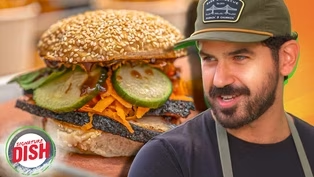
How Bark Barbecue Cafe Achieves the Perfect Bark on a Juicy Pork Belly
Clip: S4 Ep8 | 4m 17s | At Bark Barbecue Cafe, pork belly gets the 'brisket' treatment — Central-Texas style. (4m 17s)
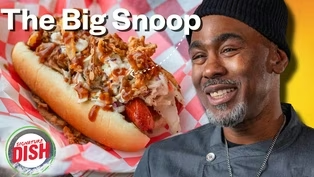
Inside the 'Big Snoop': Half Smoke Meets Pulled Pork |DCity Smokehouse
Clip: S4 Ep8 | 5m 18s | Pitmaster Shawn McWhirter breaks down the build of the 'Big Snoop' — part sausage, part pulled park. (5m 18s)
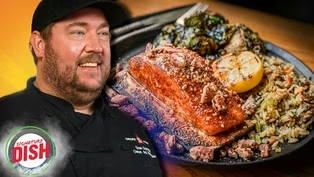
Watch Smokecraft Modern Barbecue Prepare Their Cedar Plank Salmon
Clip: S4 Ep8 | 4m 33s | Smokecraft Modern Barbecue in Arlington, VA uses smoke like a seasoning on their cedar plank salmon. (4m 33s)
Providing Support for PBS.org
Learn Moreabout PBS online sponsorship New Episode
- Food
Christopher Kimball’s Milk Street Television
Transform home cooking with the editors of Christopher Kimball’s Milk Street Magazine.

 New Episode






Support for PBS provided by:
Signature Dish is a local public television program presented by WETA