Northwest Profiles
Heirloom Revival with Marzell Van Vlaenderen
Clip: Season 39 Episode 3 | 6m 24sVideo has Closed Captions
A flood-damaged 1800s dining table gets new life from master restorer Marzell Van Vlaenderen.
A dining table from the late 1800s. Years of wear, damage, and even floodwater—yet it’s priceless to one family. Meet Marzell Van Vlaenderen, a master furniture restorer who believes anything can be repaired. Watch as she brings a cherished family heirloom back to life, preserving the history, memories, and meaning built into every piece.
Problems playing video? | Closed Captioning Feedback
Problems playing video? | Closed Captioning Feedback
Northwest Profiles is a local public television program presented by KSPS PBS
Funding for Northwest Profiles is provided by Idaho Central Credit Union, with additional funding from the Friends of KSPS.
Support provided by:

Northwest Profiles
Heirloom Revival with Marzell Van Vlaenderen
Clip: Season 39 Episode 3 | 6m 24sVideo has Closed Captions
A dining table from the late 1800s. Years of wear, damage, and even floodwater—yet it’s priceless to one family. Meet Marzell Van Vlaenderen, a master furniture restorer who believes anything can be repaired. Watch as she brings a cherished family heirloom back to life, preserving the history, memories, and meaning built into every piece.
Problems playing video? | Closed Captioning Feedback
How to Watch Northwest Profiles
Northwest Profiles is available to stream on pbs.org and the free PBS App, available on iPhone, Apple TV, Android TV, Android smartphones, Amazon Fire TV, Amazon Fire Tablet, Roku, Samsung Smart TV, and Vizio.
Providing Support for PBS.org
Learn Moreabout PBS online sponsorshipAnd I don't believe there's anything that can not be repaired.
Or at least I haven't met anything that couldn't be repaired yet.
<Joyful Music> [Meet Marzell Van Vlaenderen,] [a master furniture restorer] [who believes every piece carries a story worth saving.]
Most of my clientele, almost every one of them is going to pass something on or got something passed on.
And that's, that's where I come into play and, and just make sure that it's structurally sound and, and looks good.
[For Marzell, restoration isn't about perfection.]
[It's about] [preserving meaning, memories and craftsmanship] [passed from one generation to the next.]
I was raised in the mountains of Montana, and, uh, the timber industry was all around me.
My mom and dad were on the ranch.
They, they made cedar shakes.
And then on the side, my mom would refinish other people's antiques.
They ended up turning it into a business.
My mom got sick in ‘08, and at the end we were just going to close the business.
And at that time my factory was closing.
So, um, it was a great opportunity.
I had the shop.
I, I had most of the equipment.
I was amazed how much knowledge I had.
And I still had my dad.
So, uh, I took it over from my family in ‘08 and went public with it in ‘09.
Uh, and now I love it.
And I, you know, I feel like I'm fairly good at it, so, uh, it's an enjoyable thing.
[When we visited Marzell's shop,] [she was immersed in a deeply personal project.]
[Restoring a century old dining table that once belonged] [to a woman affectionately known as Grandma Mac.]
This was her table, and she had it for many, many, many years, using it every day in the farm.
And my client inherited it in terrible disarray.
It's from the late 1800s.
It's seen a lot of wear and tear, through the years.
And its last 20 years have been stored in a basement that flooded.
Has a lot of issues with rotten wood, veneer popping up everywhere.
We're going to work on this throughout this process.
[Marzell's approach favors strength over surface.]
[Honoring a piece's history] [while ensuring it can be used for decades to come.]
So now that I've got the clamps off of this chair, you can see this gusset that I put in here.
And when I'm done, the only reason you're going to tell the difference is because this is brand new wood, and this is 100 plus aged wood.
And when you mix the two, you will definitely always see it.
Do I care?
No.
This is a family heirloom.
To be able to sit down at this table again is more important to most people than whether or not you can see a repair or not.
[Beyond the shop, Marzell sees her work as a responsibility.]
[Passing on hard earned knowledge so that traditional] [craftsmanship doesn't disappear.]
After 20 years of me and the dog and... my shop, I needed a little bit of social.
So I spend a couple of days a week at Woodcraft.
Using my mind, sharing my information, just... trying to teach people, anybody that wants to learn.
Eventually, I'm not going to be able to do this anymore.
And this craft, I believe, should carry on.
So for that to happen, I have to start opening my mouth and teaching people.
So I feel it's really important to, to keep passing it on and to do it in a way that people can, can enjoy doing it and not... kill themselves expense wise.
I give my business cards out all the time.
If you have a question, if you have a thought, if you just want to talk to someone, call me up, send me a text, send me a picture.
We'll talk about it.
I had to have someone do that with me.
Why can't I pass that on to.
I don't have to charge you to talk to you.
So a lot of times I do a lot of consulting.
Just... Just to help pass it on.
[Even after decades of experience,] [handing a piece back to its owner still comes with nerves.]
There's not been one time that I haven't had a client come pick their stuff up, that I was not nervous.
I am always nervous.
And I don't know what that is.
Confidence?
I, I don't know.
Buut it's, yes, for me, it's nerve wracking.
I have this theory that, again, nothing goes out of my shop unless the client's happy.
And if they're not happy, that means I'm wasting money.
I'm losing money.
So, it's nervous for me in that sense, but more in the sense of “oh crap, youre disappointed.” That disappoints me.
I think it's kind of like an artist selling their stuff.
You just, you don't know if it's... liked or worthy until it sells.
So.
It's a hard one to get past.
I never have figured out how to do it.
[Every piece that leaves the shop] [carries a piece of Marzell with it.]
[Repaired,] [respected,] [and ready for its next chapter.]
Okay.
So, [Oh my Gosh!]
chair.
[Marzell!]
Chair.
[Oh, my!]
[Oh, woah, woah!]
Chair.
[Oh my gosh!]
[Oh, Marzell!]
[Beautiful!]
[Grandma and Grandpa Mac...] [would be so proud.]
[Grandma would be tickled to death.]
That's awesome.
This is why I do it.
This is why my family did it.
For this right here.
And my mom and dad were so more about the people and the story than they were about the furniture.
So, hopefully I'm passing that on, because it's not just a piece of furniture.
It's a part of everybody's history that sits around it.
Video has Closed Captions
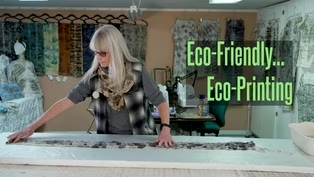
Clip: S39 Ep3 | 4m 47s | Nan Drye work with plants and plant dyes on natural fibers to make beautiful, useful things. (4m 47s)
Video has Closed Captions
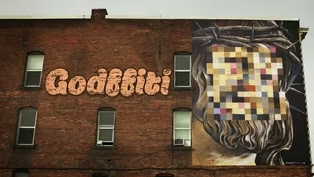
Clip: S39 Ep3 | 5m 48s | Follow the journey of Daniel Lopez, a Spokane based Muralist who turns hardships into beautiful art. (5m 48s)
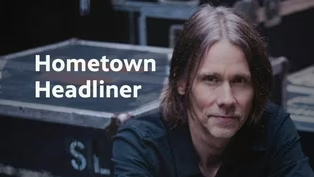
Hometown Headliner: The Story of Myles Kennedy
Video has Closed Captions
Clip: S39 Ep3 | 7m 34s | Platinum recording artist Myles Kennedy grew up in Spokane with music, mentorship, and community. (7m 34s)
Video has Closed Captions
Preview: S39 Ep3 | 30s | Daniel Lopez Muralist; Myles Kennedy Musician; Artist Uses Plant Fibers; Marzell Furniture Restorer (30s)
Providing Support for PBS.org
Learn Moreabout PBS online sponsorship













Support for PBS provided by:
Northwest Profiles is a local public television program presented by KSPS PBS
Funding for Northwest Profiles is provided by Idaho Central Credit Union, with additional funding from the Friends of KSPS.