Northwest Profiles
Eco Friendly, Eco Printing
Clip: Season 39 Episode 3 | 4m 47sVideo has Closed Captions
Nan Drye work with plants and plant dyes on natural fibers to make beautiful, useful things.
Mixed media artist Nan Drye work with plants and plant dyes on natural fibers to make beautiful, useful things.
Problems playing video? | Closed Captioning Feedback
Problems playing video? | Closed Captioning Feedback
Northwest Profiles is a local public television program presented by KSPS PBS
Funding for Northwest Profiles is provided by Idaho Central Credit Union, with additional funding from the Friends of KSPS.
Support provided by:

Northwest Profiles
Eco Friendly, Eco Printing
Clip: Season 39 Episode 3 | 4m 47sVideo has Closed Captions
Mixed media artist Nan Drye work with plants and plant dyes on natural fibers to make beautiful, useful things.
Problems playing video? | Closed Captioning Feedback
How to Watch Northwest Profiles
Northwest Profiles is available to stream on pbs.org and the free PBS App, available on iPhone, Apple TV, Android TV, Android smartphones, Amazon Fire TV, Amazon Fire Tablet, Roku, Samsung Smart TV, and Vizio.
Providing Support for PBS.org
Learn Moreabout PBS online sponsorshipWhen you're using silk fabric, which is what I use mostly.
You will actually get a print out of just about anything.
Silk takes color fabulously.
Nan Drye creates art by experimentation.
She uses ecologically sustainable methods of printing with plant material and explains the art form.
Eco printing... Eco in this case, stands for ecologically sustainable.
And pulling color out of the leaves themselves.
When you see a leaf shape, that is the color that leaf makes.
There's no ink, there's no paint.
It's a steaming or a boiling process.
And so I'm playing with the chemicals that the plant is producing throughout its growing season.
What you want are the colors in the summer green is what I call it.
Then in the fall, the tree is starting to shut down, and all the last little bit of chlorophyl goes out of the leaves.
And that's when we see those beautiful colors in the fall.
Those leaves are usually still usable as well.
A small portion of Nan's creations cover the walls of her workshop.
That highlights her foray into the eagle print process.
Her interest in the art form through time hasn't waned.
It's only gotten stronger.
It's a form of natural dyeing you're mixing, a mordant, which is, is a metal onto the fabric first.
And then placing the leaves and then rolling the whole thing up under some kind of pressure.
I tend to roll things in a jelly roll, but you can wrap them around rocks and tin cans and all sorts of things.
You want that pressure so that you get a really nice print of the leaf.
And then my method is to steam the roll of fabric over boiling water.
You can boil it as well for different reasons.
I just love the really, beautiful prints you get from steaming and that really good contact between the layers of fabric.
Never steam the stuff inside.
You don't know what fumes are going to come off of it.
This only works on natural fibers.
I personally prefer not any kind of a blend, although theoretically, if it's like cotton and linen, it should work.
I just like it's more of a sure thing if you're using single fibers.
So I work mostly on silk, but it does work on, well, wool, cotton and linen.
that's been the discovery process over the years, waiting for the right time of year for some things.
What leaves you put together in this role actually affect each other as well.
Oak leaves have a lot of tannins in them.
That's going to help make everything else darker.
Experimenting with like, you know, you can't get carried away with metals on fabric because, yeah, rust will make holes in it.
A woman in Australia named India Flint wrote a book called Eco Color.
I ran into it about 2011, and I have not been able to leave it alone since before that I was a clothing maker, and I used synthetic dyes.
But this is so much cooler, and it's just this intriguing blend of science and art.
And I couldn't leave it alone, you know?
Just couldn't leave it alone.
Currently, Nan sells her creations and teaches others the craft that she became enamored with nearly 15 years ago and uses her expertise to create new pieces through trial and error and trial and success.
When asked of her favorite leaves, she uses.
I like them all, but the arrowleaf balsam root makes a beautiful yellow print, even though it's a green leaf.
And then my favorite thing to put with it is spotted knap weed, which is an invasive species.
No one argues with me when I come to get this.
They like to load it into my car and it makes a beautiful orange yellow.
A lot of things that won't really work well on fabric.
They make a beautiful print, but it's going to disappear or it's going to wash out on paper.
It stays.
And so that's a lot of a good way to start experimenting because it's inexpensive.
it's just such a fascinating process.
People don't understand that when you're looking at a green leaf, that all that color is in there.
Right?
Because all we see is the chlorophyl because that's the way our eyes and brain interpret color.
But all those other chemicals are in there.
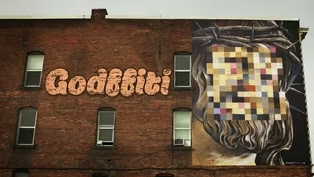
Video has Closed Captions
Clip: S39 Ep3 | 5m 48s | Follow the journey of Daniel Lopez, a Spokane based Muralist who turns hardships into beautiful art. (5m 48s)
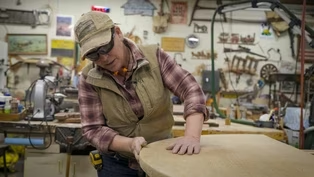
Heirloom Revival with Marzell Van Vlaenderen
Video has Closed Captions
Clip: S39 Ep3 | 6m 24s | A flood-damaged 1800s dining table gets new life from master restorer Marzell Van Vlaenderen. (6m 24s)
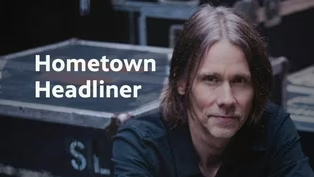
Hometown Headliner: The Story of Myles Kennedy
Video has Closed Captions
Clip: S39 Ep3 | 7m 34s | Platinum recording artist Myles Kennedy grew up in Spokane with music, mentorship, and community. (7m 34s)
Video has Closed Captions
Preview: S39 Ep3 | 30s | Daniel Lopez Muralist; Myles Kennedy Musician; Artist Uses Plant Fibers; Marzell Furniture Restorer (30s)
Providing Support for PBS.org
Learn Moreabout PBS online sponsorship











Support for PBS provided by:
Northwest Profiles is a local public television program presented by KSPS PBS
Funding for Northwest Profiles is provided by Idaho Central Credit Union, with additional funding from the Friends of KSPS.