
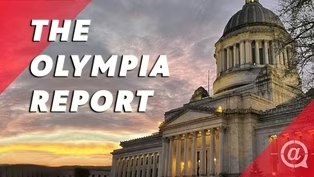
The Olympia Report
Episode 4 | 28m 33sVideo has Closed Captions
Eastern Washington legislators return from Olympia to report on the 2026 Legislative Session.
Eastern Washington legislators return from Olympia to report on the results from the 2026 Legislative Session. Find out what passed, what didn't, and what it all means for you. Guests include Sen. Marcus Riccelli, Rep. Suzanne Schmidt, Spokane City Councilman Paul Dillon, and Gonzaga Economics professor Ryan Herzog.
Problems playing video? | Closed Captioning Feedback
Problems playing video? | Closed Captioning Feedback
AT ISSUE is a local public television program presented by KSPS PBS
The Olympia Report
Episode 4 | 28m 33sVideo has Closed Captions
Eastern Washington legislators return from Olympia to report on the results from the 2026 Legislative Session. Find out what passed, what didn't, and what it all means for you. Guests include Sen. Marcus Riccelli, Rep. Suzanne Schmidt, Spokane City Councilman Paul Dillon, and Gonzaga Economics professor Ryan Herzog.
Problems playing video? | Closed Captioning Feedback
How to Watch AT ISSUE
AT ISSUE is available to stream on pbs.org and the free PBS App, available on iPhone, Apple TV, Android TV, Android smartphones, Amazon Fire TV, Amazon Fire Tablet, Roku, Samsung Smart TV, and Vizio.

At Issue: Poison on the West Plains
PFAS chemicals have left Spokane's West Plains residents without safe drinking water.Providing Support for PBS.org
Learn Moreabout PBS online sponsorship- [Legislator] Senator Riccelli.
- Thank you so much, Mr.
President.
I move that the 2026 regular session of the 69th legislature do now adjourn (speaks in Latin).
- That's a wrap on the 2026 Washington legislative session.
Now it's time to talk about how it went.
What passed?
What didn't?
Plus, everything you need to know about Washington State's first income tax, known as the Millionaire's Tax.
(exciting music) (exciting music ends) Hello, and thank you for joining us on "The Olympia Report" on "At Issue."
I'm Dana Haynes.
It was a short session this year, just 60 days, but lawmakers still had a lot on their plates.
Joining me today to talk about how it went is Senator Marcus Riccelli, a Democrat from District 3, and Representative Suzanne Schmidt, a Republican from District 4.
And we wanna make sure that you guys are, you know, relaxed, the session just ended last week, that everything's good.
We appreciate you guys being here.
- [Sen.
Riccelli] Absolutely.
- Also joining us today is Spokane council member Paul Dillon to discuss how the session will impact us here locally in Spokane.
And to talk about the economic impacts, Ryan Herzog, associate professor of economics at Gonzaga University.
Thank you all for being with us today.
We're gonna jump right into the hot-button issue that a lot of people have been talking about, and that is the so-called Millionaire's Tax.
Senator Riccelli, let's just quickly walk our viewers through the basic of what's in this bill, how much is the tax, and who will this affect?
- Yeah, well, first of all, you know, I started this session with a couple key principles.
And I think, absolutely, in a tough budget year, we need to look how we can scrub the budget and find efficiencies.
But this was really an effort to put our budget on a more sustainable track.
We heard, not only from individuals, but from businesses, that we needed to do something to try and change our upside-down tax code.
So this tax would be on the first dollar after $1 million.
In the third legislative district, for me, that's 211 folks out of the 160,000-plus I represent.
So when I hear about the importance of education, healthcare, social services, et cetera, you know, it was something that I was pleased to get behind.
I think there's a lot of good questions around, concerns around guardrails, and is this broader, could this be broader?
But for the folks in my district, a working-class district, it will only be 9.9% on folks over the $1 million.
- Statewide, 21,000.
But you're saying in your district- - In my district- - 211 people- - 11 individuals is what has been shared with me.
- All right.
Let's then go straight across the table to Representative Schmidt.
We know you voted against this.
Tell us a little bit about your reasoning behind that.
- My reasoning behind it, I don't believe that it is a millionaire's tax, I believe it's an income tax.
I believe it's a step into that direction.
Also, my vote was, came from a lot of, you know, people, individuals, emails.
I received more email and text messages, phone calls about the Millionaire's Tax, or the income tax, than I've ever received on any other bill, and all of it was no.
I've only received a few messages in support.
So that, you know, that was kind of my thought process behind it.
But also, I mean, really, it's just a fundamental difference.
I don't believe that it is a millionaire's tax.
I believe it's a income tax, and I don't think that it is the right direction for our state.
- All right.
From the start of the session, the governor's been very clear that he's going to sign this bill.
We wanna know what that means for us, personally.
I mean, I think that's a question a lot of people have because, supposedly, it's gonna bring in a lot of dollars back into the state.
I think the number has been talked about, north of $3 billion, potentially.
What does that mean for us?
- Well, first and foremost, you know, it will have to be sustained at the ballots.
We expect a challenge in the courts as well.
So the funding won't be projected to come in till 2029, so that's something we wanna level set for folks.
But the importance is for things that have been very successful, like the Working Families Tax Credit, we're adding 460,000 people that would get additional benefits.
For me, the governor actually was debating where he was on that.
And I work very closely with him, and he included a provision to cover universal meals.
That's something I've been very passionate about: universal meals for kids at schools.
I've passed three bills to move us from 350,000 of our 1.1 million students to 750,000.
Every kid in Spokane Public Schools gets free meals, but now every kid will get access to universal meals, which, I think, hungry kids can't learn.
So that's a big plus-up.
There'll also be business relief, small business relief, particularly around B&O taxes, that I think will help a lot of individual businesses.
Small businesses are still the economic engine of our economy, and I think this will be a boost for them.
- Councilman Dilon, do you think this tax will have a negative or a positive impact here in Spokane overall?
- Yeah, I think it's gonna have a very positive impact for many of the reasons that Senator Riccelli outlined.
First of all, I'd just like to say thank you both for all the debates and the 25-hour debate in the House.
People talk about how Spokane City Council meetings can go long sometime, but, yeah, that was definitely a historical debate on the floor.
So I think it is gonna have a positive impact.
You know, when we look at the Working Families Tax Credit and, really, the outsized success that that has had in Spokane, and the city has been very involved in that, we were able to allocate ARPA funds, American relief funds, after COVID-19 to help with marketing, to help with outreach, to get people enrolled in this program.
And so I'm very excited about that.
I'm very excited about, also, the relief for B&O taxes.
Yeah, I think that, you know, again, Washington, we have one of the most broken tax codes in the country, and this was long overdue to address it.
And I think that there's a lot of good conversation that can be had about, you know, next steps and implementation, where we go from here.
But at the end of the day, I've been very supportive of this.
We need to move away from regressive, you know, taxation, just with property tax, sales tax, utilities, that we so often find ourselves backed in a corner.
- That brings us right to my next question, which is for economics professor Ryan.
Tell me a little bit how you think this will affect us in Washington State and locally.
- Yeah, so really quick, to clarify, 'cause we heard Councilman say regressive, and our senator kinda mentioned the same thing.
And I think people will need to know what that means in terms of the tax code, right?
And it just means the lower-income people are paying that higher percent of their income in forms of taxes, and mostly it's state tax, it's sales tax, it's the alcohol, cannabis taxes, tobacco taxes.
All those sorts of things are hitting lower-income households hard.
So they're feeling a huge pressure right now.
The impact of this particular tax, I think I tend to agree with both the councilmen and senator, is that in the short run, it's certainly gonna benefit Spokane residents, especially on that lower income scale, assuming it stays at the $1 million threshold and it doesn't creep down at all, right?
We don't have a large portion of that population that's going to be affected by this tax.
And whenever you do a kind of transfer from the highest of income, which is largely locked up in savings, and you give it into the households, where they're going to be spending it immediately into the community, you will see that economic impact, and that's gonna be in the short run.
The longer run, we have all sorts of different questions around, right?
Yes, I think everyone agrees we have a very regressive tax system.
It was broken, it was unfairly proportional to the lower income.
But at a state level, it's hard to fix that because people and corporations can move, right?
And at a country level, it's a little bit easier to correct imbalances in your tax code.
So one of the things that pushed Washington State to be where we are is our attractiveness to a lot of the tech companies coming up from California.
California has their highest income tax bracket, I think, sitting at 12%.
So people did feel, "Hey, let's move to Washington, where there was that 0% income tax."
So I'm optimistic in the short run, Spokane sees that benefit of this tax.
But more in the long run, are the tech companies going to start looking to other locations, right?
Nevada is another possible option.
Texas is another possible option.
So is this really a sustainable tax with those corporations?
- [Rep.
Schmidt] Mm-hmm.
- We're going to jump into a question that'll be for you, Representative Schmidt.
Republicans believe just what Ryan touched on there at the end, that this could take jobs, companies, what have you, out of the state of Washington.
You represent a district that is right on the border of Idaho.
- [Rep.
Schmidt] Yes.
- What do you think?
Is that the way you lean when it relates to this bill?
- Yes, I do.
I think that we will see people leaving the state of Washington to avoid the income tax, and especially where, like you said, in my district, where I'm bordering Idaho.
I know that I've had dozens, I'm gonna say dozens of businesses that are right on the border that are working in both Washington and Idaho.
And even though Idaho has a state income tax, they don't have the B&O tax, they have, you know, other taxes, and we have other fees on businesses.
But I've had, you know, several, you know, tell me that they're going to move their business to Idaho.
Before I left for session, I had several call me and tell me that they were moving.
I've had some big businesses, one of the... You know, it's not in my district, but south of my district, the Schweitzer Engineering.
Schweitzer Engineering is an ESOP, so that means that their employees own the business and they get stock options.
So that's a big concern for them.
They have actually been building more and investing more in Moscow.
There's a lot of concern out there, but mostly mine is coming, you know, from constituents, from business owners, you know, manufacturers that are on the Idaho border, or Idaho-Washington border that could, you know, could move.
So it's a concern.
- It's a concern.
- Definitely.
- Council Member Dilon, same question for you as it relates to Spokane business.
Is there a concern that you will see some of the larger Spokane companies possibly look at moving?
- Well, I think that there's always some risk in different policies.
You know, I would hope, again, that a lot of the B&O offsets would help address that.
But these are concerns that come up with minimum wage increases, these are concerns that come up with us passing, quite frankly, the strongest the sick and safe leave law, yeah, leave policy in the nation.
And on a city level, when we did similar labor protections, we heard the same thing, you know: "There's gonna be this..." They called it the giant whooshing sound from businesses moving to Idaho, and it doesn't happen.
And often the inverse of that is that you see a lot of workers that want to come work in Spokane.
They wanna move to Washington because we have good laws that, I think, uphold working families.
And you have to look at this, I think, in the long game, and that's really what this is doing.
So obviously, you know, you hear a lot from, I think, CEOs, and you wanna be very mindful of those concerns and try and navigate that, again, because there is, I think, a longer implementation to this in 2029.
It's something that we'll be monitoring very closely.
But, you know, for me, I mean, I'm here to represent working families.
We are in an affordability crisis, and that's really what this legislation is addressing.
- Senator, the state is expecting challenges.
The big question: Is this constitutional?
The reference that's made is that in 1933, the Washington State Supreme Court overturned a graduated state income tax.
Why do you think, yourself and other Democrats, think that this particular bill will hold up in supreme court?
- Well, let's back up before we get to the structural stuff, 'cause I do wanna push back.
You know, what we're hearing today is that a millionaire's tax will get people to flee to Idaho, to where there is an income tax.
So I just wanna level set there.
But I have those regional sensitivities as well.
We wanna grow our economy from the middle out.
One of the things that I think we're doing is we're providing the funding to make sure we have an educated workforce, folks that can go into those high-demand fields.
But if we face a not sustainable budget, we're not gonna be able to continue to make those investments.
So that's my concern there.
You know, I think, structurally, the courts will decide.
I think it stands on constitutional ground.
I think we passed a capital gains tax that was upheld.
But the courts will decide, and then the voters, depending on we'll get, you know, they will get a chance at the ballots.
And we think because of the investments that are being made, again, you know, hundreds of thousands of households getting Working Families Tax Credit, every kid getting a meal in their schools, taking that off the table, the affordability crisis really points to these kinds of measured investments, significant investments into childcare and early learning.
That's where we're headed.
So, you know, some of this is our system, and it'll have to go before the courts and it'll have to go to the voters.
But I think we have solid ground we're standing on to, again, flip our system and our tax code and make it more sustainable and not regressive.
And it's upside down right now, and we gotta do work.
- All right.
Well, we know that there will be legal challenges, but we're hoping that we'll see more and talk more about this as we move forward.
- Yeah.
I'd like to add just one other thing too.
I am looking forward to going out in the community because I believe a lot of the businesses with the B&O offsets, they believe they'll be impacted.
I believe when we sit down and worksheet it up and show them and provide more information that they really won't be impacted the way they believe they could potentially... And so I really wanna take all the things out there that are making people nervous and have that real honest conversation and get down into the numbers.
I think that'll be helpful.
- All right.
Let's move on to our next topic, which is housing and infrastructure.
Governor Ferguson says he's pleased to see record investments in housing and in infrastructure itself.
Representative Schmidt, this is kind of your sweet spot.
This is where you have experience.
You sit on the Transportation Committee, your expertise is in construction.
How does this affect us here in the Spokane area, this large bill that was passed?
- The transportation budget?
Is that what you're talking about?
- Yeah.
- The transportation budget?
So, you know, in the transportation budget, we have the funding for the North-South Freeway.
I think that's something that people have, you know, questioned and worried about because we were coming back with a deficit in the transportation budget.
We work really well across the aisle when it comes to the transportation budget.
I think everyone that is on the committee, everyone on the budget cabinet is really looking at how can we better the state of Washington and how can we spread the money around and make sure that all, you know, infrastructure is being improved to the best of our abilities with the money that we have.
So I think that a lot of thought went into this and lots of hours went into creating a budget.
- And it sounds like a topic with less partisan politics, which is amazing to say.
- It is.
It is.
Yes, it is.
I would say, you know, the Transportation Committee, both in the House and the Senate, I think we work very much bipartisan.
We work together because we really do wanna come up with the best ideas possible.
We wanna be able to build as much as we can in the best way possible.
- Senator, your thoughts as well on that bill.
- Well, I mean, a bipartisan transportation budget is good for our state, puts people to work.
You know, a credit to the folks on the committees on both sides of the aisle.
I think here, locally, you've seen us as a region go to the bat consistently regardless of political affiliation for the North Spokane Corridor investments and all kinds of infrastructure.
So that's been something.
And, you know, and a nice shout out to my colleague Representative Schmidt, who I have worked closely with, and Representative Volz, who've announced that they're moving on from the legislature.
That is a big deal for our community.
We have great bipartisan work, particularly around our transportation budgets, but around a lot of our investments in our community.
- Can you talk a little bit about the housing investments that will also be made as part of this bill?
- Yeah.
Well, last year we made historic investments, particularly through our capital budget in the Housing trust fund.
But we've also been putting more tools to build the significant need for housing across our community.
Here particularly, I was impacted and signed on and sponsored a bill around religious entities being able to use some of their land to develop that for affordable housing.
Representative Hill had a Land Banking Bill.
You know, going back to last year, Representative Schmidt and I worked on legislation to allow entities like Habitat for Humanity to be able to get around some utility fees that were burdensome and not making sense.
So those investments are all important.
I think the legislature in general, we're not 100% aligned on the different strategies, but we're aligned on a lot of things.
You talk about things like condo liability reform, those types of things, we're lining up to make sure that we can put more shovels in the ground.
We need more affordable housing for all levels in our community.
- Council Member Dilon, are you pleased with what you saw come out of that particular bill for Spokane?
- Very.
Very.
Yeah, and I think, you know, you hit the nail on the head.
It's, a lot of the partisan politics go aside where it becomes Spokane priorities, and we do see a lot of regional collaboration.
And I think not just the north-south corridor, but also the impacts.
You know, I represent East Central in District 2, and there's been a very conscious effort to right some of the wrongs around how that impacted the neighborhood, so looking at the surplus land.
Thank you, Senator Riccelli, for all your work in that field.
And also, again, I think when you think about the state transportation budget, how it also impacts our neighborhoods, from safe routes, we're seeing a lot of positive projects come to fruition that are really a great benefit for District 2, for the City of Spokane and beyond.
- Ryan, all this positivity we're talking about sounds like it would be good for the local economy and the economy at large in our state.
What are your thoughts?
- I mean, yeah, absolutely.
I mean, I think everyone's touched on we have an affordability challenge.
The cost of living in Spokane has increased significantly, even relative to the western side of the state and the rest of the country, over the last 10 to 15 years.
Spokane's expensive.
And so anything we can do to build more, to get more homes on transportation routes, to get more housing in downtown areas, and, you know, turning some of the surface parking lots into housing, right, all of that is gonna be good for our local economy, especially our downtown communities, if we can get people living down there, and become an attractive destination for people, right?
The West Coast has become very expensive.
People are looking for other places to live, and Spokane certainly can have an opportunity for them if we can build that housing that they're gonna seek out.
- It always has been.
I mean, in the past, before housing got as expensive as it is now, Spokane was that place that even on a solo income, you could afford to buy your own house, and it's changed.
So you're thinking that this could kind of put that back in place.
- Yeah, and ironically, the one area in Spokane, housing has still, compared to the west, remained relatively affordable.
It's the cost of everything else that keeps pushing on homeowners, right?
And so if housing can, if we can still reduce the cost of rents and, you know, and mortgage payments, that's still gonna help them afford everything else as well, so get people back to being able to live off of one or at least, you know, certainly two incomes.
- All right.
We're gonna dip now into a more controversial subject: law enforcement masks.
This is one of the controversial bills that passed.
It had to do with law enforcement and the use of covering their face or using a mask.
Lawmakers banned law enforcement officers from wearing them to conceal their identities when they're engaged in public duties.
Senator, while that was, be applicable to all officers, it really was aimed at the response to ICE agents.
Do you think federal officials are going to abide by our state law?
- I hope so.
I hope so.
We've watched, with horror and shock, as ICE has done things across the country that I don't think any person feels is acceptable.
We've seen US citizens be detained.
You know, my soccer buddy was pulled out of Great Clips on the South Hill.
He was an asylee from Nicaragua, doing everything right, working at Corwin Auto, and was ripped from his family of four.
And so what we're saying is just some basic protections when folks come forward.
We live in a land of laws.
And, you know, one of my colleagues, Senator Mike Chapman, who actually was the law enforcement officer who took down the Millennium Bomber, talked about when he took that Millennium Bomber down, he looked straight in that person's eyes.
So if people are coming to make arrests, they shouldn't have face coverings.
And I think this was a good step forward.
I think the bill's gonna be signed this week, and it says something about our Washington State values that are hopefully coming through across our country.
- Council Member Dilon, this is a topic that's been discussed at the city level as it relates to federal officers coming in, with that immigration piece in mind.
What are your thoughts around this new law, and do you think it's a good idea?
- Yeah, I think it's a very good idea.
I was very pleased to see it pass.
I think that it really does meet the moment, unfortunately, but it must be done.
And the other component to this, too, is, you know, we've had a rise in the impersonation of officers.
I mean, I can tell you that I've been downtown and I've witnessed firsthand, at an event, someone that had a hat that said police and a mask covering.
Who are they?
What are they doing?
You know, we don't know.
And we did have two officers with the Spokane Police Department wear face masks to an event.
There was a lot of feedback and concerns that were raised with that that went against department policy that was issued prior to this bill.
I wanna credit Chief Hall with dealing with that very swiftly.
It just raises the alarm in community and safety and how we define public safety.
Everyone should feel safe and be safe in their communities, and that's really what this law is about.
- All right.
Moving on to another topic: waste to energy and the facility that we have.
Senator, you talked about it when you joined us ahead of the session.
A potential costly fine for the City of Spokane for the waste energy facility because it isn't in compliance right now with the state's Climate Commitment Act.
The new legislation means that the city won't face, I believe it was $8 million in an annual fine.
It does delay that.
Talk a little bit about that.
And I think that's a breather for the people at the city level.
- It's not a breather for the people at the city level as much as it is a breather for folks who are facing affordability crises.
Having some of our lowest income folks have spikes in utility fees was just not something that made sense, especially when the solution right now would be to truck garbage to lower-income areas in Adams County.
So I really, it was a long discussion.
It was a bipartisan effort.
We had both our local environmental community and our statewide environmental community get on board.
We want folks to move towards compliance with the Climate Commitment Act.
This gives some of the breathing room and a ramp to get the technology in place and to make sure we're heading that direction, but not, you know, hit people when they're hurting the most with spikes in utility.
So again, a big kudos to Representative Hill, who was the prime sponsor to... You know, I worked closely... Senator Holey introduced the bill, and our whole delegation, to mark this as a priority and give us some time and give the city some time to work out something but not, you know, undercut folks when they're hurting the most.
- Yeah.
We're gonna start to wrap this up.
We wanna start with you, Representative Schmidt.
What did you not get to this session that you would like, you would have liked to, or should be dealt with quickly in the next session?
- So, yeah, I had a bill that addressed the Paid Family Medical Leave Act, and looking at... Because we do have some problems with the solvency of that.
I think it's a very good program, a big benefit for the people of Washington.
However, there's just some things that we need to put in place, some guardrails just, and also making, what do I wanna say, the calculation is more sustainable so that we don't head to that solvency, insolvency level, excuse me.
- Senator, same question to you.
- Yeah, well, we heard a little bit about it: creating housing.
So I worked with the community to come up on a update for our Payment to People Bill and to actually add into that underutilized land.
And we heard from both our developers and our nonprofits that are doing affordable housing.
You know, my kind of issue was that it expanded it to some other cities that drove a fiscal note.
We had a narrow focus.
So I look forward to going back to the table to passing that and starting with Spokane because I believe we have, it's a tool in the toolbox that folks are ready to use, where some communities aren't quite ready, and we can put it in place.
But we came up a little short in the short session, and that's something I'm gonna double down next year on.
- All right.
Well, we wanna thank all of you for joining us today, our lawmakers who are sitting here, Senator Marcus Riccelli and Representative Suzanne Schmidt.
We appreciate you being here, as well as Council Member Paul Dillon, GU professor Ryan Herzog.
We really appreciate all of your time.
Thanks for, all of you, for joining us today.
(thrilling music)
 New
NewVideo has Closed Captions
Preview: Ep4 | 30s | Eastern Washington legislators return from Olympia to report on the 2026 Legislative Session. (30s)
Providing Support for PBS.org
Learn Moreabout PBS online sponsorship
- News and Public Affairs

Top journalists deliver compelling original analysis of the hour's headlines.

- News and Public Affairs

FRONTLINE is investigative journalism that questions, explains and changes our world.












Support for PBS provided by:
AT ISSUE is a local public television program presented by KSPS PBS