
Native American Leaders Reflect on the US Turning 250
Clip: 6/30/2026 | 11m 33sVideo has Closed Captions
Many Native communities are still healing from a history of broken promises.
The signing of the Declaration of Independence represents the birth of America, but groups existed on this land long before English settlers claimed it as their own. For centuries, Native Americans have fought for rights, land and sovereignty after the United States broke treaties and forcibly removed millions of Natives from ancestral territory.
Problems playing video? | Closed Captioning Feedback
Problems playing video? | Closed Captioning Feedback
Chicago Tonight is a local public television program presented by WTTW
WTTW video streaming support provided by members and sponsors.
Native American Leaders Reflect on the US Turning 250
Clip: 6/30/2026 | 11m 33sVideo has Closed Captions
The signing of the Declaration of Independence represents the birth of America, but groups existed on this land long before English settlers claimed it as their own. For centuries, Native Americans have fought for rights, land and sovereignty after the United States broke treaties and forcibly removed millions of Natives from ancestral territory.
Problems playing video? | Closed Captioning Feedback
Where to Watch Chicago Tonight
Chicago Tonight is available to stream on pbs.org and the PBS app.

WTTW News Explains
In this Emmy Award-winning series, WTTW News tackles your questions — big and small — about life in the Chicago area. Our video animations guide you through local government, city history, public utilities and everything in between.Providing Support for PBS.org
Learn Moreabout PBS online sponsorshipare celebrating the 200 50th birthday of the United States.
The signing of the Declaration of Independence represents the birth of America but groups existed on this land long before English settlers claimed it as their own.
For centuries, Native Americans have fought for rights, land and sovereignty after the United States broke treaties and forcibly removed millions of natives from ancestral territory.
Now as America, 250 celebrations reach a crescendo.
Many native communities are still healing from a history of broken promises.
So joining us now, our Megan Baker, assistant professor of anthropology at Northwestern University, Shelley to vice president of the Chicago American Indian Community Collaborative.
And Justin Velasquez, director of the Tunica, Biloxi, Chicago Branch Office.
Thanks to the 3 of you for joining us.
So first to serve, what are your general feelings about the celebrations of America's 200 50th anniversary make it will start with you first, please.
>> Brings up a lot of and billing kind of feelings.
Native people have tumultuous history with the United States.
But at the same time, this is our lands and we're going to protect it.
And some people are very enthusiastic about it.
Shelley.
Again, with you know, we've been here time immemorial.
So we are celebrating our existence and all we are a vibrant fabric of the Chicago >> community.
And we just do what you do want to continue to thrive.
>> Justin, I think 2.50, is very complicated for Native Americans because that's 250 years basically of admitting we've been Concord.
But at the same time, I am born an American.
I only know American.
I love this country.
So it as a very complicated feeling.
>> Do you think there's a way that Native Nations could be included and celebrated in some of those Absolutely.
If you invite these tribal nations and actually give them.
Respect in the invitation, I feel like a lot of them would show up and would actually be very educational for the rest of the people watching.
Megan, let's talk a little bit about terminology upfront.
Is there a preferred term for non natives to use?
Because I know that there have been.
>> Lots of people of color in this country have been getting lots of different over this Nations foundation.
But what what is the preferred term free will?
>> If you're talking about a specific, tried, the should use the name that they go by.
So chalk ties with preferred to be called talked, has.
But if you're talking a bit broadly, I think Native American, American Indian, those are good everyone.
Absolutely.
So Justin data from the 2020 census showed that Native American populations in the U.S.
are rapidly increasing, but that that data is not entirely complete.
Why not?
>> So Nate Americans in general are very underrepresented in any statistics.
It could be whether or not there seek out to be included and also there's just a vast under reporting from agencies and things like that.
>> Shelley, what's the impact of that lack of data?
So, you know, if we have one or 2 people, we need to be counted because a lot of times when we're trying to go for funding, what is the first thing that they ask for is a numbers.
What your budget, things like that.
So we need to be representative so that we can go ahead and apply for those funding sources just like everyone else.
>> There are also over 500 Native American tribes in the U.S.
but not all are federally recognized.
Show what does that mean and what implications does it have for those individual tribes?
>> I know that a lot of them that aren't federally recognized striving to do that because again, that comes with sovereignty and a lot of things that really help our tribal nations grow and helps them give them that economic independence.
So it's very important that we continue to strive and work with those communities.
There's also a bit of a lack of understanding also about where native people are living, right.
Like many folks think that everybody's on the reservation, when that's not the case.
Only 30% of Native Americans live on reservations in the 70% live in urban suburban or rural areas.
So yeah, we need to continue to work with those because of relocation.
Lot of people relocated.
Chicago's the relocation city Solana, tribal members moved from all different.
We service about 150 to almost 175 different tribal nations so that that relocated to the Chicago area.
So we want to make sure that we're servicing those those tribal members.
Megan, there's a vast history of treaties and agreements with native tribes and the U.S.
government or any of those still being upheld today.
>> Some of them alive.
But there are aspects that are There are different agreements have been broken things have not been provided as they're not supposed to as they're supposed to be funding is and strong as it should be in a lot of tribes and a lot made of institutions are suffering because of And just to help viewers with understanding what are some of those some of those treaties and what what were some of the promises made there?
>> So for that act when we were moved in 18, 30, we were kind of promised to that.
>> It would never be incorporating incorporated into another kind of state that they would be governed as sovereign nations and never included in the United States.
And that isn't the case anymore.
>> Justin tells about health health care in equity and the impact that that has a native communities, both in urban cities and and reservations.
So in my opinion, this is the biggest issue that faces Native American that need Americans are currently facing Native Americans on average live.
11.2 years less than the general population.
That is any race.
Just anyone, 10 and a half 11.2 years of less time with our loved ones and families is completely unacceptable and it goes back to Dayton, not having those correct numbers on a lot of.
Intake forms for medical things were listed as another.
So it goes back to the lack of data of how can we get to the bottom of.
What's causing us to live a decade less than everyone else when we don't have those numbers.
2, get to the bottom of it, right?
It also sounds it could be a lack of access to health care, for example, for the 30% who do live on a reservation.
>> Yes, there absolutely is.
Lack of health I trust has a lot of gaps and servicing Native Americans and >> they also have other challenges such as even getting to a medical facility.
what could be done to address this just like all the data solve the problem.
I think that's a very complicated question how.
Yeah, how do we?
Close a decade life expectancy gap amongst our people.
>> And because is a big thing, I think we just need to advocate more and again, will our even our health center here in Chicago doesn't have a dentist.
And so that's one thing that we definitely are going to get trying to get in front of to make sure that we get the funding to bring a dentist and for community K I'm Shelley Chicago is located on the ancestral lands of several indigenous tribes.
Tell us more about how the traditions and relationships of these tribes helped to shape.
>> The Chicago that we know today.
the roads, you know, we we would like to be honored for some of those something.
A lot of things that we've given to the community here.
Chicago love the roadways are old Indian tribes.
A lot of the naming of the streets are Indian name.
So again, honoring some of the one of tribes that have been here or in memoriam.
So again, being able to address all those tribes that have been here you know, providing services that we What are some of those street names for folks that to mean that it might not know least a name that we've all known?
Whatever the name is right will know where it came from.
What are what are the some of that?
Some of the names that need to be recognized?
>> I can't begin but yeah, there's plenty of places where Native Americans should be given recognition and they are just not given that recognition.
We were here before anyone else.
And you wouldn't think that.
>> I'm Justin.
A law passed in 2023 and it requires all public elementary and high schools in Illinois to teach about Native American history, sovereignty and contributions.
How would you rate the implementation of that heavy think that's been doing?
>> Honestly, could've been done a lot better.
There is still a lot of work that can be done to actually finalize what that curriculum is and what's going to be taught there could also there also needs to be more funding to help move that along and mean, it's easy to just hey, this is what we're going to do.
Not actually implement anything behind You know, one of the things that we need to do is not only get the Kirkland together, but we have to train the teachers tenure, the trend of children.
And yeah, goes back to we need funding to be able to do that.
>> Show your organization visionary ventures.
You're part of a joint effort to create the first affordable housing project with Native American Focus in Chicago.
Tell us about that project about the need for affordable housing for natives in Chicago.
The housing is called exhibit and it's up a KGUN of pretty name for at the river's edge because we're near the Chicago River.
And water is life for our community.
So having this housing again, we were promised housing over 60 years ago during relocation.
So to be able to have this housing that is targeted to our community.
>> We were very deliberate and intentional about the cultural aspects of this housing.
45 units studios to three-bedrooms so that we can have the intergenerational community within community.
So we're just very happy to be able to provide this housing after so long for our community.
what is the status of that where going ease 29?
0, 9, West Irving Park Road.
It's about 65% complete.
And the construction we actually have the river flowing through the front of the building in the brick, starting to go on.
So it's looking wonderful, right?
Winds are expected to and about ribbon.
Okay.
All right.
>> So before we go Megan, what are some of the ways that you think the relationship between native and nonnative communities could be better going forward?
>> I think there should be greater recognition of tribal sovereignty.
And people trying to support it and help allowed tries to determine their own kind of community.
Showing.
>> I think we need to be have a more of a voice in having that being on more boards and on more being out there in the community so we can provide what our community needs.
>> Justin, we need to start being in charge of telling our own There's so much need of a media within these past 10 years that isn't actually made by Native Americans.
if we let someone else tell our story, they're going to tell the wrong.
>> think that's a good place to leave it.
thanks to the 3
 New
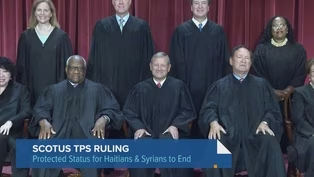
NewSupreme Court Allows Trump to End Temporary Protected Status for Haitians, Syrians
Video has Closed Captions
The decision could leave longtime Chicago residents at risk of deportation. (9m 8s)
Providing Support for PBS.org
Learn Moreabout PBS online sponsorship New Episode
- News and Public Affairs

Top journalists deliver compelling original analysis of the hour's headlines.
 New Episode
- News and Public Affairs

Today's top journalists discuss Washington's current political events and public affairs.
 New Season
 New Episode
 New Episode
 New Episode
 New Episode
 New Episode
 New Episode
 New Episode
 New Episode
 New Episode
Support for PBS provided by:
Chicago Tonight is a local public television program presented by WTTW
WTTW video streaming support provided by members and sponsors.