
June 30, 2026 - PBS News Hour full episode
6/30/2026 | 57m 46sVideo has Closed Captions
June 30, 2026 - PBS News Hour full episode
June 30, 2026 - PBS News Hour full episode
Problems playing video? | Closed Captioning Feedback
Problems playing video? | Closed Captioning Feedback
Major corporate funding for the PBS News Hour is provided by BDO, BNSF, Consumer Cellular, American Cruise Lines, and Raymond James. Funding for the PBS NewsHour Weekend is provided by...
June 30, 2026 - PBS News Hour full episode
6/30/2026 | 57m 46sVideo has Closed Captions
June 30, 2026 - PBS News Hour full episode
Problems playing video? | Closed Captioning Feedback
Where to Watch PBS News Hour
PBS News Hour is available to stream on pbs.org and the PBS app.
Providing Support for PBS.org
Learn Moreabout PBS online sponsorshipGEOFF BENNETT: Good evening.
I'm Geoff Bennett.
AMNA NAWAZ: And I'm Amna Nawaz.
On the "NewsHour" tonight: The Supreme Court rules against President Trump's order ending birthright citizenship, delivering a blow to the administration's immigration agenda.
GEOFF BENNETT: Other major court rulings uphold bans on transgender athletes in women's sports and strike down longstanding campaign finance restrictions.
RICK HASEN, UCLA School of Law: It's now created an almost deregulated system, where we will be lucky if in the next five years we will still have campaign contribution limits to candidates and campaign disclosure rules.
AMNA NAWAZ: And the death toll continues to rise in Venezuela, as rescue efforts fade and the humanitarian crisis grows.
(BREAK) AMNA NAWAZ: Welcome to the "News Hour."
The U.S.
Supreme Court wrapped up its term today, issuing major rulings in cases centered on some of the nation's biggest political fights.
The most high-profile is a landmark ruling striking down President Donald Trump's executive order seeking to end birthright citizenship.
That's the guarantee of citizenship to virtually everyone born in the United States.
In his opinion, Chief Justice John Roberts wrote -- quote -- "Citizenship then and now was the right to have rights, to freely participate in our political community.
The framers of the 14th Amendment extended that promise to every free-born person in this land.
We keep that promise today."
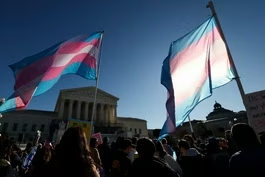
GEOFF BENNETT: The justices also issued two other major rulings today, including upholding state laws that ban transgender athletes from women's and girls' sports.
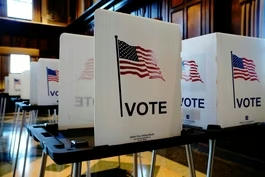
And the court's conservative majority transformed campaign finance laws, lifting limits on how much political parties can spend on advertising and other expenses in coordination with the candidates.
We're going to break down each of these decisions.
And, to start, we're joined once again by "News Hour" Supreme Court analyst and SCOTUSblog co-founder Amy Howe.
Amy, it's great to see you.
AMY HOWE: Hello again.
GEOFF BENNETT: So, the court's conservative majority has handed President Trump a number of victories this term, but, today, it ruled against one of his chief goals, ending the promise of birthright citizenship to children born on U.S.
soil.
What was Chief Justice John Roberts' reasoning?
AMY HOWE: This was really a history lesson.
He sort of walked us through, starting with early English history.
He said, in Great Britain, if you were born in Britain, then you were a British subject.
He said the colonists brought that rule over with them to the United States, and everyone accepted it as the rule until the notorious 1857 decision by the Supreme Court in the Dred Scott case, in which the court ruled that a formerly enslaved person who was brought to this country was not a U.S.
citizen.
And so he said we enacted the 14th Amendment in 1868, both to ensure that formerly enslaved people were U.S.
citizens, but also to enshrine the broader birthright citizenship rule.
And then in 1898, in a case called Wong Kim Ark, the Supreme Court reaffirmed the idea that everyone who's born in the United States is a U.S.
citizen.
GEOFF BENNETT: We were talking earlier about how this case actually started.
And it was focused on a different legal question.
The administration won that earlier fight.
How did we go from that victory to the ruling against the Trump administration today?
AMY HOWE: Yes, so just about this time last year, we were here talking about a case involving challenges by the Trump administration to what's known as universal injunctions or nationwide injunctions, whether a single district judge could issue an order that bars the government from enforcing a policy or a law anywhere in the country.
And so here we had federal judges all over the country who were ruling that the Trump administration's order striking down birthright citizenship was unconstitutional and barring the government from enforcing it.
So the government came to the Supreme Court last year, asked them to rule that federal judges don't have that power.
The Supreme Court agreed with them, but these cases then went forward in this case as class actions, as groups of parents of would-be children who would be affected by the birthright citizenship order or the children themselves.
And so a federal judge in New Hampshire certified a class temporarily and ruled for the children against the Trump administration, and then the Trump administration appealed the birthright citizenship order to the Supreme Court.
GEOFF BENNETT: We're going to discuss the implications of this transgender athletes case deeper in a moment.
But Justice Kavanaugh wrote that the -- in the majority opinion, he said that states and schools -- quote -- "may maintain women's and girls' sports for biological females."
So what did we learn from this decision and how could it affect students across the country?
AMY HOWE: Yes, so, right now, roughly half the states have laws similar to the ones in West Virginia and Idaho that the Supreme Court upheld today.
They rejected challenges under both federal law and under the Constitution.
But as Justice Kavanaugh said, that the Supreme Court did not weigh in on whether or not other states could have laws or have policies that allowed transgender women and girls to compete on women and girls' sports teams.
Now, some of the lawyers who were involved in some of the cases have said that they will bring litigation challenging some of those policies.
There is already some litigation in the lower courts challenging the policies of allowing transgender athletes to play.
So we could see this issue back up at the Supreme Court soon.
GEOFF BENNETT: And on campaign finance, the court struck down the post-Watergate limits on how much individuals can give to political parties and how much those parties can spend on their candidates.
So that means that parties can now both coordinate with candidates and raise unlimited funds.
What was the reasoning behind that ruling?
AMY HOWE: So the Supreme Court has said that when you're talking about campaign finance restrictions, really, the only rationale for restrictions is to prevent corruption.
And what the Supreme Court said in this case is that there are other tools in place, these base contribution limits, what's known as earmarking rules, and then disclosure obligations, that go far enough to prevent corruption.
And so we don't need to have this, what Justice Kavanaugh in his majority opinion referred to as really sort of severe restriction on speech that these coordinated party limits impose.
GEOFF BENNETT: Amy Howe, thanks so much.
And we're going to hear from you more and a bit so don't go anywhere.
AMY HOWE: OK, thank you.
AMNA NAWAZ: For more on the court's birthright citizenship ruling, we're joined now by Amanda Frost.
She's a professor at the University of Virginia School of Law and the author of "You Are Not American: Citizenship Stripping from Dred Scott to the Dreamers."
Her second book on birthright citizenship is due out in September.
Amanda Frost, welcome back to the "News Hour."
Thanks for being with us.
AMANDA FROST, University of Virginia School of Law: Thank you for having me.
AMNA NAWAZ: So the argument we heard by President Trump against birthright citizenship has been that the 14th Amendment was intended to be very limited, just applying to the children of enslaved people.
What did the justices say today about that argument?
AMANDA FROST: Yes, so they rejected -- the majority rejected that argument.
They said the language, which is universal in application, doesn't limit itself to the enslaved or formerly enslaved, would apply to everyone.
They noted that during the, debates over that language, it explicitly came up whether the language was supposed to cover the children of Chinese immigrants -- and Chinese immigrants at the time were a very disfavored and unpopular group.
And the answer was, yes, it was intended to cover the children of Chinese immigrants.
So the reading of the citizenship clause as just applying to the formerly enslaved is wrong.
Of course, it applied to them, and that was a major impetus for the decision, but it was not limited to them.
AMNA NAWAZ: We saw President Trump react to the ruling by posting this online in part.
He wrote that: "It's too bad for our country, but we can easily make it up in Congress through legislation."
He went on to say: "No long and unwieldy constitutional amendment is necessary."
He's basically saying he could effectively end birthright citizenship through Congress.
Can he?
AMANDA FROST: No, that's just wrong.
The Constitution of the United States is the supreme law of the land.
On the first day of law school, you learn, if you didn't know it already, that legislation that violates the Constitution is invalid.
So, this executive order is invalid because it violates the U.S.
Constitution, said five justices.
And any legislation Congress passed would similarly be invalid.
AMNA NAWAZ: I want to put to you another thing we heard during this debate, which was that opponents of birthright citizenship talk about the incentives it provides to illegal immigrants.
And we also heard a lot about birth tourism.
How prevalent is that?
AMANDA FROST: Yes, so a couple points about that.
One is, even anti-immigration groups estimate birth tourism to be fairly low, a small percentage of the overall births.
But I understand that it offends certain groups, or maybe a lot of people.
And the answer is to target that.
And, in fact, there's laws on the books that allow Customs and Border Protection officials to stop people from coming to the United States on short-term visas who are visibly pregnant and look like they're coming to give birth.
And the question is, should we enforce that, rather than end birthright citizenship for hundreds of thousands of children born to people who are in the United States for years?
And there's a targeted enforcement mechanism that we could use to prevent birth tourism, if that's the problem.
We don't need to end birthright citizenship for everybody.
AMNA NAWAZ: As we reported, the decision was 6-3.
The majority was written by Chief Justice John Roberts.
Given everything you know about birthright citizenship, did it surprise you that three justices would have overturned this 150-year precedent?
AMANDA FROST: I was a little surprised, in part based on the oral argument, where we heard more skeptical questions from Justice Kavanaugh and Justice Gorsuch.
It was clear Justice Alito was very skeptical of birthright citizenship from the oral argument.
But I think that the key point here is that, by a vote of 6-3, these justices said no.
This signature executive order by President Trump when he felt so strongly about that he attended the oral argument is invalid either under the Constitution or Kavanaugh said, Justice Kavanaugh said under federal law.
Either way, President Trump cannot decide who is and who is not a citizen unilaterally.
AMNA NAWAZ: You have written so extensively on this topic and on its history.
So after this decision, do you believe that the constitutional debate over birthright citizenship has been effectively settled?
AMANDA FROST: I think it's been settled for the time being.
I will say that we continue to have this debate as a nation over who belongs.
And I think there's a reason for the 200 pages that the court wrote, and that's because they're debating who is an American and what the meaning of American is.
And that's a debate I think we will continue to have as a country.
But I'm glad to say that, for the time being, hundreds of thousands of newborn children in the United States will be secure in their citizenship.
And all Americans giving birth going forward won't have to prove their status to the federal government's satisfaction, which is what would have happened had this executive order gone into effect.
AMNA NAWAZ: That is Amanda Frost, professor at the University of Virginia School of Law, joining us tonight.
Amanda, thank you so much for your time.
Good to speak with you.
AMANDA FROST: Thank you.
GEOFF BENNETT: We want to dig deeper now on another major case the court decided today, upholding state bans on transgender athletes competing in girls and women's sports.
For more, we're joined by Katie Barnes, who covers sports and gender as a senior writer for ESPN.
They're also the author of "Fair Play: Trans Athletes and the Fight for Fairness."
Thanks for being with us.
KATIE BARNES, Senior Writer, ESPN: Thanks for having me.
GEOFF BENNETT: So help us understand how wide of an impact this ruling will have.
Who exactly will it affect?
KATIE BARNES: So I think the important thing is to say that it's not a nationwide ruling.
The scope of the ruling is limited to the 27 states who have this legislation in place, specifically the cases in Idaho and West Virginia.
The court held that those laws are allowed to stand.
And so that implies that the other 25 states of similar legislation will also be able to keep their laws on the books.
But it does not go a step further by saying that not only did these laws not violate Title IX, but by having transgender-inclusive policy, that is a violation of Title IX.
So for the remaining states that don't have such laws on the books, their legal outcome, they're able to decide that for themselves and keep the perspective that they have had in place.
GEOFF BENNETT: And what does this ruling mean for the plaintiffs personally, a 15-year-old in West Virginia?
The other is a former Boise State University student in Idaho.
KATIE BARNES: So for the 15-year-old in West Virginia, her career is effectively over in girls' sports.
If she wants to, she is able to compete in the men's category and the boys category.
But she has said that she does not want to do that.
So, in terms of being able to move forward and finish out her high school athletic career in girl sports, this ruling effectively ends that possibility for her.
In terms of the other plaintiff in Idaho, she actually had petitioned the court to remove herself from the case by saying she did not want to pursue any additional athletic opportunities at Boise State University and just wanted to finish out her academic career there and get her degree and move on with her life.
And it's worth speaking to the fact that that particular plaintiff spoke to the breadth of what types of sports are governed by these laws.
She originally filed her -- filed her challenge on the basis of wanting to try out for the women's cross-country team at Boise State, did not make that team, and then continued her challenge on the basis of wanting to play club sports at Boise State.
So it's not just competitive interscholastic athletics that are affected by this legislation.
It's also club sports, as well as intramural sports, at the collegiate, as well as the school sports levels.
GEOFF BENNETT: The states and advocacy groups that defended these bans, how are they interpreting today's ruling by the court?
KATIE BARNES: I think, for those who are in favor of this legislation, they are quite happy.
It's been a lot of celebratory messages.
I have heard from Barbara Ehardt, who wrote H.B.500 out of Idaho, and she called it a significant victory.
And so for folks who want to see transgender girls not able to play girls' sports, they are feeling very good about this ruling today.
GEOFF BENNETT: Justice Brett Kavanaugh, who once coached girls' basketball, he underlined the importance of the athletes' dedication.
He tried to -- it appears, to speak to the humanity of all involved.
He wrote: "No student athlete on either side of the issue, whether a biological female or transgender, deserves to be ostracized or vilified."
What does fairness in competition look like now, both for the transgender athletes who want an opportunity to compete, and for the girls and women who believe it's unfair to compete against athletes who are biologically male?
Based on your reporting, is there a framework or an approach that can meaningfully account for both concerns?
KATIE BARNES: Interesting question, because prior to H.B.500 passing in Idaho in 2020... GEOFF BENNETT: And we should explain H.B.500.
This was the first law that was passed, and it banned transgender girls from competing in women's sports at the school and collegiate level.
KATIE BARNES: Yes, that's right.
And, yes, before that law, there was a really robust policy mechanism that was exploring those questions and also allowed for the answer to be different at various levels of competition and through various age groups.
And so there were high school associations with different policies from the Olympics, et cetera, et cetera.
And even within national governing bodies, you saw different policies for different age groups and seriousness of competition.
And with the passage of H.B.500, that really reframed the context for where these battles would be fought and started to really reshape the policy and legislative landscape around transgender athlete eligibility.
A lot of that conversation has fallen away.
And so to answer that question, it's very challenging because I think that there are those who see any inclusion or allowance of a transgender girl or woman to compete in the girls and women's category as a functional failure of policy.
And there are those who would like to see transgender girls, women be eligible under some circumstances.
And those two perspectives are very, very hard to reconcile.
And I think some folks would like science to answer this question for us.
And it's very complicated.
It's a small sample size when it comes to transgender athletes.
And the science is still new in terms of the effects of hormone treatments, and at what age group, et cetera, and how that can impact or not athletic advantage in sports, and at what level we should care about having more restrictive or more inclusive policy.
GEOFF BENNETT: Katie Barnes, senior writer for ESPN and the author of "Fair Play: Trans Athletes and the Fight for Fairness."
Katie, thanks again for your time this evening.
KATIE BARNES: Really appreciate it.
AMNA NAWAZ: For more on the court's 6-3 decision to lift limits on how much political parties can spend in coordination with its candidates, we're joined by Rick Hasen.
He's a professor of law and political science at UCLA.
Rick, welcome back to the "News Hour."
Thanks for joining us.
RICK HASEN, UCLA School of Law: It's good to be with you.
AMNA NAWAZ: So Republicans were arguing the limits on these coordinated party expenditures amounted to limits on free speech.
What's your reaction to this Supreme Court ruling of lifting those limits and along ideological lines?
RICK HASEN: Well, this is more of the same.
We have had the Supreme Court since the 2010 Citizens United case rule that campaign finance law after campaign finance law is unconstitutional.
Now, some of their earlier rulings, like the ones in Citizens United, helped to create super PACs which empowered outside groups.
But the limits on political parties, they had -- the Supreme Court in its deregulatory phase hadn't really tackled.
And so what happened today is, the court is giving political parties a leg up, so now they will be able to compete for larger dollars with those super PACs and can work more directly with candidates.
And the majority says this is going to be good for democracy because strong political parties are good for democracy.
AMNA NAWAZ: I want to ask you more about the impact too, but in terms of who it may benefit, I want to remind folks this case is born of the then-Ohio Senate candidate J.D.
Vance's campaign, who sued back in 2022 to challenge the limits.
Republicans backed the case.
We know the Trump administration when it came to power supported it.
Does this ruling end up benefiting Republicans more than Democrats?
RICK HASEN: In the short term, the ruling probably benefits Republicans more than Democrats, simply because the Republican Party, the party operators like the National Republican Senatorial Committee, which was one of the plaintiffs in this case, they have had an easier time raising money this election cycle than their Democratic counterparts.
So they have got a Head Start, even if people start giving more to the Democratic Party.
In the longer term, I think we're going to see more parity between the parties.
So by the time we get to 2028, some of that super PAC money, certainly not all of it, but some of that super PAC money that was going to outside group supporting candidates will now flow through parties, and that will give candidates more control over the message and the communications that come from their campaigns.
AMNA NAWAZ: So, in the more short term or medium term, even as you look to the lead-up to the midterm elections, in a practical way, when and how is this going to show up?
Where will people see that?
RICK HASEN: You know, the first people to see it are the for-profit television stations, because now the political parties are going to be able to get what's called the lowest unit rate.
They're going to be able to get the cheapest advertising that candidates are entitled to.
So we're probably going to see more campaign advertising.
It's going to show up, probably more Republican advertising because of that advantage I just talked about, in the short term.
But, eventually, I don't think it's going to look all that different, because already we have such a deregulated system, thanks to earlier decisions of the Supreme Court.
There's so much money flowing into our politics today that it's hard to imagine that there's going to be even more money.
It's just going to get shifted from some outside groups to some political parties.
AMNA NAWAZ: It's worth reminding folks it wasn't always that way, right?
It was after Watergate that a number of campaign finance regulations went into place specifically to lessen the influence of money into politics.
And then you have seen that erosion, as you mentioned, with the 2010 Citizens United decision over time.
What has fundamentally changed about our campaigns and about our elections as a result of the erosion of those regulations?
RICK HASEN: Well, I think what you're seeing now is a movement towards a plutocracy.
In 2016, there were no individuals or couples who contributed at least $100,000 -- $100 million to political groups.
In 2024, there were nine such donors, so that just nine donors alone were putting in $900 million into the last election.
The Supreme Court 50 years ago in Buckley vs.
Valeo said that independent spending can't corrupt, and you could only limit contributions to prevent corruption, which the court in more recent years has defined to be much more narrow, like quid pro quo bribery.
The court moved ideologically to the right, and it's now created an almost deregulated system, where we will be lucky if in the next five years we will still have campaign contribution limits to candidates and campaign disclosure rules.
AMNA NAWAZ: Well, say more on that, because there are still limits on individual contributions.
Do you see, based on what this court has shown, that those could potentially be challenged and go away as well?
RICK HASEN: Well, so one thing I was looking for in the case was whether the court was going to signal that they were going to make it even harder for contribution limits generally to be upheld.
And the court didn't do that today.
So, right now, the limit that you could give $3,500 directly to a federal candidate for office, that looks pretty safe.
But the next thing I think that's going to be attacked are rules that were put in place in the McCain-Feingold law in 2002, which ban so-called soft money to political parties.
Once that opens up, you're going to see political parties be able to draw in much, much more money.
They're going to be able to spend that money, and I think we're going to be back to the system I think in some ways worse than the pre-Watergate system, where the amount of money that's going to be put in to try to influence people's votes and influence what elected officials do once they're in office is going to continue to hit records.
AMNA NAWAZ: That is Rick Hasen, professor of law and political science at UCLA, joining us tonight.
Rick, thank you so much.
RICK HASEN: Thank you.
GEOFF BENNETT: And for more now on how the White House has responded to today's rulings and the relationship between the president and the nation's highest court, we are joined again by Amy Howe and our White House correspondent, Liz Landers.
So, Liz, as you well know, President Trump was personally invested in this birthright citizenship case.
He even attended the oral arguments, which is rare for sitting presidents.
I don't think it's -- well, it might have happened before, but not in modern history.
LIZ LANDERS: Yes.
GEOFF BENNETT: How is he responding to today's ruling?
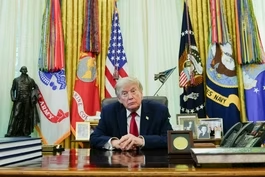
LIZ LANDERS: He's responding with disappointment.
The only thing we have heard from him so far is this TRUTH Social post that he posted this morning.
And I know you all read that earlier, but in it he talks about the future and what he may be able to do going forward and a pathway he thinks to still overturning birthright citizenship.
He wrote out that Congress should start today to work on ending this.
And he posted earlier in the morning, actually right before this decision came out from the Supreme Court, a post from a Web site called Just The News, and the headline says -- quote -- "Trump's efforts to reverse birthright citizenship may succeed with or without the Supreme Court."
And this story suggests that Congress could change the law with legislation called the Birthright Citizenship Act.
This was introduced by two allies of the president, Senator Lindsey Graham and another House Republican, on the day that he was inaugurated in January of 2025.
And this piece of legislation would amend the Immigration and Nationality Act.
I think we are probably going to see the president push members on this, but it is unclear how that would fare, given today's very definitive decision from the Supreme Court.
There are other allies of the presidents on Capitol Hill, like Senator Mike Lee, who was acknowledging that this sort of change would require an actual constitutional amendment.
And, more broadly though, Geoff, I think that this is an interesting moment, when we're seeing the president increasingly react and lash out at the Supreme Court.
Back in February, I was in the Briefing Room when the tariffs decision came down and the president had a press conference, and he was very angry and upset with the Supreme Court justices, in particular, some of the justices that he had appointed to the court that ruled against him in that decision.
There were more justices today who he had appointed to the court who also ruled against him in the citizenship case.
GEOFF BENNETT: On this matter of birthright citizenship, how has the president's argument, how has it evolved over the years, and what does it mean now for his immigration agenda?
LIZ LANDERS: Honestly, the president has been saying the same thing about this since he announced his presidency, his presidential bid in 2015.
I was looking back at some of his comments from that time, and he said that he did not think that changing the policy of birthright citizenship would require a constitutional amendment, which is what he is saying today, which is, I think, questionable, and argued that Congress could do the same thing.
And he has also had some of the same campaign aides now become top White House advisers and aides on this issue, like Stephen Miller, who is a very powerful top immigration adviser to the president.
Miller wrote today on Truth -- on X, on that platform, that: "This is one of the most destructive and outrageous decisions in the long history of the Supreme Court."
We know that Miller and the president were crafting a lot of this kind of immigration policy while the president was out of office for four years and they were teed up, and ready to go with some of these policies on day one.
President Trump signed this executive order on birthright citizenship on his first day back in office in his second term.
And, looking forward, we're also hearing from other members of the administration today who are talking about what they are going to do.
The border czar, Tom Homan, came out and talked to White House reporters a few moments ago, and he said that the immigration agencies and DHS are going to triple and quadruple down on investigations into birth tourism.
He framed this as a national security issue.
And then right after he spoke, we saw a Department of Justice memo that was issued today directing Department of Justice prosecutors to prioritize the investigation and prosecution of these so-called birth tourism schemes, Geoff.
GEOFF BENNETT: Amy, do you see a through line or a pattern to the cases that that the court has ruled in terms of victories or defeats for the Trump administration?
AMY HOWE: The president, these are certainly -- the tariffs decision, the birthright citizenship case, were really some of his top priorities, as Liz said.
These were also cases in which he was really swinging for the fences, so to speak.
In the tariffs decision, the Supreme Court, the majority made a point of saying this was a power that no president since this law was enacted had ever invoked.
In birthright citizenship, this was sort of going against what everyone had understood the law to be since the 14th Amendment was enacted in 1868.
And so to the extent that there's a through line -- Lisa Cook, no one had ever tried to fire a member of the Fed's Board of Governors before.
To the extent that there's a through line, I would say that the this Supreme Court is willing to give this president quite a bit of power.
There -- they do have their limits.
When he really starts to test the boundaries, as he did in the tariffs case and the birthright citizenship case, the Lisa Cook case, they may push back.
GEOFF BENNETT: It's the end of a term.
We sometimes hear about retirements.
There's been a lot of focus on the conservatives on the court because the Republicans have the Senate majority.
Any indication that there might be retirements upon us?
AMY HOWE: There's been a lot of speculation recently, in particular about Justice Samuel Alito.
But, as you say, this is often the time when we hear about retirements., the idea being that the Senate could hold hearings over the summer and have a successor confirmed in time for the first Monday in October, when the court starts to hear arguments again.
We haven't heard anything yet.
There's still a window, certainly, in which Justice Alito or Justice Clarence Thomas, who's the other really senior justice on the court, could announce their retirement, but nothing so far.
GEOFF BENNETT: Liz Landers, Amy Howe, thanks so much for your analysis and your guidance over these last few days as you have walked us through these days now of major court rulings.
We deeply appreciate it.
LIZ LANDERS: Of course.
AMY HOWE: Thank you.
AMNA NAWAZ: Hopes faded further today that more people will be found alive in Venezuela six days after earthquakes slammed the country.
The government's official death toll is 1,900, though that is believed to be a vast undercount.
By one estimate, 50,000 people remain missing and 60,000 buildings may have collapsed across the northern coast.
Stephanie Sy reports.
STEPHANIE SY: Rescuers are still listening for signs of life.
But six days in, the silence is deafening.
Yet, today, this Jordanian team heard something.
Eyes fixed on the monitor, they snaked a camera through the layers of collapsed concrete.
They spot him, a tiny arm, a toddler, motionless beneath the rubble.
(CHEERING) STEPHANIE SY: Emaciated and weak, but alive, wrapped in a blanket, the team rushes him to a waiting ambulance.
These rescues are becoming rarer as time passes.
Thousands of Venezuelans still have loved ones trapped beneath collapsed structures, the frustrations of these residents evident as they try to block a rescue truck from leaving the disaster zone, demanding crews keep searching.
WILKER MOLAYA, Father of Missing Daughter (through translator): They will not move.
I have nothing to lose.
I have nothing to lose.
They can kill me if they want.
STEPHANIE SY: They're angry by what they see as a government that is failing them.
WILKER MOLAYA (through translator): They don't help us and they won't let us in.
They don't give us any equipment and we have families trapped there.
STEPHANIE SY: Yulis Salcedo waits outside a hospital in Caracas.
Just days ago, she was preparing to welcome her 21-year-old son home after he was deported from the United States.
YULIS SALCEDO, Mother of Anderson Salcedo (through translator): The flight arrived at 11:00 a.m.
Then they went through all the migratory process.
He called me at 5:00 p.m.
and told me: "I love you so much, Mom.
See you tomorrow at home."
Like any mother, I prepared a welcome for him with his blue, yellow, and red balloons.
STEPHANIE SY: Anderson Salcedo spent his first night back in Venezuela at this hotel in La Guaira, shown in a satellite image.
Hours later, the earthquake struck.
This is what's left of the complex.
He survived, but remains in intensive care.
He was among some 140 deportees, including children.
This video showed their arrival back in Venezuela hours before the earthquake struck.
Most are still missing.
YULIS SALCEDO (through translator): I want justice.
I want justice because it's not fair that my son is lying in that bed with respiratory support with his legs amputated at the age of 21.
I'm asking for justice because this government can do to us Venezuelans whatever they want.
STEPHANIE SY: At the Port of La Guaira, hundreds of coffins now line the docks.
The port has become a temporary morgue after local hospitals ran out of space.
Across Caracas, families have pitched tents on sidewalks and city streets.
After days of aftershocks, they're too afraid to go back.
CARMEN BALLEJOS, Displaced Caracas, Venezuela, Resident (through translator): Where are we going to sleep if it's shaking all the time?
It's like we're dancing.
And if we stay in our homes because we want to be at home, then we're going to suffer just like the victims are suffering.
And we don't want that.
But the state, the country is in shambles.
STEPHANIE HOCHSTETTER, World Food Program: The common denominator is great suffering and great distress.
STEPHANIE SY: Stephanie Hochstetter of the World Food Program spoke to the "News Hour" from La Guaira and described some of the suffering she's witnessed.
STEPHANIE HOCHSTETTER: ... that struck me the most was a father walking along the sidewalks of destroyed buildings in Catia La Mar holding his 2-year-old, his 4-year-old, and his 5-year-old, asking for help to return to Caracas because he had lost his building.
He had no water, he had no food.
His wife had been taken to Caracas to be hospitalized because she had -- her leg had been amputated and he didn't know where to take her -- his children.
STEPHANIE SY: The WFP is giving weary, quake survivors a single stop for their basic needs.
STEPHANIE HOCHSTETTER: To facilitate this access to the people and not have them have to go to one place for a doctor or a medical emergency, another place to find a bathroom, another place -- they need showers.
They need to wash their hands.
They need water to drink.
So the intention of putting everything together is that, to make this suffering a little lighter.
STEPHANIE SY: For the "PBS News Hour," I'm Stephanie Sy.
AMNA NAWAZ: In the day's other headlines: A record-breaking heat wave is intensifying across much of the Central and Eastern U.S., pushing temperatures to what officials are calling dangerous levels.
More than 200 million Americans were under alerts today for extreme heat.
Temperatures felt well above 100 degrees across much of the Midwest.
And soon that same sweltering heat will peak in places like New York.
ZOHRAN MAMDANI (D), Mayor of New York City: Temperatures will climb into the high 90s and triple digits.
With humidity, it will feel even hotter, with a heat index that could peak around 112 degrees.
If the forecast holds, this could be the hottest Fourth of July since 2010.
AMNA NAWAZ: As we look ahead to that July 4 weekend, forecasters say that, starting tomorrow, it's going to get worse before it gets better for large portions of the Midwest, including Chicago, Cleveland and Detroit.
The heat dome, as it's known, shifts east by the end of the week, threatening record temperatures across New York, much of the mid-Atlantic and even New England.
As the Supreme Court wraps up a consequential term today, it's set to take up a major gun rights case in the fall.
The justices will hear arguments on whether bans on AR-15s and other assault weapons in Connecticut and the Chicago area violate the Second Amendment.
Similar laws are in place in about a dozen states, including New York and California, a national assault weapons ban expired in 2004.
This conservative-leaning High Court has significantly expanded Second Amendment rights, including a ruling just last week that struck down a gun restriction in Hawaii.
The Food and Drug Administration announced today that Zyn nicotine pouches can be marketed as less harmful than cigarettes.
The company can now sell 20 versions of its products with a claim that reads -- quote -- "Using Zyn instead of cigarettes puts you at a lower risk of mouth cancer, heart disease, lung cancer, stroke, emphysema, and chronic bronchitis."
It's a win for Philip Morris International, the parent company of Zyn's Swedish manufacturer.
But the FDA does not say Zyn is safe and critics fear the new designation could lure new users, especially young people.
Turning now to Iran, U.S.
diplomats touched down in Qatar today for another round of indirect talks with Iranian officials.
U.S.
officials say Steve Witkoff and Jared Kushner will meet with Qatari and Pakistani mediators this week, as will delegates from Iran in separate talks.
This latest diplomatic effort comes days after a new round of strikes and with tensions remaining high over the Strait of Hormuz.
Today, Iran's Foreign Ministry spokesperson said mediators will discuss the interim deal this month, but there will be no face-to-face talks.
ESMAEIL BAGHAEI, Iranian Foreign Ministry Spokesman (through translator): What will likely take place in Doha tomorrow is a discussion regarding the implementation of provisions of the memorandum of understanding.
Therefore, I emphasize once again we have not planned any meeting at any level with the American side for the coming days.
AMNA NAWAZ: The memorandum of understanding includes a 60-day window for the two sides to negotiate a permanent truce, as well as other issues, like Iran's nuclear program.
Russia says it shot down more than 400 Ukrainian drones nationwide in a wave of overnight attacks.
That includes near Moscow, where the region's governor says a 6-month-old was killed and at least three people injured.
Separately, Ukraine's President Volodymyr Zelenskyy posted video today, saying a strike hit won a Russia's largest satellite centers.
In the meantime, Ukrainian officials say at least 17 people were injured when Russian strikes hit civilian and infrastructure facilities in the Zaporizhzhia and Sumy regions.
Russia's military released video today claiming it struck military targets.
Also today: KEIR STARMER, British Prime Minister: The best way to avoid war is to prepare for it.
The best way to defend is to deter, to have the strength to make your adversaries think again before they act.
And that is what we are delivering.
AMNA NAWAZ: Britain's outgoing Prime Minister Keir Starmer announced a roughly $20 billion hike to the U.K.
defense budget to counter threats like Russia.
The increased spending is meant to focus on drone technology and other elements of modern warfare.
President Trump reported more than $1 billion in income from his family's crypto ventures last year.
That's according to an annual financial disclosure released today.
That includes more than 500 million from World Liberty Financial, which he and his sons co-founded, and more than $600 million from Trump meme coins.
Meantime, on Wall Street today, stocks ended higher, thanks in part to a rebound in A.I.
stocks.
The Dow Jones industrial average added around 130 points.
The Nasdaq jumped nearly 400 points, or about 1.5 percent.
The S&P 500 also closed in positive territory, though it was down for the month of June.
And in World Cup news today, Norway advanced to the Round of 16 for the first time ever, beating Ivory Coast two goals to one.
A late goal by Erling Haaland sealed that victory.
And, after the match, the team joined fans in their now famous Viking Row.
They will play Brazil on Sunday for a spot in the quarterfinals.
Meanwhile, Paraguay fans celebrated last night's win over Germany, with the country's president declaring today a national holiday.
It was one of two upsets decided in penalty shoot-outs, with Morocco sending the Netherlands home earlier than many expected.
NBA superstar LeBron James says he won't be heading back to the Los Angeles Lakers next year, and will instead play his 24th season elsewhere.
Team president Jeanie Buss called James one of the greatest athletes in history, adding -- quote -- "We will always be thankful for his eight years with the Lakers."
The 41-year-old can officially start talking with other teams as of this evening, when his free agency period starts.
But the NBA's all-time leading scorer won't be able to sign with a new team until July 6.
And tennis great Serena Williams played her first singles match in nearly four years today, thrilling the crowd at Wimbledon, but coming up short on the court.
The 44-year-old lost in three sets to a player less than half her age, Australia's Maya Joint, who's just 20.
At times, Williams showed the flashes of greatness that helped her win seven singles titles at Wimbledon, but Joint came up big when it counted for her first major win at the tournament.
Williams still has a doubles match later this week with her sister, Venus.
She left the court today with a wave and a smile.
Still to come on the "News Hour": New Jersey Representative Tom Kean returns to Congress after mysterious monthslong absence; and Barstool Sports founder Dave Portnoy explains his tense relationship with the media.
GEOFF BENNETT: Well, after months of speculation, the mystery surrounding a New Jersey congressman's absence is finally over.
This morning, Republican Tom Kean Jr.
addressed the House, saying he owed his constituents, his colleagues, and the American people an explanation.
REP.
TOM KEAN (R-NJ): I was given the diagnosis of depression.
Now, when people hear the word depression, many people think it simply means feeling sad.
But depression is so much more than that.
It is physical.
It is emotional.
And until you experience it yourself, it is difficult to fully understand how powerful this illness can be.
GEOFF BENNETT: That's as other drama unfolded in the House as well.
The chamber ground to a complete halt over an internal Republican divide.
Our Lisa Desjardins here to explain.
She was in the chamber today, including for the congressman's speech.
So what more did Congressman Kean have to say, Lisa?
LISA DESJARDINS: It was a short speech, but he also addressed this question of why he waited so long to talk about this.
He said that at first, when he went to a doctor, he was surprised that the doctor recommended that he be hospitalized.
Then, after he was hospitalized, he thought he would only be there for weeks.
Obviously, it lasted much longer.
Now, Kean has been gone or was gone for almost four months, though, Geoff.
So, in contrast, in terms of handling this, Senator John Fetterman of Pennsylvania also was hospitalized for depression back in 2023.
He publicly disclosed that the next day after he was hospitalized.
So there are still questions about why exactly he waited so long to explain this.
Our Kyle Midura caught up with the congressman today to ask about his pledge of transparency.
KYLE MIDURA: Does this experience changed how you think about access to health care, mental health services more generally?
Oops.
Sorry.
When you committed to full transparency, was the extent of that always going to be one floor speech?
Are you going to open up at some point take questions?
LISA DESJARDINS: Now, Kean rarely talks with reporters, and, as you see there, he did not answer any questions, so it's not really clear if he is going to say more about this.
GEOFF BENNETT: And how is this being received on the Hill?
LISA DESJARDINS: Right.
It's amazing.
I talked to Democrats and Republicans about this, more than a dozen, and overall they have sympathy for him.
They're glad he's back.
They're glad that he says that he's recovering.
But there is this idea that perhaps members are not paying enough attention to their own personal health and to each other.
There is some consternation over how long he was gone and the lack of explanation.
As for his own personal political future, he insists he is fully committed to running for reelection, but his district, Geoff, is one that Democrats are targeting.
They would like to flip it.
I don't think they will target his diagnosis, but his lack of explanation could be a target.
GEOFF BENNETT: Meantime, as we said, the House ground to a halt today over President Trump's SAVE America Act, his desired elections bill.
So what happened and what does it all mean?
LISA DESJARDINS: All right, let's unpack this and try and do it without hurting our brains, because many members of Congress actually themselves don't quite understand what's happening there.
As I just left the Capitol, members of Congress are flying out back home, ending their workweek in Washington on a Tuesday.
All of this, as you said, is about the SAVE America Act, more or less, and about hard-liner Republicans who want to take a stand in the House to try and force the Senate to push it.
This bill isn't going anywhere in the Senate.
As you said, it's about election and I.D.
requirements.
However, these hard-liners today were trying to be aggressive with Senate -- with Speaker Mike Johnson.
Let me talk a little bit about that more aggressive action and what he did to appease them.
House leaders proposed attaching the SAVE America Act to a must-pass defense bill known as the NDAA.
But these 14 hard-line Republicans just a few hours ago broke ranks, rejected this idea.
This was a way for them to get a vote on the SAVE Act.
They said it's not good enough.
And thanks to the close margin margins, those 14 Republicans were able to shut down the floor, effectively blocking almost all legislation.
Now, it's an interesting tactic I have never seen used before, where one chamber is shutting itself down in order to pressure the other chamber.
Senators, I don't think, are feeling that pressure.
I talked to Chip Roy, who's one of the hard-liners, and he gave one of the most clear explanations for what he thinks is happening.
REP.
CHIP ROY (R-TX): You only have certain leverage points.
And this town works on leverage points, nothing else.
I mean, it's going to be very clear.
If you don't use the leverage points, they're going to roll over you.
LISA DESJARDINS: But for many other Republicans, this is actually too much.
This is a tantrum, they think, and it's inexplicable, even a nightmare.
REP.
DON BACON (R-NE): Why are we punishing ourselves and making us look bad for -- because we're not happy with the Senate?
And it doesn't make sense.
But it's low-I.Q.
thinking.
LISA DESJARDINS: Now, for Democrats, this feeds their message that Republicans add to chaos.
But, for some, they -- Brendan Boyle, who I spoke with, said this isn't just a sideshow.
This actually does matter.
REP.
BRENDAN BOYLE (D-PA): Obviously, it's a mess.
It's personally very frustrating, as someone who wants to get something done.
And it leaves us at a standstill, to the point in which we literally can't call up legislation on anything else until this gets resolved.
LISA DESJARDINS: The House will not be back in session again until July 13.
GEOFF BENNETT: So these members are taking a two-week break, although I know members of Congress always push back on that, because they say they're working in district.
LISA DESJARDINS: Yes.
Yes.
GEOFF BENNETT: Yet there's so much for them to do here.
There's so much work for them left here in D.C.
LISA DESJARDINS: Right.
That's right, funding of government, the defense bill, all of the issues this country's facing.
Right now, they're going home.
GEOFF BENNETT: Lisa Desjardins, thanks, as always.
LISA DESJARDINS: You're welcome.
AMNA NAWAZ: Dave Portnoy, the outspoken, unapologetic, polarizing founder of the media company Barstool Sports, has written a book.
It's a memoir called "Cancel Me If You Can."
And it tells the story of how he grew Barstool from a free gambling newsletter to a multimedia Goliath today.
I spoke with Portnoy for the latest episode of our podcast "Settle In."
We talked about politics, culture, and the controversies he and Barstool have faced over the years.
Here's a clip from that conversation.
You seem to be someone who's sort of highly skeptical of institutional media.
Is that fair to say?
DAVE PORTNOY, Founder, Barstool Sports: A hundred percent.
And you couldn't say that loudly enough.
AMNA NAWAZ: Which kind of begs the question, and I have been curious about this the whole conversation, because you don't have to talk to us.
Like I said, I consume some of your media.
I see how incredibly powerful and influential a voice you are.
Obviously, I have questions I want to put to you.
I was looking forward to this conversation.
But why did you want to talk to us?
DAVE PORTNOY: So, this is obviously promoting the book, which I have to do.
I... (CROSSTALK) AMNA NAWAZ: To be forced into this?
DAVE PORTNOY: No, no, no.
Listen, anybody -- and this has been my kind of M.O., and I'm sure, like, your producers or whoever told you, anybody who lets me record as well, so what is said can't be twisted, which I learned early in interviews, where I was seeing clips of mine -- it's like, wait a minute, you cut off the second part of what I said to make me look like the devil.
So anybody who's willing to sit down with me and says, hey, you can keep a record of it... DAVE PORTNOY: ... I'm happy to sit down with.
And a lot of... AMNA NAWAZ: So you're recording on your end this whole conversation too, right?
DAVE PORTNOY: Correct, yes.
AMNA NAWAZ: Because you don't trust anyone who you don't know.
And we don't know each other, I should say.
We're meeting for the first time here.
DAVE PORTNOY: Yes, I generally will trust anybody who agrees to that.
So some of my more checkered past, if you want to say, the things that be like, well, Dave did this, the "Business Insider" article, New York Times, I begged to sit down with these people, like begged.
You can report -- you're writing things that I know are false, and I have definitive proof that they're false, and you won't meet with me.
You won't sit down with me.
If you're willing to sit down with me and let me -- as long as I know things aren't going to be twisted, I'm happy to talk to anybody.
I actually -- and maybe it's naive, I don't think it is at this point, I think I'm a good person.
I don't have anything to hide.
So if somebody's not coming in with agenda against me, I'm happy to sit down, and a lot of times I think maybe they will walk away and be like, he's not who we thought he was.
He's a lot more complicated or maybe interesting or whatever.
So I never have a problem with sitting down.
AMNA NAWAZ: You know, for everything you have you have built from literally the ground up to this incredibly powerful company, this potent voice that you have, honestly, I have to say what surprises me most about the conversation is how you still very much seem to see yourself as like an underdog, someone who people are coming for all the time who has to scrap to stay alive.
Is that a fair representation?
DAVE PORTNOY: Yes, I don't see it -- like, even as we talk, my heart does start beating a little bit quicker, but it's not on the underdog, because we have made it.
Like, Barstool... AMNA NAWAZ: As we're talking here, your heart's beating faster?
DAVE PORTNOY: Because it brings up some of the stuff that drives me insane... AMNA NAWAZ: Yes.
DAVE PORTNOY: ... like the "Business Insider' and things that have been said, like -- and it's never going to happen.
But I have a passion.
I don't know if it's revenge.
I know things have been done to me that's so wrong and dirty with the mainstream media that I get upset even talking about it.
It still drives me nuts.
So it's not the underdog because I know we're not.
Like, and, in fact, even we will maybe see with this book.
I used to be able to drive people to go drink this, go do this when we were more on the up.
Now it's harder because we have made it and people see my lifestyle and how it's like we don't necessarily need to support Dave.
So it's not the underdog, but I don't being done wrong, and it still upsets me some of the things that I feel I have been really wronged over the course of my career.
AMNA NAWAZ: And, Dave, you have millions and millions of people watching your stuff every day now.
Aren't you part of the mainstream media now?
DAVE PORTNOY: It's a great question.
Yes, I -- but we're still like -- if you say Barstool says something versus CNN, NPR, New York Times, Washington Post, that doesn't hit.
We're different.
I mean, we did start -- I certainly do the politics, but the main Barstool stuff is still generally 98 percent of the time meant to make you laugh.
It is sort of a comedy brand.
I have gotten bigger.
I -- politics, I have said stay out of it.
I get so wrapped up in it that sometimes I don't follow my own advice, and we're big enough where... AMNA NAWAZ: I was going to say, you don't stay out of it, though, do you?
DAVE PORTNOY: Correct.
And we have become big enough where it's like, OK, what's the worst that can happen?
But, yes, I definitely don't follow my own advice with it.
But when you say mainstream media, seeing a quote from Barstool still does not carry for most people the same weight, I don't think, as established blue blood-type news organizations, nor should it really.
AMNA NAWAZ: And you can watch that full episode of "Settle In" on our YouTube page or wherever you get your podcasts.
GEOFF BENNETT: And that's the "News Hour" for tonight.
I'm Geoff Bennett.
AMNA NAWAZ: And I'm Amna Nawaz.
On behalf of the entire "News Hour" team, thank you for joining us.
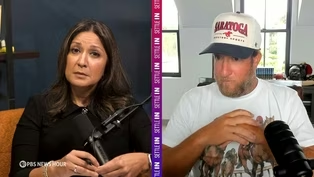
Dave Portnoy joins Amna Nawaz on 'Settle In'
Video has Closed Captions
Dave Portnoy and Amna Nawaz discuss media and controversies on 'Settle In' (5m 19s)
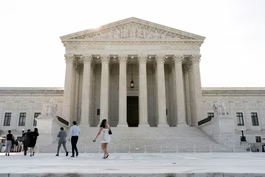
Examining the Supreme Court's birthright citizenship ruling
Video has Closed Captions
Examining the Supreme Court's birthright citizenship, campaign finance rulings (5m 40s)

Hopes of finding earthquake survivors fade in Venezuela
Video has Closed Captions
Rescue efforts continue, but hopes of finding earthquake survivors fade in Venezuela (4m 59s)
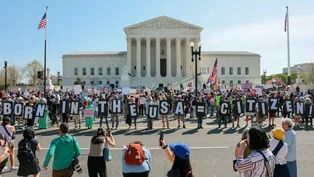
How the birthright citizenship ruling impacts Trump's agenda
Video has Closed Captions
How the birthright citizenship decision impacts Trump's immigration agenda (4m 43s)

News Wrap: Central and eastern U.S. face dangerous heat
Video has Closed Captions
News Wrap: Heat wave brings dangerous temperatures to central and eastern U.S. (7m 15s)
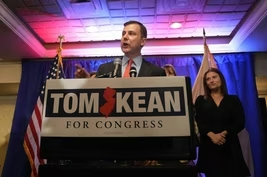
Rep. Kean returns to Congress after mysterious absence
Video has Closed Captions
New Jersey Rep. Tom Kean returns to Congress after mysterious absence (5m 48s)
Supreme Court lifts limits on political party spending
Video has Closed Captions
Supreme Court transforms campaign finance rules, lifting limits on party spending (5m 30s)
Trump's response to Supreme Court rulings and what's next
Video has Closed Captions
Trump's response to the landmark Supreme Court rulings and what's next (6m 24s)
Who is affected by Supreme Court's ruling on trans athletes
Video has Closed Captions
Who is affected by the Supreme Court's ruling on trans athletes in women's sports (6m 24s)
Providing Support for PBS.org
Learn Moreabout PBS online sponsorship
- News and Public Affairs

Today's top journalists discuss Washington's current political events and public affairs.

- News and Public Affairs

FRONTLINE is investigative journalism that questions, explains and changes our world.

 New Episode
 New Episode


 New Episode

 New Episode
 New Episode
Support for PBS provided by:
Major corporate funding for the PBS News Hour is provided by BDO, BNSF, Consumer Cellular, American Cruise Lines, and Raymond James. Funding for the PBS NewsHour Weekend is provided by...