
From the Streets to Stability
Season 2026 Episode 1 | 58mVideo has Closed Captions
Is Spokane’s homelessness problem improving? At Issue digs into the latest initiatives to find out.
The city of Spokane reports that more homeless people are moving into stable housing and drug treatment programs are expanding. Dana Haynes hosts Spokane Mayor Lisa Brown, Spokane Police Chief Kevin Hall, and other local leaders to learn more about the latest initiatives and what’s next for our region.
Problems playing video? | Closed Captioning Feedback
Problems playing video? | Closed Captioning Feedback
AT ISSUE is a local public television program presented by KSPS PBS
From the Streets to Stability
Season 2026 Episode 1 | 58mVideo has Closed Captions
The city of Spokane reports that more homeless people are moving into stable housing and drug treatment programs are expanding. Dana Haynes hosts Spokane Mayor Lisa Brown, Spokane Police Chief Kevin Hall, and other local leaders to learn more about the latest initiatives and what’s next for our region.
Problems playing video? | Closed Captioning Feedback
Where to Watch AT ISSUE
AT ISSUE is available to stream on pbs.org and the PBS app.
At Issue: Poison on the West Plains
PFAS chemicals have left Spokane's West Plains residents without safe drinking water.Providing Support for PBS.org
Learn Moreabout PBS online sponsorshipYou pick at it long enough, it becomes a scar.
Wounds from Spokane's homelessness and drug crisis are going to take time to heal, and they'll leave scars.
But city leaders say that's all part of the process.
And the process is working.
This is not the end goal to ending homelessness.
This is just the very first step in introducing homeless services to an individual.
Dig into the data here from the officials driving change, and explore how they plan to build on the momentum.
Now on at issue from the streets to stability.
Hello, and thank you for joining us for this episode of At Issue.
I'm your host, Dana Haynes.
We launched this public affairs program last spring with the topic of homelessness and public safety in Spokane.
But a lot has happened since then, so we want to talk about it with a panel of local leaders.
Let's go ahead and meet them.
First, we're going to start with Spokane Mayor Lisa Brown.
Thank you, mayor, for joining us.
The director of neighborhoods, Housing and Human Services for the city, Dawn Kinder, Spokane Police Chief Kevin Hall, thanks, chief, for joining us today.
Justin Johnson, the director of community services and regional behavioral health for Spokane County.
Thanks, Justin and Phil Altmeyer, the CEO of Union Gospel Mission.
We want to thank all of you for joining us today.
I'd like to start our discussion today with some good news from the City of Spokane's 2025 Longitudinal Systems Analysis.
It shows fewer people entered the homeless system and fewer people relied on services within that system.
According to the city, 7221 people received services in 2024.
In 2025, that number dropped by almost 806,430.
That's an 11% decrease.
The city also says more people exited the system into permanent housing in 2024, 37% exited into permanent housing, and in 2025 that number jumps, 57% found permanent housing.
And that's an increase of 54% from the prior year.
Mayor, we want to start with you today.
And what specific policies and changes do you think most contributed to that 11% drop in the number of people using city funded services?
Well, Dana, the thing that we are trying to accomplish is reaching people before they're on the streets.
And so I would say that eviction prevention and other types of upstream, connections is what we really need.
Because once a person has become, homeless, they are vulnerable to, to many things that can happen to them, more likely to be engaged with, substance abuse and can be victimize themselves.
And so the idea of getting to them early and, having outreach teams that can do that work is really key.
And I think that's part of what's going on in this, in the numbers.
You have to be proud of that 54% increase in permanent housing as well.
It's coordination among all the different parts of the system outreach teams, providers, law enforcement, code enforcement, working together to make sure we have the right response to the individual.
And I think that it as well as building more housing all the time, that is part of the success.
Dawn, a lot of this happens in your department.
What has changed operationally?
I know when the mayor says it's stop it starting upstream, but has there anything changed in your department that's helped, with these numbers going in a positive direction?
Well, I think the staff has been really focused on working collaboratively with our providers and building that coordination.
There's a lot of really great efforts in Spokane that take place amongst a large array of providers, but really focusing on bringing those folks to the table and coordinating that, that we're maximizing our resources.
And really leveraging where we can make impact has been really, really critical.
And the teams worked very hard to be incredibly strategic at one, how we invest resources, how we coordinate providers and build those partnerships so that folks are not given a cold referral, but really a direct connection to the next stage of stability.
And we've worked really hard on our data as well to make sure that we've got incredibly accurate data, which we use very intentionally to inform those decisions so that we know where we're making those decisions based on what's really happening on the ground.
Is the addition or have we, since we last spoke a year ago, you were part of this discussion a year ago.
Have we added a lot more housing?
Is it about that more vouchers?
Does that help increase these numbers?
I mean, both of those things would help, but that's not what's been happening.
We have not had an increase in housing vouchers in our community.
If anything, we have seen fewer vouchers in the in the community.
Housing continues to be built, but certainly not at the pace at which we need it.
So I do think a lot of what we're seeing is both of the mayor mentioned in terms of different investments and eviction prevention to keep people housed at the beginning, and then also really working on that stability piece.
Once we have them engaged in services, I think one of the things that we're really proud of, and this has been true for many years in Spokane, is that once we have somebody housed, we have a 93% retention rate of keeping them in that housing.
So when you see a number like a 54% increase and then 93% of those are retaining housing.
We're seeing a lot of, of benefit there by just better leverage in the system.
It's not that we can't get people permanently housed.
Once we do that, they stay, very stable.
So we're just focusing on how we get folks to that point most efficiently.
And then how you prevent folks from having to enter the system to begin with.
Our system has what's called a navigation center.
We're actually going to show more about that.
You're coming up in a minute, but we also have this scattered site model.
Explain how that is helped in Spokane.
So I think one of the big, you know, there's certainly a place for congregate shelter.
Those shelter systems do incredibly important work as well.
I think the scattered site model, what we're seeing work really well.
There is that building smaller communities with intentional focuses on certain populations is allowing folks to maybe access shelter in a way they might not consider in a larger group setting.
And then also building those meaningful relationships with staff on site, because they are able to staff at a different ratio and really help people stabilize quickly and move on.
I think we acknowledge that we're never going to emergency shelter our way out of homelessness.
And so we we are choosing to invest in deeply with folks who are actively engaged and continue them in the process so that once they're stably housed, they don't return.
And that bed opens up for somebody currently on the street.
But those subpopulations and meaningful relationships, go a long way.
And I'm not saying meaningful relationships don't happen in congregate settings.
They certainly do.
You GM does great work in that space.
But it's been a good alternative for folks who don't feel safe in a very large group.
Before we get further into some of these topics, I want to take a couple of minutes to update our audience on one of the initiatives we've been talking about, the navigation center.
I just mentioned it a few minutes ago.
Last spring, we first introduced our viewers to the Homeless and Housing support facility.
It's located in Spokane's Browns Addition neighborhood.
At that time, it was already seeing results.
Here's a clip from our first story.
These smaller shelters are just engaging people in a more personalized way.
We're building community and we all know them by name.
This is what really it takes to to get people moving forward and believing in themselves and creating that access to opportunity in the community.
I just came over here on a whim, and, the amazing folks here let me come in and, made me feel at home.
And until I got my bad date and impatient and then, went impatient and upstairs got into clean and sober housing, and, I got a job, today, and, I'm able to be a person I feel like again.
Well, about eight months ago, in October, the city decided to change the way the center operates.
It's still a resource hub for people experiencing homelessness, but it no longer provides overnight shelter.
The facility is now operated by Jewels Helping Hands.
Executive Director Julie Garcia shows us how it works.
Welcome to the Jewels Helping Hands Housing navigation Center.
This is a space that navigates homelessness in Spokane and Spokane County to our scattered site locations.
The process starts with an intake form that gets people into the city's Homeless management Information System, or HMAS, and onto lists for shelter, beds, housing, and other resources.
As you can see behind me, one of our staff is doing an intake with somebody experiencing homelessness.
We talk with them about what their goals are.
Where would you like to go tonight?
Where are you staying currently?
We navigate them into any available and open beds.
Jewels Helping Hands also operates several overnight shelters.
Those efforts and coordination with other providers ensure people have a bed to sleep in at night.
But by day, when many of the overnight shelters closed, the navigation center fills a gap.
They can do their laundry here.
We play relaxing music.
They get peanut butter and jelly sandwiches in this space.
And then as we walk this direction, you sign up for for a shower down at the front desk.
We have underwear.
We have socks.
All of the clothing that we get is Dawnated by the community.
So if we have it, we give it to you.
I'm a firm believer that even if I can't offer you an entire outfit, can I get you socks and underwear?
Because nobody wants to take a shower and put on dirty socks or underwear?
Those are just the things jewels, helping hands and Dawnations from the community provide.
Another layer of support makes this facility even more unique.
This is the heart of the navigation center.
This is how we operate.
These are providers that come here.
Partnered services give people the extra help they need to end the cycle of homelessness.
They have mental health, behavioral health, STD testing.
They can get IDs and and birth certificates here.
Whatever your needs are, we're going to find you a provider that can get you on your next step.
Garcia says the navigation center alone cannot end homelessness.
Instead, it's the first step in introducing homeless services to someone.
And she's optimistic that the approach is the right one for Spokane.
I am absolutely hopeful that we are getting onto the right path to providing appropriate interventions for people experiencing homelessness through the scattered site model.
This navigation center, the other providers, the unified care teams, the new requirements for staying at shelters, all of that stuff leads me to believe that we're headed in a direction that will actually impact the visible homelessness in the city of Spokane.
But she's been in the field long enough to know priorities can change with election cycles.
The problem with homeless services is it is very politically driven.
So this is the this is the path that we get on every four years in this community.
When we get a new mayor or we elect new officials, the system that we've already created is no longer on their agenda.
We plan to put our heads to the grindstone and work hard to prove that this model is sustainable, regardless of who's in politics, whether you have an hour or a day after your name.
Moving people through the system effectively is still Spokane's best option of reducing visible homelessness.
All right.
I always think it's good to take a peek inside our facilities like this, because so much of the work all of you do is done where the public doesn't see it.
The public is just driving in their car and they might see someone who is homeless, and then they they make their own opinions based on that.
So it's really good to look inside.
So I'm going to start with you.
You are the CEO of the Union Gospel Mission.
And I want to bring up your services and what you provide in just a moment.
But first, what do you think about the navigation center and this particular resource, and how do your shelters fit into the city's scattered site model?
Well, having been here 40 years and witnessed what happens and what Julie said, politically, things change.
I'm just glad we have been involved and dependent on politics to determine what we do.
But looking at the navigation center, I love some of the things about it.
It's not a new concept.
Under Mayor Condon, they opened one too.
The only difference was they didn't stay there.
They provided all the resources.
I think sometimes we have to talk about who it is we're trying to help.
But going back to what we offer, I was just looking at some statistics under the mayors scattered site I believe if everyone maxed out, you have 215 beds.
I'm are the mission provides 268 beds.
We do that year round.
And what I love is we provide medical services and all those relational connections.
We've averaged about 175 people getting jobs every year.
And again, I think the difference is accountability and loving people and being able to help them in a way that produces change, because it's hard to help addicts when they're addicted and you allow them to stay in their addiction and expect change.
So I love the fact that we have the freedom to do that.
And I know that Julie sends people to our shelter, that she feels like they want more.
They want a different environment in which to be.
So again, I think, we've been doing it for 75 years now in the city and saving literally.
When I look at the cost, I think I heard the other day, you're paying $60 or $64.
Some sense a night for each person.
We're doing that a lot cheaper.
And it's all the public saying, we appreciate what you're doing, and it's great to be able to see results.
We'll get more into your services in just a moment.
Chief, when we met with Julie, she also talked about the success of the coordinated efforts between her team and your teams out on the street.
How are the services at the navigation center?
Helping officers make a difference?
And what did they say about having this resource?
It's not just the services.
It's actually having a physical place where we can direct people or take people or provide transportation to people, because when we, when the officers engage these folks out on the streets, on the sidewalks, wherever they may be, in the past, we had no place to direct them to.
And now we have that place.
And, it's a place where they can, you know, get a clean pair of clothes, they can get a lunch, they can engage with service providers who are there.
And that is the game changer there.
So when we issue a nudge or we give them a choice, you can get a citation or you can go to the navigation center.
More times than not, they choose the navigation center.
And that's what we want.
We don't want to punish these folks for their behavioral health issues.
Oh.
For being homeless or for their substance abuse issues.
What we want to do is have them engage in services, and this is the pathway that's allowing us to do this that we didn't have in the past.
Mayor, we heard Julie talk a little bit about politics.
And we know in Spokane, oftentimes, at the city level, we do change mayors fairly often.
No matter how long you're in office, how are you working to make sure the systems you establish stay put and stay in place?
I think the key here is both the, use of data.
And that's a collaborative effort with the city, the county, the valley and the regional health district.
So that will be a way for people to monitor what happens, into the future.
But the other key is the relationships that are being built and the understanding that is being gained, that the most expensive way to deal with a person who is, unhoused, possibly, severely mentally ill and or substance addicted is in a jail bed.
It doesn't give them what they need, and it doesn't give the community the safety that they want.
So this system that we're working to put together by, the relationships that are being built and the connections that are being made, like, everybody participates in it.
You can call 311 or is or enter A311 report.
If you don't like to use the phone any time, day or night.
And that means that you've now tapped into a system where we try to send the right response and again, get the person connected to services.
Shelter is not the ideal.
The ideal is the connection that gets them into maybe transitional housing next, maybe supported housing, ultimately independent housing and stability or reunification with family.
It's not a one size fits all.
It is a coordination and relationship building that will sustain this into the future.
Let's shift gears slightly to talk about some news at the federal level that may force some changes here in Spokane, the U.S.
Department of Housing and Urban Development, or HUD, recently announced a funding plan that pivots away from what they call a Housing First model.
The updated framework prioritizes recovery and supportive services over permanent housing.
Mayor, do you think that's going to affect the programs in that you have in place at the city level?
Well, certainly we will, we always pivot on an annual basis to make sure we're utilizing different streams of funding from from the federal or state government with different strings attached.
In the most beneficial way.
We're always Dawn and her team are always knitting together those funding streams so it will have an impact.
But I think I want to point out that, Housing First makes it sound like we're giving housing to people, we don't have enough housing for folks.
Treatment first makes it sound like there would be treatment available for everyone.
We don't have enough treatment.
We are building out housing options, treatment options and connections.
And, the federal funding, I believe, there are some, some pitfalls there.
But also, I have a lot of confidence in our team to put forward successful applications.
And then most of that funding then gets passed on to providers, who who actually do the work.
You brought up, the topic, and it leads us right into our next discussion, housing versus treatment, which I don't think versus is the right word.
It's housing and treatment.
Phil, back to you.
Union Gospel Mission does not receive HUD funding, as far as I know.
Correct.
How does your funding model work?
And then how do you how does your service, model look compared to other models?
Well, I think, you know, this whole topic of homelessness, I look at our city and I look, you know, this morning I took a 630 drive through our city, and I counted over 200 people out on the streets, many who had spent the night sleep in there.
So we can talk about philosophy of what we're doing.
But the downtown looks a little different than that.
And so what I see in our city, and this is interesting, we talk statistically to I did a little research.
When people check in we ask them, are you from Spokane or outside of this?
We're 62% from outside of the Inland Northwest.
The Inland Northwest, 62%.
Why is it that we're attracting so many people to Spokane?
Do you follow it up with that question?
Yes.
We asked everyone.
Yeah.
Inland Northwest, which includes more than Spokane and 62% are coming from outside of that.
And so when I look at what's offered in our city and what we're allowing in our city, we are a magnet to people coming here.
And we have to be honest that a lot of the housing that is put up, I think of the six units right down in Catholic Charities, right.
Main, when you come into town, this is always labeled Housing First.
We had some conversation, whether it is or not.
But when I look at the speed that scores and who gets to go in there, the difference is we reward the people that are making good choices.
We have accountability.
But when you reward people that make bad choices, you can't expect behavior to change.
Just because people using fentanyl on the street, they're going to stop when you put them in housing.
That's why it looks like it does around that whole area.
So to me, the difference in philosophy is loving the people enough to hold them accountable.
And the other thing I think it's important for us to understand.
When I grew up, my mom wanted all five of us boys to play the piano.
You know how many of us play it today?
None of us.
She spent a lot of money.
She wanted us to do that.
And you know what?
We can't force something on people that they don't want.
And it's hard for most citizens to realize that we have many people today that their choice of lifestyle is the street.
We think it's housing, but it's the street.
And not only that, when they're addicted, they're not going to think clearly and make good choices.
So what do we do to love them and help them?
And to me, it's hold them accountable, providing the services they need mentally.
If they're struggling, they're not going to make a good choice.
So do we just leave them in that condition?
Do we reinforce that condition?
So I would say the philosophical difference is what it means to love and help people versus just keeping them where they're at, enabling.
And why is our city the number two in the nation with fentanyl deaths?
Is what we're doing really working?
I got a got away in there.
That's that's just simply false.
It's simply false that we're second for fentanyl.
There's a lot of statistics that get thrown around that really aren't backed up.
So, you know, cause number one, we're number two, big picture, I think city size wise, big picture.
I think there's a lot we agree on.
But it doesn't help to, claim, wildly inaccurate statistics.
And so I just need to point that out to folks.
And, Dawn, I would like you to weigh in, too, because we were having some discussion even before we started here.
And I want you to talk a little bit about your philosophy.
Is not housing first necessarily talk a little bit about what you believe in conjunction with what Phil just said, or a response to what Phil just said.
Yeah.
So I think it's a and I agree with a lot of what Phil said.
I've known for a long time.
UGM does incredible work.
I've long said that if they left, we'd have a major problem.
That is not what we want to see.
They do very important things.
I think part of what's, challenging about the way that Housing First as a term has been, made political is that it has made it a polarized, terminology as opposed to what it was really intended to do, which is it is not a funding stream.
Housing first is not a contract.
It's not a place.
It's a philosophy that basically says what Phil just said, which is that people, some people might not choose to engage, and that is okay.
Right?
We cannot force somebody to participate in anything, housing or otherwise.
But somebody should not be denied housing because they have not yet fully addressed their mental health or substance abuse or physical disability or whatever the other presenting challenges might be.
What Housing First says is that we're not housing only.
We are housing.
Plus all of these services, which include substance use treatment.
And we're going to help you connect to those things, but we're going to give you a safe place from which to do that.
I think the idea that somebody chooses and is successful in getting clean while on the street is very, very, you know, not only challenging, but unlikely because they're not able to be safe.
They are an apartment of vulnerability.
And they're living in fight or flight mode.
I can't imagine, trying to be in that position, where I'm not able to make good choices.
I still pointed out potentially, and then somehow fix all of that before I'm able to be given a safe place.
So I think it's not treatment or housing.
It is both.
And and Housing First has never excluded all of those services.
In fact, if you actually read HUD language, we find that those very services with those HUD dollars from a housing first perspective.
So what treatment first is proposing we already do, or what we don't do is deny you housing before you accept or commit to going to treatment.
And we don't force anyone to do anything.
So I think there's a lot of misunderstanding there.
And I think unfortunately, the folks, most damaged by that or the folks we're trying to help, because we are we are creating a level of polarization that does not actually move the needle for anyone, politically or the people on the street.
Justin.
Go ahead.
And I'd like to add a little nuance to that too, because the, philosophy around treatment first and Housing First is centered around HUD.
And the money that's put out there isn't a direct correlation to behavioral treatment funding that's available.
So although treatment first as a philosophy might be the intention, the available funding or the individuals, available to receive that may not be there, there may not be funding, the individual may not qualify to be eligible.
So even if that was the intentionality for individuals to receive it, it may not be available coinciding with that model too.
So I think that's the important part.
Just because we say treatment should be an option, which again, treatment first doesn't exist in the developed world.
We provide treatment when people need that treatment.
So far as we have the funding and there's eligibility exists, but it may not necessarily mean that the funding is available to coincide with that model as well.
And I think that's a nuance there.
You can't just implement a certain philosophy without having a corresponding funding to support where you are indicating is needed.
And I think that's a challenge where behavioral funding has been chronically underfunded, not in parity with, what we see in physical health and care, especially as we look to commercial insurance, on that side as well.
There really is a need for parity as we look at mental health and substance use access, which leads us right into our next topic.
We're going to talk more about drug treatment.
Now.
Back in April, Spokane County broke ground on a new Spokane County Path crisis relief and sobering center.
The new facility, which is expected to be completed next year, will expand the county's existing stabilization center.
And you just heard Justin talk, but I will reintroduce you again.
You're from the county and you're involved in the implementation and the construction of this project.
Start with the basics for us.
How what is the existing center offering and what will this new expansion help provide the public?
Yeah, definitely.
So the existing stabilization center, which came online around 2021 and 2022, provides three levels of care mental health stabilization, withdrawal, management not secure.
So there's always a misnomer there.
Secure is where individuals are detained and withdrawal management is where they're voluntarily placed.
And then co-occurring residential which looks at the substance use and mental health in a residential setting.
Each one has a different level of access of care under the statute, the mental stabilization is primarily psychiatric.
They have to have a condition that is mental health and nature.
Withdrawal management is a substitute.
And then co-occurring generally is a longer stay in the residential.
The difference with that, looks at a change in the statute in 2024, which expanded for crisis relief, services, which looks at a 23 hour, 59 minute model, which generally just means that they're not staying overnight.
But looking at is there a place where individuals can come in regardless of what condition they're experiencing?
Certain aspects of their medical, comorbidity?
A lot of facilities restrict individuals if they have certain medical conditions.
This looked at said, can we expand access and not let that be a barrier?
And then also looking at insurance or carrier, pre authorization, removing all of that, saying if we removed all that have no barriers, no wrong door, can individuals come in and begin that service?
Because what we see in the emergency rooms, especially when individuals are brought in for medical clearance, if they're withdrawing from a substance, it's usually a 4 to 10 hour window where individuals are withdrawing.
And generally about that time, right, they start to have the wherewithal to be able to say, should I or what I want to continue.
That's where we generally lose individuals because then they can make decisions, even if it hasn't yet been determined, if that's the good decision or if they can under the statute for involuntary detention, they can walk out and leave AMA.
And then we've lost that.
And this facility expansion, looking at the stabilization center and building the new prevention, assessment, treatment and healing diversion recovery center really looks at that aspect of, say, all under one roof, all under one service.
And addressing that no wrong door approach.
Is this something that one would be open 24 hours a day?
And also, is this something where somebody could just walk up who's in crisis, who wants help, or do they need a referral?
Or an officer on the street needs to refer them?
How does that intake process work?
Yeah, I know it's a great question.
It's one of the things we evaluated when we placed the new stabilization center is at the time that was developed, law enforcement referrals were some of the biggest concerns, right.
Allowing for some availability to divert individuals from a correctional setting or from, the E.R., that was the primary referral source.
Since that time, we've noticed that community referrals have increased sort of desire for that as well.
Self referral.
So this also will be open 24 seven will allow for both a walk in, community referral, self referral.
One of the things we see as providers is the individuals, and they just want to drive them in line for that direct connection, warm handoff.
It will allow for a direct provider referral.
And it will also still provide for first responders and law enforcement for a drop off.
But instead of requiring law enforcement to preclear them with their insurance right, they have to be medical necessity.
They will be able to drop them off, provided they are, you know, not having an open abscess or wound that can't be admitted there.
They'll be able to have a wide range of more, options for individuals who are experiencing certain co-morbidities, like, let's say they have a, they need dialysis, right?
That will be, a middle class that's currently prohibited but will be expanded to allow so more access for the community members, which has been a request, but also for all other areas, including the medical, providers in the community to direct referral.
Same day.
Chief, I have to believe that this is something that your officers are in desperate need of.
And like the sound of.
Yes, this is another pathway, for the officers to use another alternative, for them to use for people who are in an active crisis or, who are looking or seeking for treatment voluntarily.
The the gap we have is the involuntary folks, the folks who are in active crisis, are not engaging, and quite frankly, are at a place when the officers are engaging them or they can't make an informed decision about their own care.
Those are the folks who go to the E.R.. And the E.R.
does a great job.
And but they're also not designed for this population, right?
For the most part.
And so frequently, we lose those folks as they just walk out or a discharge from from the E.R.. And that's a gap we're still struggling with.
But, the stabilization center, the last time I looked was, per year, used over 200 times by law enforcement for drop offs.
It's quicker, it's easier, and it's cheaper than jail or the E.R.. It is a fantastic model.
It's just one component.
It's everything we've talked about here, you know, is one component that that fits a population really, really well.
And then there's other service providers that fit a different population really well.
It's giving them the suite of options so that folks who are all very different on different places in their journey, be it behavioral health or substance use or unsheltered homelessness, they need those options to figure out which one fits for me and works best for me.
So I don't think this binary choice of what's better or what's worse, it's everything.
Can I just add that this is why it's really important that the city and the county are working together, and that we have the Safe and Healthy task force that's been formed, making recommendations, because we can we can only improve if we keep this coordination moving forward.
The city and the county jointly went to the federal government asking for support for this facility.
We jointly went to the state asking for support, and we now have a set of recommendations that will take us to the next level and scale what's working.
But, that doesn't come without conversation, hard work and collaboration.
And I just want to point out, because you always see when the city and county don't agree on something, but there's been a lot of hard work going on to get to this place with the path center.
And building on that will be good for the region.
That was going to be one of my questions, so thank you for asking that.
I do want to go back to Justin just for a moment, because I think, our taxpayers are probably asking this question in their living rooms right now as they're watching this, but it's a $21 million expansion.
Where is that money coming from?
How is it funded?
So, my wrong on that.
No no, no.
So the $21 million was what we, the county set aside in case of various different things that occurred, right as you go through the build process would initially do it.
And three years later, there are different factors that come up cost of construction, whatnot.
But the facility actually only costs $13 million.
However, because of planning on the county side, years ago or this this conversation began back in 2021, and the county had been setting aside already existing mineral sales tax funds, which was set aside by the board and was fully funded through that.
And that was held while we looked for other funding to offset that.
In addition, the opioid settlement funds that the county received as part of the large pharmaceutical settlement was also assigned to that, which would further offset any ask.
So money was began to be set aside back in 2021.
This is part of that smart planning and really looking at how can we invest long term in the community without having to come back and say, taxpayers, we need additional money on this.
Phil, I'll let you weigh in a little bit.
Is are these kind of facilities what you would like to see more of?
Do you think this is enough at the county level to help with the situation, or.
I think they're going to help.
There's no question about it, I think, and I want to share this.
It's hard for me when I talk about some of these things that people don't personalize it.
It's not about the homeless.
It's about a broken system.
And a safe place is not a place where you put people into a house, and the guy next door to you is using.
That's not a safe place for an addict.
And we have to come to grips with the biggest problem we have on our streets is addiction.
You see it?
I mean, all you have to do is drive through there, but you see it all around you.
So how do you help an addict if you leave the choice up to them?
Like you said, how many people, Justin, are going to walk in and then walk out?
You know, I mean, I remember when I started 40 years ago, there was only two shelters in town.
We were the only one open year round.
The other one was open 3 or 4 months.
We have a policy.
No drugs, no alcohol.
You come in clean because we want a clean safe.
That's what I call a safe place.
Guess what would happen the three months the other place would open up?
We'd have about 20 guys leave that has stayed sober all year.
And now they could go and drink for 3 or 4 months.
Addiction is addiction.
And you know, if you want to help people, you provide safe places.
That encourages them to stay away.
And that's the problem.
The government has the government funding.
It's hard, but I'll tell you the treatment first.
They're coming along saying, we're going to honor those that put this as a priority, and that's what we do.
So again, I think it's just it's not about criticizing people or what they're doing.
When you take that dollar, you're limited to what you can do.
And by the way, it's to me encouraging many of our listeners, the city supports us because they know what we do and the results we see, and they speak for themselves.
When you love people, have accountability and provide a safe place.
And again, it's a problem our city has.
Do we feed that problem or do we address it.
And these facilities will be great.
But again, like I said, there's many people today that are choosing their addiction, their lifestyle over the services you're going to provide.
And how do we drop that number of what we see on our streets?
How do we change what we see?
I mean, like I said, I drove through all these things are great that we're doing, but how do we change it?
For the added that is choosing every day to live in their addiction.
And they're right there.
I mean, the sidewalks were covered.
There was at least 50 or more people that had their blankets sleeping on the street this morning when I drove by.
How do we change that?
How do we change it?
That's my question.
These programs don't.
It's I think, a couple I mean, just a couple things.
I mean, one, we we do actually invest in recovery shelter.
We have we fully fund cats recovery shelter.
Which is I think right now we're at almost 30 beds for people who are clean and sober and using their treatment services.
I absolutely agree that there is a place in this model for those kinds of, locations to exist.
And, none of our shelters, even low barrier shelters, do not allow drugs or alcohol or weapons on site.
They don't, however, kick you out.
If you are, they let you in if you show up under the influence.
Because I do want you to sleep inside if you're willing to make that choice.
And that is a level of engagement that we know some folks need before they're considering treatment.
So I think we have to be honest about what's happening, which is that no, no housing program, no shelter program, none of them.
We have no safe few sites in this community.
None.
And not a single federal or state dollar has ever allowed that to be the case.
So we're not investing in safe youth opportunities.
We do invest in recovery based services.
And we will always make sure that even if you are struggling with alcoholism, there's a shelter bed that will accept you as long as you're not bringing that on site.
And there is a challenging population.
You heard the chief mentioned it.
There are some folks who are not going to choose to engage.
Right.
We saw that in our point in time count this year.
We had shelter beds open the night of the point in time count.
We know that there were shelter beds opened last night and there were people outdoors.
And that is a thing that we are talking to internally.
We've talked a lot with, our partners in law enforcement and code enforcement about how do we try and address this group of folks who are who are actively choosing not to engage in services?
That's a real thing.
I think we're all working to get our heads around.
I don't believe, and I would dispute, that what we find creates that problem, though, I don't believe that that that is accurate.
And if somebody is using drugs in a housing program, they would face eviction the same way anybody using drugs inside a housing program, whether it's affordable or not, would face it.
And lots of housed people use drugs in their homes.
So, you know, I think there's, you know, a lot that could be debated there, but, that would be my.
Yeah.
Take let's turn the the discussion to downtown.
And chief, specifically, what are you hearing from officers feedback about what's going on downtown?
I think there is a public assumption that homeless people in the downtown core are committing all the crimes.
Kind of give me a snapshot of what's going on in downtown right now.
Sure.
Downtown, the homeless people, the unsheltered folks who are who are living downtown, they're all pretty much known.
I mean, I'm sure the same folks that, you know, have been dealing with for years, that a lot of the shelter operators know and have been dealing with for years, primarily it's low level, crime, crimes of disorder, we call it, and the violence that occurs is generally, unsheltered against unsheltered.
They, they victimize each other.
And, that's part of the, the safety issue.
If we if we can't get them into a shelter at night, if there's not something available for them.
They're they're definitely in that fight or flight.
Stage.
And so it's difficult for the officers to engage these folks when we don't have the place, to offer them.
And that's what happens at night.
There is nowhere for them to go at night, like there is during the daytime with the trio center.
But we say also that the outreach teams and one of the innovations that I think is making a big difference is that we have people who have moved through to the other side.
They're clean and sober, they're living stably, they're employed, and many of them want to give back.
So there many of our providers now know that it's a best practice to use peer navigators, people who have, struggled and can identify, with the kinds of challenges that that the individuals that they're, they're doing outreach to are dealing with.
And that can be another step towards success when you have someone who can speak your language, who can say, I know where you're at.
When we do our point in time count, we interview people.
It's a federal requirement, and we also have a local group that helps, formulate questions.
But we ask people, where were you when you first became homeless?
What what do you think led you here?
We learn a lot about people's backgrounds, the trauma they've experienced, domestic violence.
They may have experienced post-traumatic stress for veterans and, having peer navigators who've also had those experiences and come out the other side is a really important innovation, and it is definitely showing improvement in being able to make the connection that gets a person on the next step.
Along with that, chief, last October, the City Council passed the Safe and Accessible Spaces Ordinance.
Explain what that means and what it has Dawne to help your officers on the streets.
Well, the ordinance effectively changed, how the officers can utilize, arrests, and arrest, meaning either a citation or a physical booking in jail.
And previously, they weren't allowed to, to make an arrest if the person complied with them and got up and left when they asked him to leave, as opposed to now the officers, at their discretion, can make the arrest if if they deem that's what's going to solve the issue at that point in time.
And this adds to the sort of optimism to your previous question with how the officers are feeling, what they're seeing there.
They are seeing visible improvements, and they're getting greater compliance.
And one of the key, components of this is when they're offering services.
Previously, before this ordinance came into effect, they had zero, positive engagements with services.
We are currently at 471 engagements with services.
Since the ordinance went into effect, we've had over, 2600 engagements with folks, and, only about 1600 of those has resulted in arrest.
The other ones, either they accept services or they accept going to the navigation center or or the officer, just for whatever reason, is deemed, this isn't the right time for these people to receive a citation.
They're compliant and they're moving on.
And so it it has made a miserable, I believe, a visible difference downtown.
What I'm hearing from the downtown business owners that's made a difference.
What I'm hearing from DSP, GSC, the different organizations that operate downtown, what we're seeing a visible difference.
And we we feel as though we're gaining traction on this problem.
And and it's not through zero tolerance arrest and incarcerate.
Quite frankly, that would bankrupt the city.
And it's not good, for a lot of folks, a lot of folks belong in jail.
A lot of folks don't belong in jail, particularly those who are suffering from behavioral health and substance use issues.
They deserve services.
And that's where we're trying to, like, keep using the word nudge.
We're trying to nudge them into, that pathway, be it, be it another service, the transition center, to try and get them, help for if it's substance use, a chronic relapsing disease, particularly with opioids, or alcoholism.
But quite frankly, the biggest issue we're seeing now is methamphetamines.
Fentanyl is going down.
Methamphetamine is going up.
And when you talk to the medical examiner, Doctor Singh, we are almost level now on fatal overdose with fentanyl and methamphetamines.
Interesting.
That's that's a topic we need to revisit at some point, because I think that's new information to the general public at large.
I think most people think of fentanyl being that the thing that is killing people in our city.
Well, last spring, we met a downtown Spokane business owner struggling with the conditions downtown.
Jake Rosenberg owns Solitude Barbershop in the heart of downtown near Howard and Sprague.
Here are a couple of clips from our first interview with Rosenberg.
There's like ten people hanging out there laughing, drinking, smoking, doing all of their stuff.
It's like 10 a.m.
on a Tuesday here in front of my barber shop.
Vacationing with your drugs.
I'm not going to approach a large group.
We don't have the bandwidth to walk up to a group of 7 or 8 people.
I put my heart and soul into this place.
A lot of money, blood, sweat and tears.
So I don't want to leave.
But everything in life is change.
And if my hand is forced where I have to change.
If things don't get better soon, I don't think anybody, even as passionate as I am, needs to put up with what's happening on this level.
About a year ago now, while Rosenberg says things haven't dramatically change in his neighborhood.
He does have a new perspective.
Here's what he had to say when we caught up with him recently at his barber shop.
It's an interesting situation to be someone who's kind of exposed to an environment for so long.
I think after a while, what you start to develop is, a bit more of a jaded disposition than you expect.
What felt kind of hot blooded for myself and a lot of other business owners a while back, has become more of a desensitized.
That's just how it is responds.
We've potentially transitioned into something where we're like, okay, well, this might be our new normal.
That's just the nature of Spokane's downtown scene now.
Adapt.
Move on.
You hear people complain about it and you're like, what is this last year?
Why we're not doing this anymore?
You know, like we're moving on here.
Not to say it's not a problem.
I don't want to be like, oh, cool.
Stop putting effort downtown.
No, we still need it.
It's just the energy's a little different.
We don't need a scar.
The image of what we have in Spokane.
If you pick and pick and pick, it will bleed and burn and look awful.
And that's that.
don't scar it.
Just wait for the healing.
Mayor Brown, I'll come to you with your reaction first.
What's your reaction to what you just heard Jake Rosenberg just say?
You know, people stop me all the time.
Downtown.
More new businesses have opened this last year.
The numbers, Downtown Spokane Partnership.
There's definitely improvement.
But that doesn't mean that there's going to be, no visible homelessness.
We've got to keep, coordinating and working together.
Particularly, it's important to realize that there hasn't been the level of investment in behavioral health treatment and just behavioral health, options for folks that we need.
And many of those people are suffering in homes, but once they're suffering out of a home on the streets, then the right response is for people.
If you see something to call and say something and not to take for granted that you can't have an impact, please call 911.
If it's life threatening, call 311 if it's something you really think that the city, needs to know about so that we can respond?
We have time for one more question.
I want to give time to everybody to answer this.
So, you know, we've we've talked a lot today.
There are some numbers that show we are making progress.
But what's next?
Maybe.
Mayor, I'll start with you even though you just finished talking.
But let's start with you.
You know what is on your agenda for the next six months to a year as it relates to this crisis?
Well, I want people to realize that we are, working very hard on more housing throughout the city at all levels, but particularly downtown workforce housing to luxury housing.
Those options turning a place into, neighborhood.
And the activation that comes with that is definitely happening.
And part of the positive prognosis for downtown specifically, but also, again, the safe and healthy work that's happening where regional leaders, health care leaders are all working together on the next important investments for our region is a really important piece that will make a difference for a generation to come.
Chief, same question what are your priorities as it relates to this topic?
For the next six months to a year, I'll continue working on where I see those gaps.
And both with, substance use disorders and behavioral health.
I think there are gaps in the population already talked about the high acuity, active, active crisis, folks, who who, quite frankly, are gravely disabled and how we, manage that population, particularly those who who inhabit downtown.
But also I'm looking towards, greater capacity and helping and working with safe and healthy task force with the county, with anybody who will work with me and I will work with anybody, to increase the capacity of, of treatment providers, in the city, you know, a part of what Phil said, I agree with addiction is a major problem, but it's not just Spokane.
It's across the country, and it continues to be a problem.
And we have to deal with that, in a humane way.
There is a a lack of treatment, options here in Spokane.
And that's where I always I get the argument that people are drawn here because of all the services we provide.
Well, I come from someplace that had a lot more services, and they're not going there.
So, I don't know.
I still struggle to wrap my head around that argument.
You know, with respect, but we need a lot more treatment providers here, both for behavioral health and substance use, and I, I will continue to work in that that arena.
Just because the people need it.
Phil, same question to you.
Priorities for the next six months to a year.
We'll stay on track with what we've Dawne all along.
And I, I still say this.
It's treatment.
It's helping people to those addictions.
And I still say the reason I know there's a God exists.
When you understand addiction, the desire for someone to change is a miracle.
And to be able to help people change is what we're going to continue to do.
Well tonight celebrate probably, I think, 35 people that have gone through 18 months of recovery.
It's hard work.
You don't just recover overnight, and I'm glad we can provide that treatment to those that want it, and we'll stay on track to do that.
Justin, I know you're building a buildings, but yes.
What are you doing over the next six months to a year?
What are your priorities?
Well, in the next six months, we're hard at work implementing, programs and services that have been under, planning for many, many years.
Not just expanding out of correspondence partnerships with the city.
We're having conversations across the region.
We are expanding out have been expanding out our crisis response teams.
That's been echoed by both first responders, law enforcement.
Having someone in the field that can respond after they make a call is critically necessary, including to the hospitals.
And we've expanded that out.
One of the biggest investments was our youth and family teams.
Crisis isn't just 72 hours.
It can be, a week to two weeks after, and our teams are now going at home and we're seeing the benefits of that.
We're seeing less, hospitalizations for youth.
They're more acute, but we're seeing less of those overall.
So there are winds that are in place that we're pushing, of course, our building, our crisis relief in sobering center.
And then also we have our stars investment, which is our sober triage and transition program, which is an initial investment in a partnership with the city that addresses that immediate how can we get individuals out of the emergency room and into a place where they're safe that doesn't need that level of care and reduces the impact, right, that the community may feel when they go to the ER?
I think that's immediately what we're going to be working on long term.
I echo what the the mayor said, Safe and Healthy Task force identified key areas where we can work better and collaboration that don't require, additional money.
Right.
That we can work to better, be informed about what the needs are in the community, target, strategically, the areas that are necessary, and then begin the process of providing that immediate relief in areas both of those individuals suffering behavioral conditions, but also to the members of the community affected.
Dawn same question.
Yeah.
And know, you know, I think there's a couple really, tactical things you mentioned earlier, how much the public doesn't see.
And that's really where I live.
And I love I love that kind of logic puzzle of how do we bring this system together?
I think one of the big things we're going to do is continue to look at the data.
You mentioned the LSA at the beginning, we had an 85% increase in folks exiting emergency shelter to permanent housing.
And then you look at the navigation center, and they successfully placed 436 people in the shelter beds.
And that is the exact flow that we need to be able to see as people getting into that shelter bed from the nav center and an excellent shelter bed in the housing.
That is how we start to address the visible crisis of street homelessness.
But we also have huge initiatives going on.
We're making some major changes to our coordinated entry system, which is really about how people access care and services.
A lot of exciting partnerships with our county counterparts on how we do more leveraged funding opportunities for the community to be more strategic.
And that investment at a true regional level.
We're super excited about those things that are really kind of invisible, but end up impacting those data points and the visible challenges that PD is often encountering on the street.
And we're really excited about about that work and where it's going to take us long term.
All right.
I want to thank all of you today.
I think this is a very healthy discussion.
Not everybody agrees on how to approach this crisis, but I think through disagreement sometimes that's how we find solutions.
So I do want to thank all of you for lending your expertise today and for our viewers.
We make sure that you stay up to date with Spokane's only in-depth public affairs program at ksp.org.
There you can watch previous episodes, read news updates, and listen to our At Issue podcast.
From all of us here at KSPS PBS, Thank you for watching.
At Issue: From the Streets to Stability
Video has Closed Captions
Preview: S2026 Ep1 | 30s | Is Spokane’s homeless crisis improving? At Issue digs into the latest initiatives to find out. (30s)
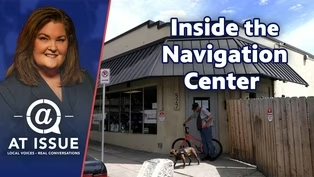
Inside Spokane’s Homelessness Day Center
Video has Closed Captions
Clip: S2026 Ep1 | 3m 46s | Take a tour of Spokane’s updated Navigation Center, a hub for people experiencing homelessness. (3m 46s)
Providing Support for PBS.org
Learn Moreabout PBS online sponsorship New Episode
- News and Public Affairs

Top journalists deliver compelling original analysis of the hour's headlines.

- News and Public Affairs

Today's top journalists discuss Washington's current political events and public affairs.



 New Episode
 Recently Added
 New Episode



 New Episode
Support for PBS provided by:
AT ISSUE is a local public television program presented by KSPS PBS